

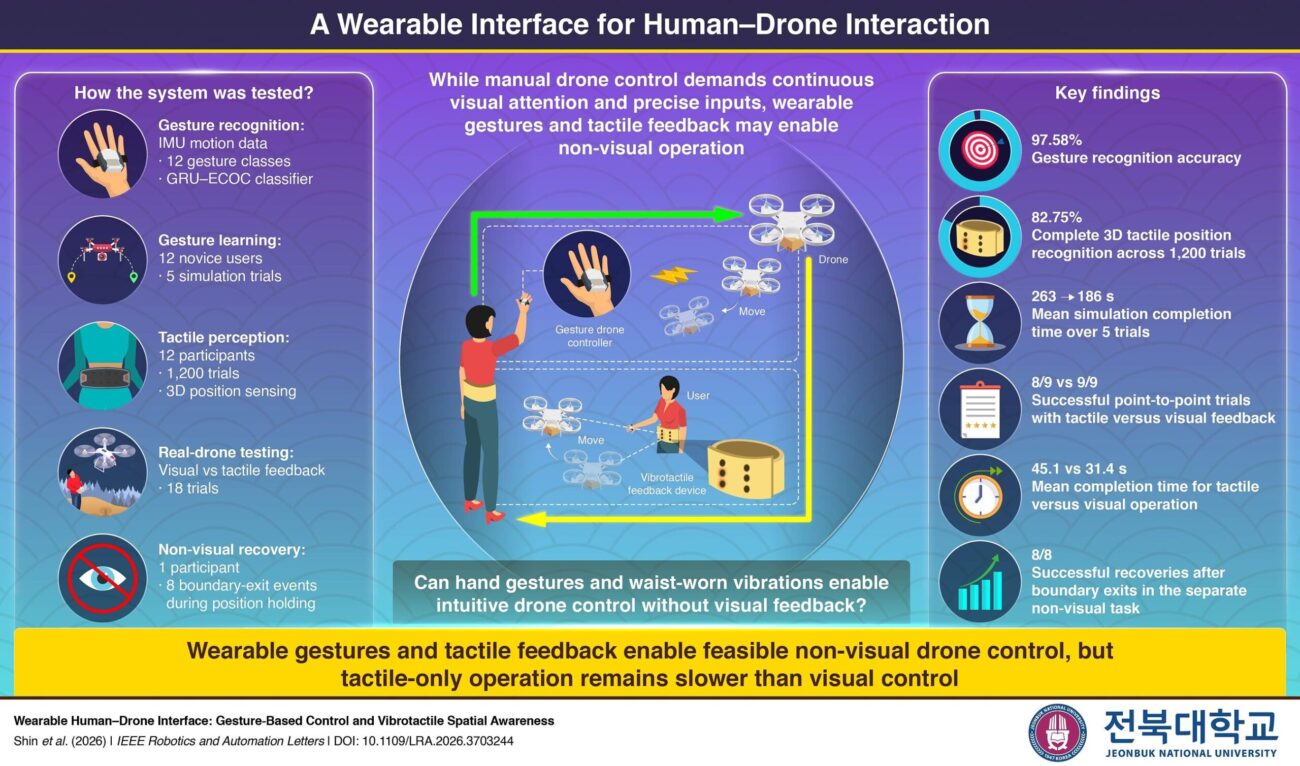
Researchers at Jeonbuk National University in South Korea have developed a wearable drone interface that lets a person steer an aircraft with hand gestures while feeling where it is through vibrations around the waist. The aim is to cut down on how much a pilot needs to stare at a screen during flight. The university announced the work on November 12, 2026, and the findings appear in the paper “Wearable Human-Drone Interface: Gesture-Based Control and Vibrotactile Spatial Awareness,” published in Volume 11, Issue 9 of IEEE Robotics and Automation Letters after first going online on June 12, 2026.
Flying a drone by hand usually means watching a display while working the controls at the same time, which splits attention between the aircraft and everything else around the operator. Professor Kee-Ho Yu of the Department of Aerospace Engineering led the project, working alongside researcher Myeong-Ho Shin and Dr. Giancarlo Eder Guerra Padilla. Their system pairs two pieces of hardware, one that reads what the user wants the drone to do and one that reports back on where the drone is, so both commands and spatial feedback travel through the body instead of the eyes.
How the Wearable Drone Interface Turns Gestures Into Flight
The first piece is a sensor worn on the back of the hand. It recognizes 12 distinct gestures and converts each one into a drone command, and in testing it identified those gestures correctly 97.58% of the time with a macro F1 score of 0.9773. Because commands come from familiar hand movements, the wearable drone interface does not ask the user to master a traditional set of sticks. Anyone who has read about the DJI FPV drone will know how much of modern flying still depends on what the pilot can see, and that dependence is what the Jeonbuk team set out to reduce.
The second piece is a belt fitted with 36 vibration motors that is worn around the waist. Patterns of vibration tell the wearer three things about the drone relative to their own body: which direction it lies in, how high it sits compared with them, and how far away it is. The project came out of the university’s aerospace robotics and mechatronics research group, and the team designed the hand sensor and the belt to operate as one connected system rather than as two separate add-ons.
“The aim was to connect the user’s intention with clear information about the drone’s position, rather than improving commands or feedback in isolation.” Prof. Kee-Ho Yu, Department of Aerospace Engineering, Jeonbuk National University
Test Results Point to Early Promise and Clear Limits
In an indoor study, 12 participants completed 1,200 trials wearing the belt with no visual guidance at all. They correctly identified direction, height, and distance together in 82.75% of trials, taking an average of 3.1 seconds to respond. Direction turned out to be the cue people read most reliably, while distance caused the most confusion of the three.
A separate simulated waypoint task looked at how quickly newcomers could pick up the wearable drone interface. Twelve novice users flew the simulation repeatedly, and their average completion time dropped from 263 seconds on the first attempt to 186 seconds by the fifth attempt.
The team then moved to a real drone with a single novice participant. Flying point to point with visual feedback, that person reached the target in all nine trials at an average of 31.4 seconds. Relying on touch alone, the same participant succeeded in eight of nine trials with an average time of 45.1 seconds. In a boundary task where both vision and hearing were blocked, the participant brought the drone back to its target zone following eight separate exits from the boundary.
The researchers describe these results as evidence of feasibility rather than readiness for field use, and they note that the real-drone evaluation involved only one person. They suggest the wearable drone interface could eventually help with infrastructure inspection, search-and-rescue support, and training, all settings where operators need to stay aware of their surroundings, though none of those uses were tested in the study. Their next steps include larger studies across varied outdoor conditions, along with improvements to distance cues, response speed, comfort, and safety before practical deployment is assessed.
