

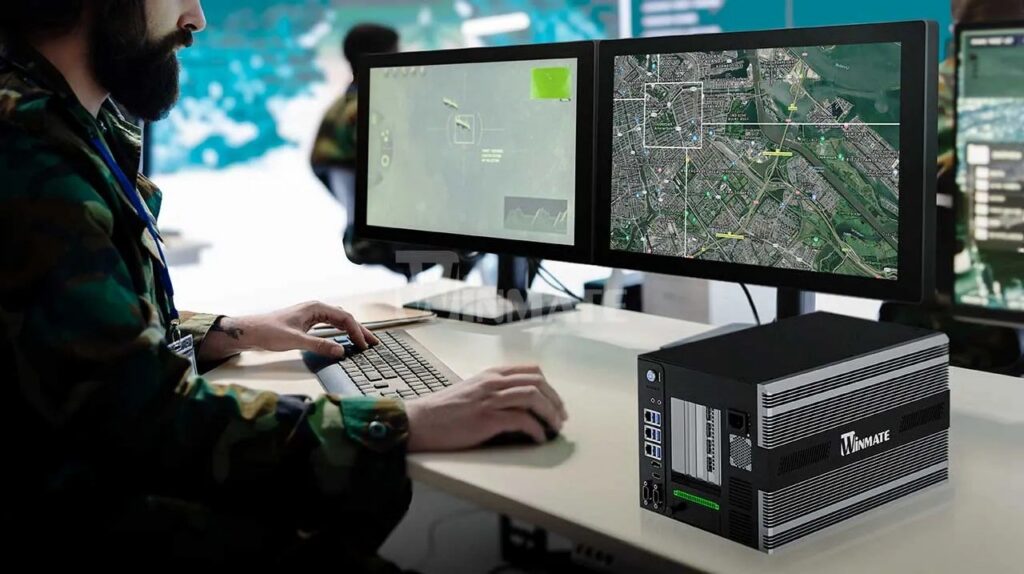
Blaize Holdings and Winmate have signed a Strategic Partnership Agreement that will put AI chips inside a new generation of field-ready hardware, with the Blaize Winmate drones lineup positioned at the center of the deal. The two publicly traded companies announced the agreement on May 4, 2026, and said they expect to close approximately $15 million in business during the first year as integrated systems begin reaching customers in defense and critical infrastructure markets.
Under the deal, Blaize will supply its energy-efficient industrial AI chips for integration into Winmate’s rugged platforms. Those platforms include drones, handhelds, vehicle-mounted units, and embedded edge devices that operators rely on in defense, border security, maritime, and healthcare environments. The agreement runs for an initial three-year term with automatic renewal, and both companies have signaled that the current commercial target is just a starting point for what they expect to become a much larger multi-year relationship. Blaize is based in El Dorado Hills, California, while Winmate is a publicly traded firm headquartered in Taiwan.
Why On-Device Intelligence Matters in the Field
Most AI workloads currently run inside large data centers, an arrangement that works for many commercial use cases but tends to break down when decisions need to happen in seconds. Soldiers stationed at remote posts, Coast Guard crews operating at sea, and medics treating patients in field clinics often work in places without reliable network connectivity. Even when bandwidth exists, sending data round trip to the cloud can be too slow or too risky for the task at hand.
That gap is what the new partnership is designed to address. Blaize designs its chips to industrial grade specifications and to run AI directly on the device, removing any reliance on the cloud. Winmate manufactures hardware purpose-built to keep working through heat, cold, dust, vibration, and rough handling. By combining the two, the companies aim to deliver real-time AI processing inside drones, patrol vehicles, handheld units, and diagnostic tools used in extreme environments where consumer-grade equipment would simply fail.
Blaize Winmate Drones and Other Target Applications
The integrated platforms are aimed at a defined set of mission-critical use cases. Border security and surveillance teams will use them for real-time threat detection and perimeter monitoring, while mobile command and control units will run on-site intelligence and situational awareness for field teams on the move. Drones and unmanned ground vehicles will draw on the platform for autonomous navigation and mission execution, expanding what unmanned systems can do without continuous operator input or a backhaul to a remote server.
Critical infrastructure operators across power, ports, and transportation are another priority audience, with the integrated systems supporting continuous monitoring and predictive analytics on existing equipment. Maritime domain awareness covers vessel tracking and anomaly detection at sea, while field healthcare rounds out the target list with portable diagnostics and decision support for remote and disaster zones. The Blaize Winmate drones combination, along with the handheld and vehicle-mounted variants, builds on existing work in edge AI for defense applications and is positioned to serve customers across these segments through a shared stack.
Blaize describes its broader chip and software offering as a programmable AI platform tuned for inference at the edge, with a Hybrid AI architecture that combines the company’s Graph Streaming Processor with GPU-based infrastructure. That same stack will sit at the heart of the joint Winmate systems, allowing computer vision, multimodal AI, and sensor-driven applications to run inside ruggedized hardware without depending on a continuous link back to the data center.
A Growing Market for Blaize Winmate Drones and Edge AI
Demand for on-device AI is climbing quickly. Citing BCC Research, the announcement says the global edge AI market is expected to expand from $11.8 billion in 2025 to $56.8 billion by 2030, a compound annual growth rate of 36.9%. Defense agencies, government bodies, hospitals, ports, and critical infrastructure operators are all looking for AI that can run securely on their own equipment without sending sensitive data over public networks.
“Our customers can’t wait, and they often can’t rely on the cloud. They need AI that runs where the work happens. Winmate makes some of the most capable rugged systems in the industry, and our chips are designed to run AI inside exactly those kinds of devices. This partnership turns a years-long vision into a practical, deployable answer for defense and critical infrastructure operators,” Dinakar Munagala, CEO of Blaize, Inc.
The companies plan joint engineering, sales, and marketing work to bring the integrated systems to market, with additional opportunities expected through follow-on programs as the relationship matures and the integrated drone, handheld, and vehicle-mounted product lines reach more customers in defense and critical infrastructure.
