

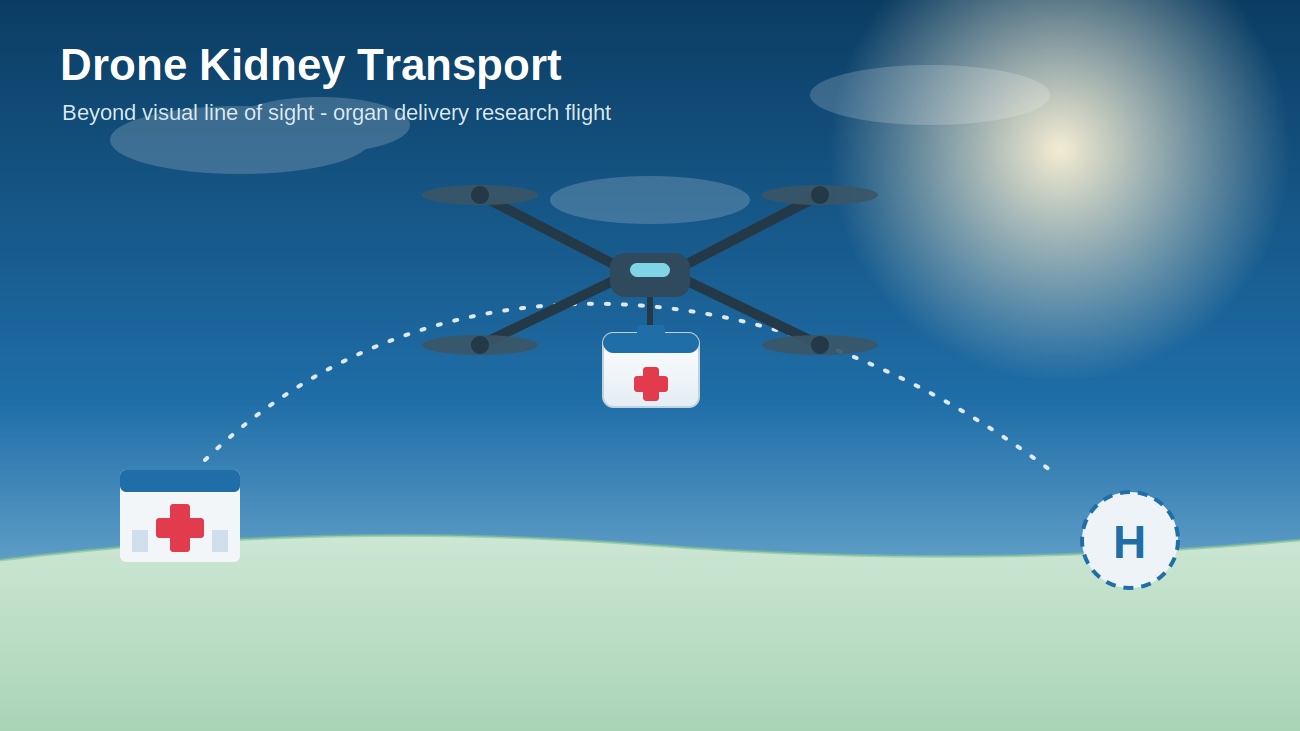
A team of medical and aerospace researchers has shown that a drone can carry a human organ through the air without harming it. Teams from the United Network for Organ Sharing (UNOS), NASA Langley Research Center, and LifeNet Health recently completed a first-of-its-kind drone kidney transport study, flying donated human kidneys beyond visual line of sight in what the groups call a major step for the future of organ transportation and transplantation.
The flights took place on June 5 near Hampton, Virginia, and each lasted roughly 15 minutes. Researchers wanted to learn whether moving organs by air could make delivery faster and more dependable while keeping the tissue safe along the way. The study points to a future in which unmanned aircraft could help shrink the time between when an organ is recovered and when it reaches the patient who needs it.
How the Drone Kidney Transport Study Worked
Before and after each flight, the kidneys were biopsied and placed on preservation pumps so the teams could measure any change in organ health. During the trips, instruments tracked temperature, pressure, and altitude to record exactly what the organs experienced in the air. The early signs were encouraging, as preliminary findings showed no evidence that the flights had any negative effect on the kidneys.
The organs used in the research were donated by a family working with LifeNet Health after doctors determined the kidneys could not be transplanted into a patient. That gift allowed scientists to study how air transport might support future advances in transplant logistics and organ preservation. LifeNet Health’s work in tissue donation for research makes studies like this possible, because organs that cannot be used for transplant can still help researchers improve preservation methods and develop new treatments. The organizations stressed that donation for research happens only with proper authorization and under strict ethical and regulatory standards.
For LifeNet Health, the project ties directly to its mission of getting lifesaving gifts where they are needed. The organization framed the flights as part of a broader push to modernize how donated organs and tissues move between sites.
“Just as every patient waiting for a transplant matters, so does the timely transportation of the organs and tissues that can save and heal lives. Advancing transportation and logistics innovation can make a meaningful difference in ensuring these lifesaving gifts reach patients when they are needed most.” Rony Thomas, President and CEO of LifeNet Health
Why Faster Organ Transport Could Save Lives
Organ transplantation is one of the most time-sensitive processes in all of medicine. Once an organ is recovered, it stays viable for only a short window, so every delay in reaching a transplant center can affect how well the organ works or whether the surgery can happen at all. Faster and more reliable transport could widen access for patients on the waiting list and cut the time many of them spend waiting for a match.
The need is enormous. National transplant data shows that more than 100,000 people are waiting for a lifesaving transplant across the country, with another person added to the list every eight minutes and 13 people dying each day while waiting for an organ that never arrives. The hope that drones could one day ease those numbers builds on earlier discussion about how the technology might support organ transplants, and the new flights give that idea fresh real-world evidence. In Virginia alone, more than 3,000 people are currently on the transplant waiting list.
Leaders involved in the study say the early results give them reason for optimism. They describe the collaboration as a meaningful first step rather than a finished solution.
“With more than 100,000 people currently waiting for a lifesaving transplant nationwide, innovation in organ transportation is essential. This successful collaboration represents an important step toward making organ transportation safer, faster, and more efficient.” Mark Johnson, UNOS Interim CEO
UNOS, NASA, and LifeNet Health say they plan to keep exploring drone transportation in real operational settings, including moving research organs between hospitals and airports. For now, the June flights stand as early proof that drone kidney transport can handle one of medicine’s most delicate cargoes.
