

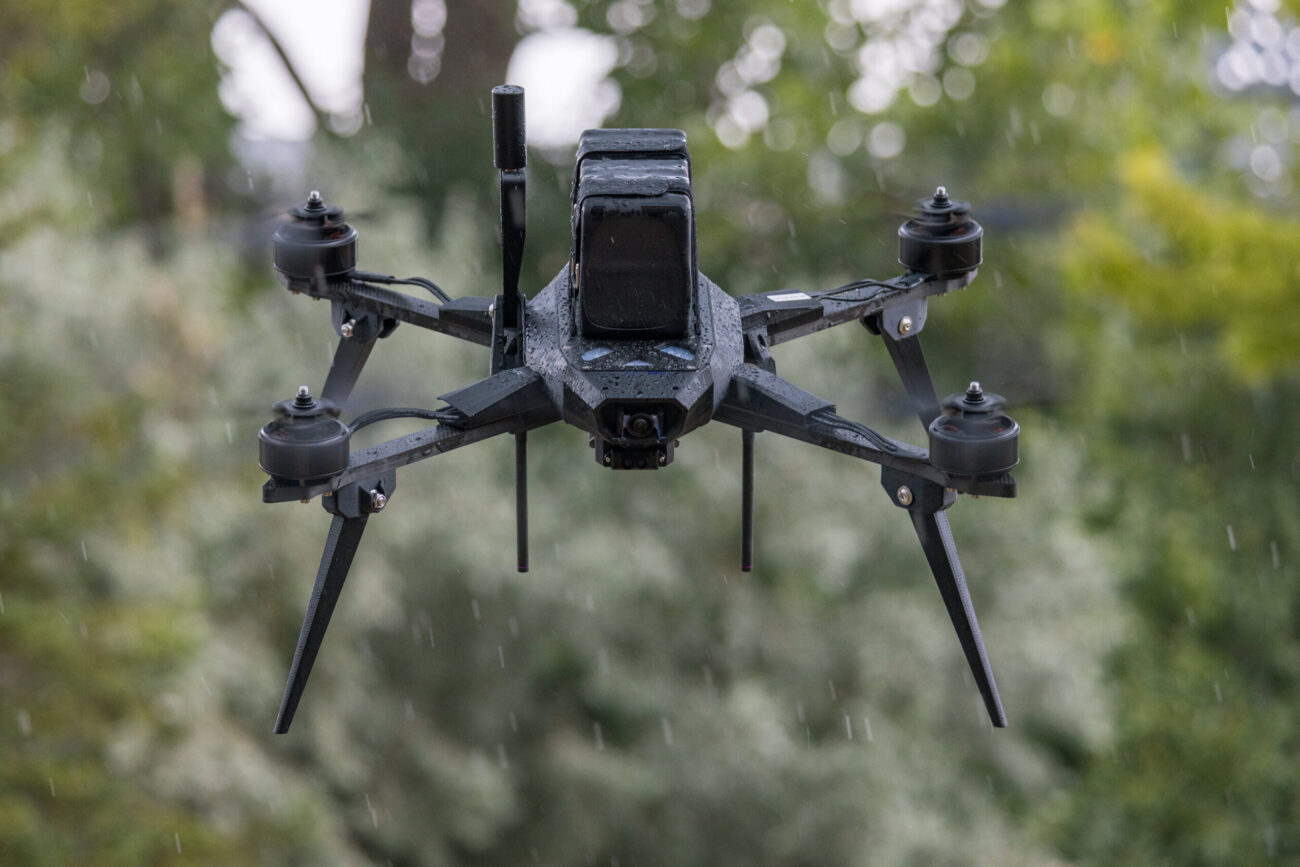
Swarm Defense Technologies has secured a prototype delivery order for 4,000 Kiwi one-way attack drones through the Department of War’s Drone Dominance Program. The order carries a minimum value of $25 million, a figure that includes munitions, and it represents a large production commitment for the Swarm Defense Kiwi platform. The Michigan company plans to build every aircraft covered by the order at its 40,000 square foot facility in Auburn Hills.
The award follows Gauntlet II, an evaluation event held at Fort Carson, Colorado, where military operators tested competing aircraft in unscripted mission scenarios. Swarm Defense entered that process with a combination of established drone manufacturing capacity and software designed to let a single operator manage multiple aircraft at once. That pairing of hardware production and swarm control is the foundation of how the company approaches its defense work.
Swarm Defense Kiwi Production Draws on Firefly Roots
Kyle Dorosz, the chief executive of Swarm Defense Technologies, described the 4,000 aircraft order as a major milestone for the company. He credited the engineering and production teams with earning the opportunity through repeated rounds of testing and improvement, and he thanked the program for the trust it has shown in both the aircraft and the company’s ability to produce them in volume.
“The Drone Dominance Program has placed its confidence in both our aircraft and our ability to deliver them at scale. Our engineers and production team earned this opportunity through constant testing and improvement, and I’m proud of what they’ve accomplished. We appreciate the program’s trust. Our focus now is on delivering for the service members who will rely on these systems.” Kyle Dorosz, CEO of Swarm Defense Technologies
Swarm Defense grew out of Firefly Drone Shows, which the company identifies as the largest American manufacturer of light show drones. Since 2017, Firefly has led development of swarm technology and has built more than 20,000 swarming drones over that period. The two companies share engineering and manufacturing resources in Auburn Hills, which gives the Swarm Defense Kiwi program access to an existing production base.
Swarm Defense handles aircraft design, electronics engineering, proprietary software and U.S. manufacturing under one roof. Its in-house development covers flight controllers, electronic speed controllers, power and battery management electronics, and embedded firmware. The company also writes its own ground control software and swarm coordination technology rather than relying on outside suppliers for those pieces.
Strike Deck Software Lets One Operator Command a Swarm
The software side of the program centers on Strike Deck, the company’s ground control system. Strike Deck allows one operator to oversee dozens of swarming aircraft by automating waypoint navigation and the flight control of relay aircraft. It also performs real-time path deconfliction across the entire swarm so that aircraft do not interfere with one another. Terminal guidance helps with the final approach to targets that operators have designated, while the choice of targets and the authorization to engage stay with the human operators.
Adam Wright, the company’s president and a former Navy SEAL, said combat units need to bring volume to the fight and that swarming lets a single pilot accomplish work that would normally take several pilots. He also argued that the aircraft is simple enough to reduce the training burden on troops.
“The Kiwi breaks the math of drone warfare. It’s so simple that anyone can learn to fly five of them simultaneously after only a few hours of training. We’re reducing manpower, cognitive load and training requirements, all at the same time.” Adam Wright, President of Swarm Defense Technologies
The current order applies only to the one-way attack configuration of the Swarm Defense Kiwi. According to the company, the same Kiwi quadcopter can also be set up for intelligence, surveillance and reconnaissance missions, used as an airborne communications relay, or flown as a reusable precision dropper. Those alternate roles fall outside the scope of this Drone Dominance award.
In a separate effort, Swarm Defense holds a Phase I prototype agreement with the Defense Innovation Unit under its Containerized Autonomous Drone Delivery System project. The concept calls for a container of drones that is deployed forward and kept dormant until a single operator at a remote station launches ISR and strike capability when needed. Beyond the Kiwi platform and Strike Deck, the company’s product lineup includes Swarm Studio mission planning software and Swarm Threat Emulator systems, which are used in Army, Air Force and Navy counter-drone training programs.
