

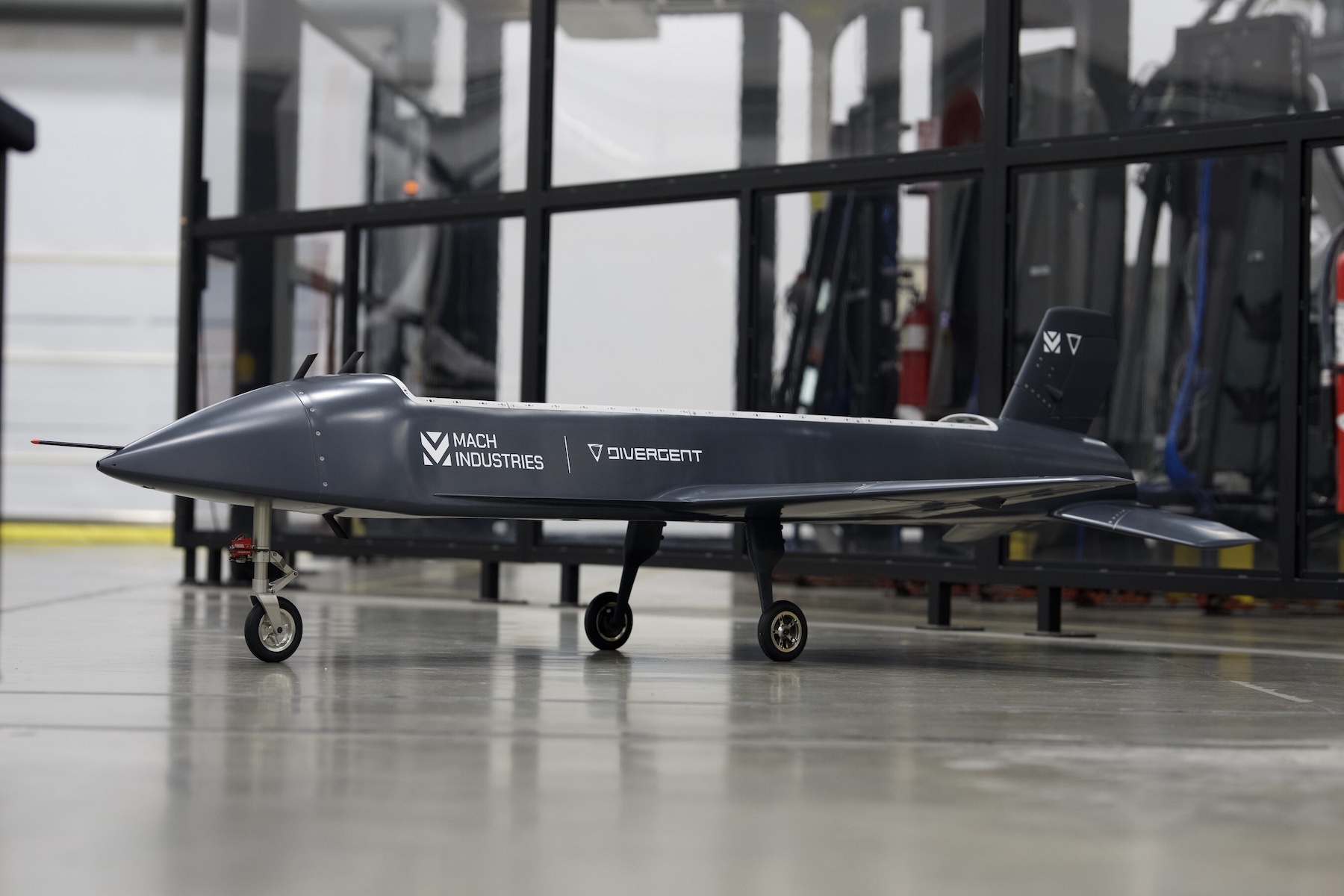
Venom prototype aircraft development moved at an unusually fast pace as Divergent Technologies and Mach Industries announced a partnership that took the system from concept to a flight-ready prototype in 71 days. The companies described Venom as a prototype flight demonstration aircraft meant to show what they called hardware development at software speed, using a combination of Mach’s baseline requirements and architecture with Divergent’s digital manufacturing approach.
According to the announcement, Mach Industries established the baseline requirements and architecture by leveraging avionics and simulation from existing, flight-proven tech stacks and using a modular, open-systems architecture to accelerate progress from concept to flight. Divergent said it executed the digital design and 3D printing of Venom’s structure, including the wings, fuselage, skins, and control surfaces, producing them as monolithic assemblies rather than conventional multi-part builds.
Venom Prototype Aircraft Showcases Rapid Autonomous Strike Development
The announcement included a statement from Alex Lovett, identified as the Principal Deputy Assistant Secretary of War for Mission Capabilities in the Office of the Under Secretary of War for Research and Engineering. In the release, Lovett said the partnership demonstrates a pivotal capability and emphasized that the 71-day timeline matters because it supports a strategy focused on affordable mass and rapid acquisition. The statement also referenced a vision described as “Drone Dominance,” tying the rapid development approach to broader defense priorities around scaling low-cost systems.
“This partnership between Mach Industries and Divergent demonstrates a pivotal capability for the nation. By combining Mach’s innovative systems with Divergent’s revolutionary digital manufacturing platform, we’ve moved from concept to a flight-ready prototype in 71 days.” Alex Lovett, Principal Deputy Assistant Secretary of War for Mission Capabilities, Office of the Under Secretary of War for Research and Engineering
Divergent said its approach is enabled by the Divergent Adaptive Production System, which it described as collapsing traditional multi-hundred-part assemblies into unified additively manufactured structures. In the context of Venom, the company said this reduces overall part count and supports speed by avoiding conventional tooling-heavy processes that typically slow aerospace manufacturing and iteration cycles.
Mach Industries said it used a common simulation and controls foundation to support high-fidelity prototyping and adaptable iteration across hardware and software. In the release, the companies described this as enabling parallel development and accelerated validation, which contributed to reaching first flight on the 71-day timeline. In their framing, Venom is meant to demonstrate a new model for autonomous defense systems where manufacturing and iteration move faster than traditional aerospace development cycles.
The partnership announcement also emphasized scaling beyond a single prototype. Divergent said it will drive rapid scale-up of the system and produce thousands of airframes annually. That scale language matters because the release positions Venom as more than a one-off technology demonstrator, describing a pathway from rapid prototype to scaled manufacturing.
UAV Production Model Targets Faster Iteration and Scaled Manufacturing
The companies described Venom as evidence that software-defined manufacturing can replace tooling-heavy aerospace processes with a model that supports rapid iteration and scalable production. In their view, advanced manufacturing is not only an efficiency advantage but a strategic capability that can deliver operational systems at the speed, volume, and performance demanded by modern defense missions.
Divergent’s announcement included background on its production platform, describing it as an end-to-end software-hardware production system for industrial digital manufacturing that supports design, additive manufacturing, and automated assembly of complex structures across automotive, aerospace, and defense applications. In the middle of the partnership description, Divergent described its platform as transforming manufacturing economics by optimizing designs, reducing material usage, and limiting the need for upfront capital expenditures tied to traditional production setups.
Mach Industries described itself as a defense manufacturing company headquartered in Huntington Beach, California, and said it develops advanced unmanned systems and the manufacturing infrastructure to scale their production. The release also stated that Mach vertically integrates weapons, propulsion, and manufacturing to deliver speed, adaptability, and resilience intended to preserve military advantage.
Within the partnership framing, the companies positioned Venom as a practical demonstration that autonomous strike aircraft can be developed and built more quickly than standard aerospace timelines would typically allow. The announcement does not describe Venom as a fielded operational system, but it does present the 71-day concept-to-flight result as a measurable outcome of combining Mach’s architecture and iteration approach with Divergent’s digital design and additive manufacturing methods.
By emphasizing rapid iteration, reduced part counts, and scalable production goals, the companies said Venom supports a broader push toward producing autonomous systems faster and at higher volumes. The partnership announcement frames that capability as a strategic advantage for defense users who need systems that can be developed, validated, and produced at a pace aligned with evolving mission demands.
