

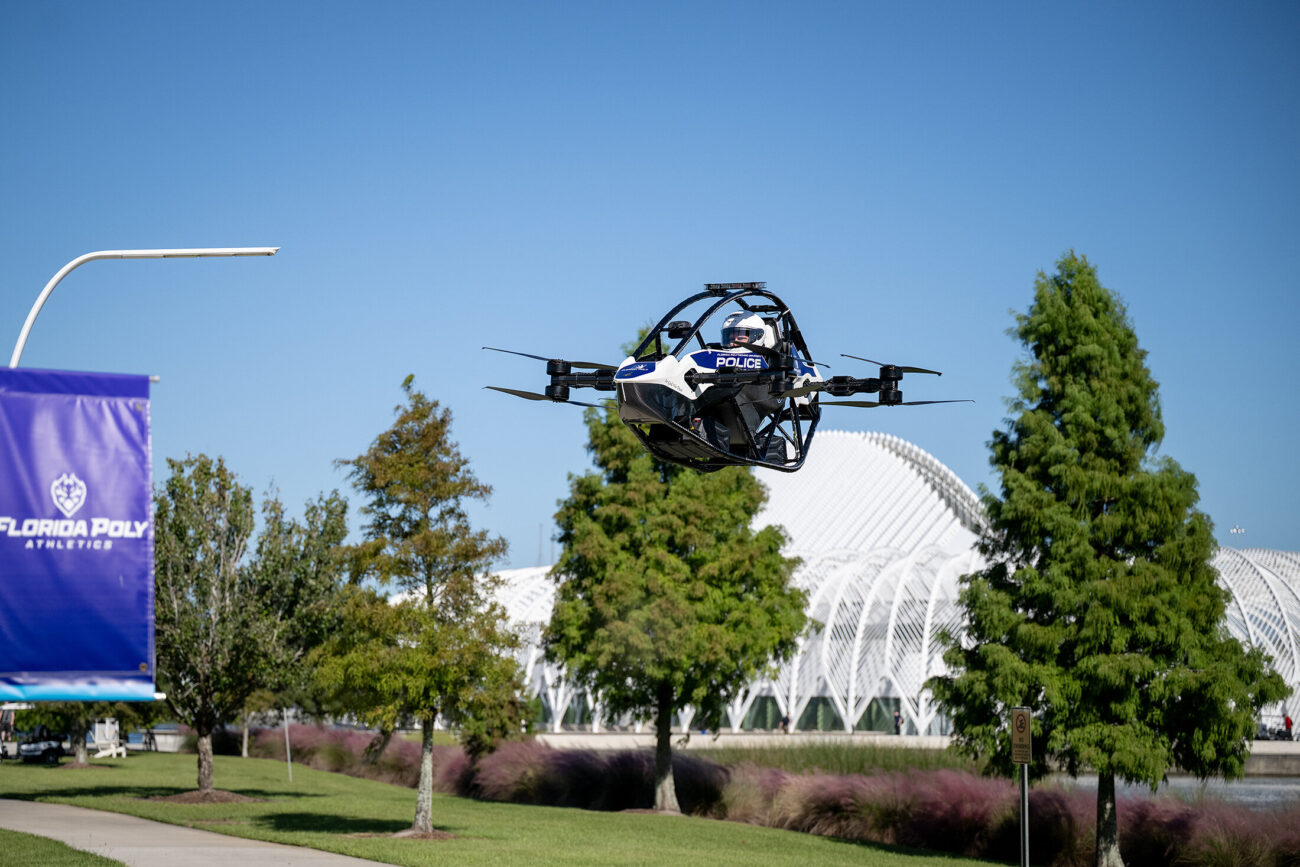
Florida Polytechnic University’s police department is now the first law enforcement agency in the United States to bring an electric vertical takeoff and landing aircraft into its operations. The Florida Poly eVTOL is a manned Jetson ONE that the university has named Astro, a choice that tips its hat to science and to the family dog from the classic Jetsons cartoon. The Lakeland school announced the aircraft on October 20, 2026.
University officials describe Astro as Florida Poly’s first move into advanced air mobility, or AAM, a fast-growing area of aviation that the department wants to study for its public safety value. Before the aircraft can join regular operations, the university has to finish the approval process with the Federal Aviation Administration. Florida Poly says that effort to secure FAA clearance for the aerial patrol vehicle is now in its final stages.
How the Florida Poly eVTOL Could Support Police Work
Police Chief Aaron Murray has laid out several jobs the aircraft could take on once it is cleared to fly. He said Astro could strengthen the department’s ability to keep watch over the campus and the acres surrounding it, while also reaching places that are hard to access with regular patrol vehicles. Murray also pointed to recovery work after storms and the fast delivery of emergency supplies as possible missions.
“Advanced air mobility is a technology on the rise, and we can either choose to be proactive or reactive as it develops,” said Aaron Murray, the University’s police chief. “We want to stay at the forefront of this technology and understand how it can be used to advance public safety and airspace safety altogether.” Aaron Murray, Police Chief, Florida Polytechnic University
The department does not plan to use the Florida Poly eVTOL only on its own grounds. The university police department intends to partner with law enforcement agencies across the surrounding region so that Astro can help during emergency response efforts and other public safety operations. That regional role gives the aircraft a reach beyond the campus itself.
Jetson Moved Florida Poly to the Front of the Line
Astro was built by Jetson, a company based in California. Stéphan D’haene, the company’s CEO, said Jetson sped up Florida Poly’s order for the Jetson ONE even though the vehicle carries a three-year waiting list. He explained that the university’s STEM focus and the police department’s public safety mission both lined up with the company’s goals for the future of safe flight. D’haene added that Jetson has long looked for uses that go beyond recreation, which is why the company made the project a priority.
Astro will also serve as a hands-on learning and research tool for students and faculty. Florida Poly launched a new aerospace engineering degree this fall, and the Florida Poly eVTOL gives students in that program an immediate chance to study emerging flight technology in a real-world setting. Provost Dr. Brad Thiessen said the school wants students working with emerging tools before they become common, and he described Astro as a working lab for analyzing data and solving new engineering problems.
Faculty members and students have already begun planning how to use real-time operational data from Astro in academic research and senior capstone design projects. Murray said tying an educational piece to the technology matters to a technology university, since it opens doors for learning, new partnerships and work on airspace safety while linking his officers directly with students.
Florida Poly eVTOL Joins a Growing Push in Central Florida
Astro is the newest step in Florida Poly’s effort to put emerging technology to work on campus. The university recently gave its police department a drone unit and opened a Security Operations Center for cybersecurity that is powered by students. Murray noted that tools such as bicycles, motorcycles and drones were once written off as toys or hobbies, yet they have since made a huge impact on how police agencies do their work.
The aircraft also arrives as AAM gains ground across Florida, especially in the central part of the state. Florida was recently chosen to take part in the FAA’s eVTOL and Advanced Air Mobility Integration Pilot Program, which is designed to bring next-generation aircraft safely into the national airspace. Just four miles from the Florida Poly campus, the SunTrax facility in Auburndale houses the nation’s first dedicated AAM aerial test track, and eVTOL testing there is expected to start by the end of 2026. That location places the Florida Poly eVTOL only a few miles from a site built specifically to test the same class of aircraft Florida Poly has just added.
