

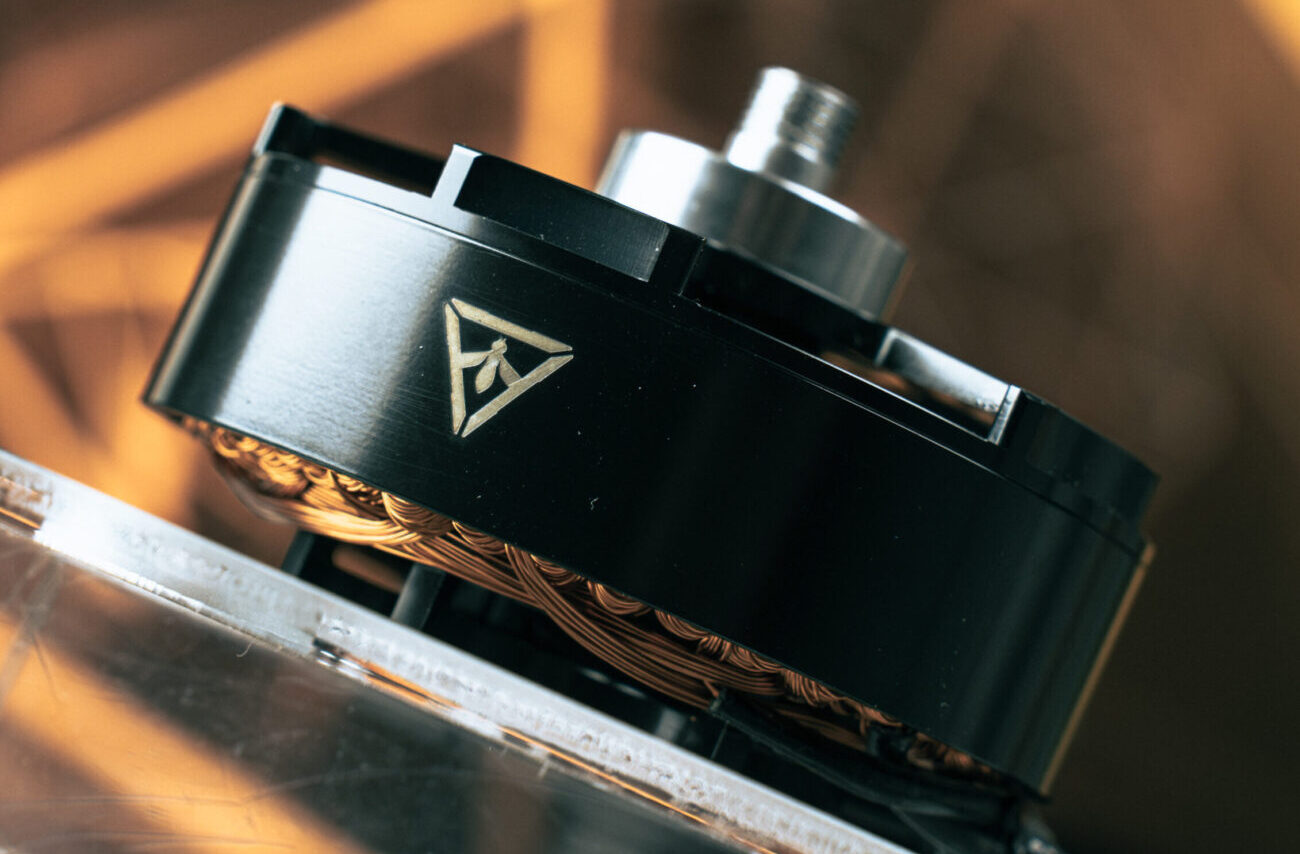
Hoverfly Technologies has launched Hoverfly Elements, a new line of NDAA-compliant drone components aimed at the United States defense and commercial markets. The Florida company, which calls itself the world’s leading US-based tethered UAS provider, introduced the line at the Xponential 2026 trade show. The timing lines up with sharp growth in the sector, as the US drone components market, valued at about $5.9 billion in 2025, is projected to pass $14.4 billion by 2033, driven largely by federal demand for verified, non-Chinese supply chains.
Elements runs as a dedicated business division and brand within Hoverfly, focused entirely on the parts that the wider UAS industry depends on. Its first products include drone motors and electronic speed controllers offered through a Motors suite powered by Korea Robot Manufacturing, or KRM, along with GPS modules powered by Septentrio. The company describes these pieces as the critical building blocks for an American drone sector that is moving away from foreign-made hardware.
Hoverfly Elements Debuts At Xponential 2026
The debut of Hoverfly Elements at Xponential 2026 pulled steady attention from across the drone industry. The company says its bright orange booth turned into a gathering point for program managers, systems integrators, procurement officers, OEM leaders, and defense technology specialists over the course of the show. Reported conversations stretched from near-term buying opportunities to longer-range work on custom component integration, with visitors highlighting the timing of a domestic, compliance-first supplier.
Hoverfly was already active in this space before the debut, having earlier entered the market with its Hoverfly Motors line powered by KRM. The new launch builds on that groundwork and widens the company’s reach across a broader set of parts. Steve Walters, chief executive of Hoverfly Technologies, said the reaction at the show pointed to genuine need rather than passing interest.
“Xponential confirmed what we already knew: the market is urgently looking for exactly what we’ve built. Industry leaders, potential partners, and key decision-makers came to our booth not just out of curiosity, they came with real problems that Hoverfly Elements is designed to solve. The energy was unlike anything we’ve experienced at a trade show.” Steve Walters, CEO of Hoverfly Technologies
That enthusiasm, the company suggests, reflects a market that has been waiting for a trusted American option. Hoverfly positioned the booth as a place for problem-solving conversations rather than a simple product display.
Building NDAA-Compliant Drone Components For Defense
The push behind Hoverfly Elements is rooted in recent policy shifts. The National Defense Authorization Act, known as the NDAA, along with recent Federal Communications Commission rulings, has reshaped which drone components can be used in federal, defense, and critical infrastructure roles. Chinese-made parts, once common across the supply chain, are no longer viable for a growing class of these applications, which has left a sizable and underserved demand for trusted, verified alternatives.
That demand grows sharper under the Drone Dominance Program Supply Chain Framework, which sets phased sourcing rules across $6.6 billion in small UAS purchases, tightening from non-covered-country assembly in August 2026 toward full domestic traceability by August 2027. Hoverfly built its line for that environment and routes the lineup through the company’s Elements product division as it scales up. Suppliers that cannot prove compliance risk being locked out entirely, and the Motors line, backed by investment from KRM, is said to meet the framework’s Phase 2 requirements at launch.
For navigation, Hoverfly Elements is working with Septentrio, a Hexagon company, on high-integrity GPS modules. The company says these units provide multi-band, multi-constellation positioning with anti-jamming and anti-spoofing protection built for the demanding settings where defense drones operate. Hoverfly also points to more than a decade of work inside the Department of Defense and its experience with the Blue UAS verification program, noting that every Elements component is being routed through that process as a baseline.
The company frames the work around three ideas: compliance with NDAA and Blue UAS standards, performance through allied and domestic manufacturing, and fast deployment to operators in the field. Hoverfly has also signaled that motors, ESCs, and GPS modules are only the starting point, with plans to add tether kits for persistent, long-duration missions and to offer custom design and integration services for original equipment manufacturers working within NDAA procurement limits.
