

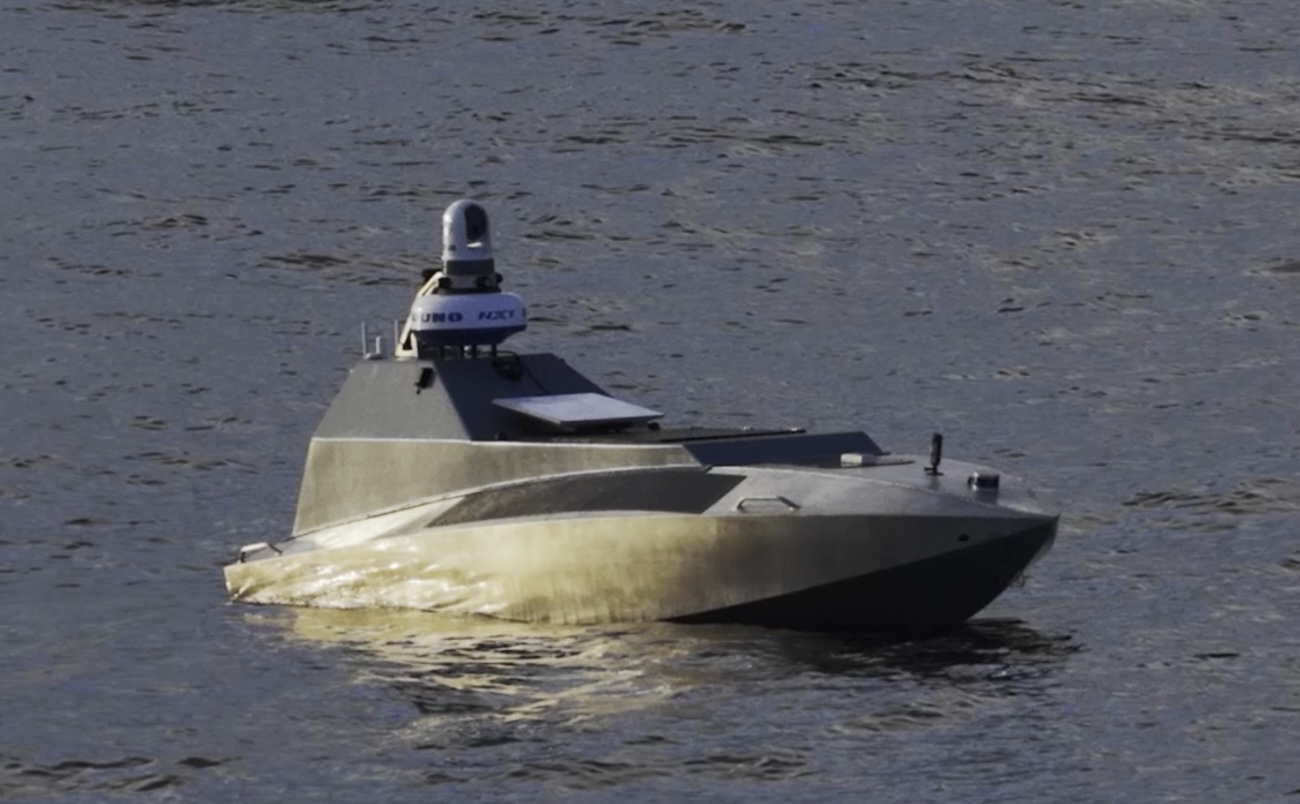
Seasats has added a new long-range weapon to its fast unmanned boat. The San Diego company announced on November 18, 2026, that it successfully integrated and launched Anduril Industries’ Altius-600M loitering munition from the Seasats Quickfish, the rapid response unmanned surface vessel, or USV, in its lineup. According to the company, the work gives Quickfish the ability to strike higher-end maritime targets from long range.
Seasats argues that strike USVs built in large numbers could widen sea denial efforts while keeping the cost exchange favorable. Pairing the boat with Altius pushes its strike range farther out and allows it to engage higher-end platforms at sea, which the company says raises what any single vessel can contribute to an operation. Quickfish can hold its position on the water for weeks and move to a new spot at speeds of up to 40 knots, so the strike option stays ready even as mission needs shift.
Seasats Quickfish Launches Altius-600M From a Bolt-In Bay
Anduril’s Altius-600M is aimed at maritime strike missions against larger surface targets. Crews do not have to be anywhere near the boat when it fires. Operators can direct both the Seasats Quickfish and the Altius munition from a ground control station located anywhere in the world, which keeps personnel well away from the point where the launch happens.
Hardware changes were kept to a minimum. The Quickfish rapid response vessel has an enclosed, modular payload bay that Seasats designed with uncrewed aircraft launches in mind, and the Altius launch system fits into that space as a removable, bolt-in setup. Seasats says adding it required no permanent changes to either the hull or the bay.
Mike Flanigan, co-founder and CEO of Seasats, compared the concept to the way navies have long used aircraft carriers to move air power within reach of a fight. In his view, Quickfish spreads that same kind of reach across a group of small vessels instead of concentrating it on one large ship.
“Naval air power depends on the ability to position aircraft within range of their targets. The aircraft carrier does that by putting an air wing forward. Quickfish disaggregates a similar capability across small vessels. Integrating Altius adds field-proven, longer-range strike capability to Quickfish’s persistent maritime presence.” Mike Flanigan, Co-Founder and CEO, Seasats
Altius is a family of autonomous air vehicles from Anduril that can be launched from air, ground, and maritime platforms, with configurations for intelligence, surveillance, and reconnaissance, electronic warfare, and strike. Fontaine Alexander, general manager of Altius-600 at Anduril Industries, noted that working at sea puts special demands on aerial systems. She said the endurance and modular payload design of Quickfish make it a good match for Altius, giving the munition mobile, unmanned launch points on the water that extend its reach. She added that the project demonstrates how naval forces can field an established strike system from a small, adaptable surface vessel as they bring unmanned platforms into their fleets.
Quickfish Moves From FPV Drones to Longer-Range Munitions
The Altius test is not the first aerial payload Seasats has launched from Quickfish. The company previously sent Neros Archer drones into the air from the same vessel, and the new integration stretches the boat’s payload options from first-person-view strike drones to longer-range loitering munitions. Seasats says these additions, together with Lightfish’s library of more than 50 mission payloads, reflect the modular approach it takes across its platforms.
Seasats describes its mission as closing maritime blind spots by keeping continuous watch over important waterways. Its networked USV systems are designed to operate persistently, keep data flowing without breaks, and take action when required. The company lists border protection, port security, tripwire operations, oceanographic research, hydrographic survey, and countering illegal trafficking and fishing among the jobs its vessels support.
The Seasats Quickfish program sits within a company that already has deep ties to government customers. Seasats reports more than $100 million in U.S. government contracts, and its vessels work with the U.S. Navy, NOAA, and research institutions around the world. The company is based in San Diego and counts Shield Capital, L3Harris Technologies, and Konvoy Ventures among its backers.
