

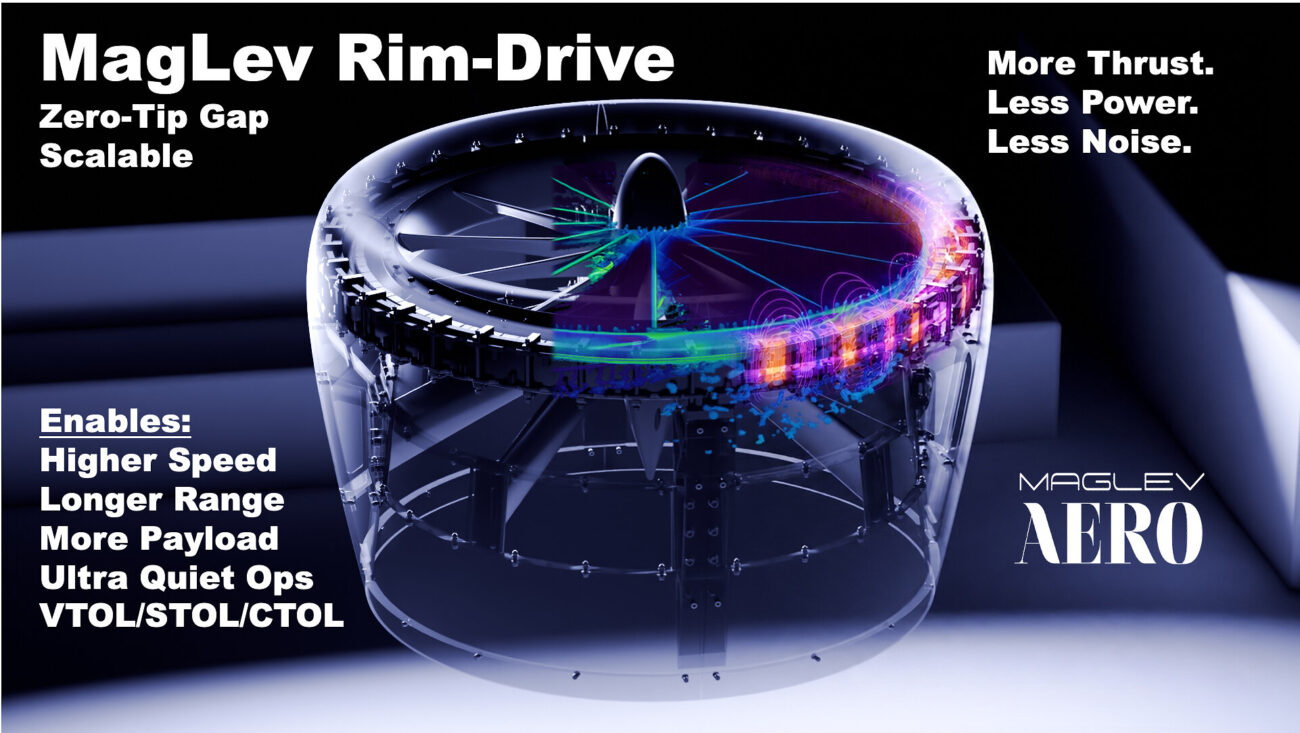
MagLev Aero DARPA funding is set to push the Boston company’s drone propulsion technology toward flight readiness. On September 25, 2026, the aerospace propulsion developer announced that the Defense Advanced Research Projects Agency had selected it for two concurrent awards, one through the Minimum Viable Product (MVP) program and one through the Embedded Entrepreneur Initiative (EEI). The company says both awards arrive as non-dilutive government funding and will help carry its platform from prototype to flight-tested production.
MagLev Aero frames the awards around a gap it sees in military aviation. As defense drones rapidly grow more capable on the modern battlefield, the company argues that propulsion systems able to deliver true drone air dominance are still missing. Its answer is a design that it says produces more thrust while drawing less power. According to the company, that efficiency supports higher speeds, longer range, bigger payloads and a much quieter noise signature. Those are the traits needed by drones built to evade detection and capture, counter-drones meant to catch and kill hostile threats, and cargo drones flying contested logistics missions.
The company says the funding, along with growing defense-market demand, will support the industrialization of its next-generation propulsion platform. MagLev Aero is aiming that platform at rising demand for high-performance drone propulsion manufactured in the United States, in line with White House “Drone Dominance” priorities and the fast-growing commercial advanced air mobility (AAM) market. By speeding the move from prototype to flight-tested production, the MagLev Aero DARPA support is expected to cut technical and integration risks for dual-use commercialization.
Inside the MagLev Aero DARPA MVP Award
DARPA’s MVP effort is designed to help technology developers prototype, test and adapt new breakthroughs quickly. Under this award, MagLev Aero will build and test a full-scale propulsion demonstration platform that is relevant to flight. The work is set to end with a Technology Readiness Level 6 (TRL-6) demonstration carried out in a relevant operational environment.
Reaching TRL-6 is meant to confirm the aerodynamic performance, stability and reliability of the system. MagLev Aero says that validation would give aircraft makers a highly efficient, drop-in architecture built around its MagLev HyperDrive propulsion platform, which could shorten OEM research, development and fielding timelines. The effort targets airframers and OEMs developing the next generation of autonomous drones as well as crewed aircraft.
The company also expects the technology to bring step-change gains in payload capacity, acoustic signature reduction, operational range and overall aircraft efficiency. MagLev Aero presents those improvements as key competitive advantages for OEMs chasing future defense and commercial fleet programs. Its system relies on a rim-driven ducted fan architecture, and the company holds 44 issued patents.
EEI Award Targets Defense Sales and U.S. Manufacturing
The second MagLev Aero DARPA award runs alongside the first. DARPA’s EEI program will speed up the company’s defense commercialization, go-to-market execution and U.S. industrialization strategy. The funding pays for embedding an experienced business leader inside the company to help it work through federal acquisition frameworks and capture strategic transition opportunities.
That executive is expected to position MagLev Aero for program capture and for large, urgent government procurement efforts. Those efforts span government agencies and armed forces, with the company listing the Air Force, Navy, NASA, AFWERX, U.S. Special Operations Command (USSOCOM) and the Air Force Research Laboratory (AFRL). On the manufacturing side, MagLev Aero plans to build a “Made in the U.S.” production and supplier base for next-generation drone propulsion hardware. The company cites the need for secure, domestic supply chains as the driver.
Ian Randall, Co-Founder and CEO of MagLev Aero, called the two DARPA contracts a major inflection point for the company. He also described the larger purpose he sees behind the work.
“We are not just proving out physics in a lab; we are helping build the propulsion industrial base for the next generation of American air power. By rapidly advancing our scalable, domestically manufactured propulsion platform to TRL-6, we are delivering a proven solution that meets the urgent national need for trusted, high-performance U.S. drone technologies.” Ian Randall, Co-Founder and CEO of MagLev Aero
MagLev Aero is backed by Breakthrough Energy Ventures and Material Impact. The company is also developing an engineering framework that blends modern AI compute technology, multiphysics optimization and human innovation to speed up electrified propulsion design. Its stated goal is to raise efficiency, range, payload, noise reduction, speed and resiliency for both defense and commercial aircraft.
