

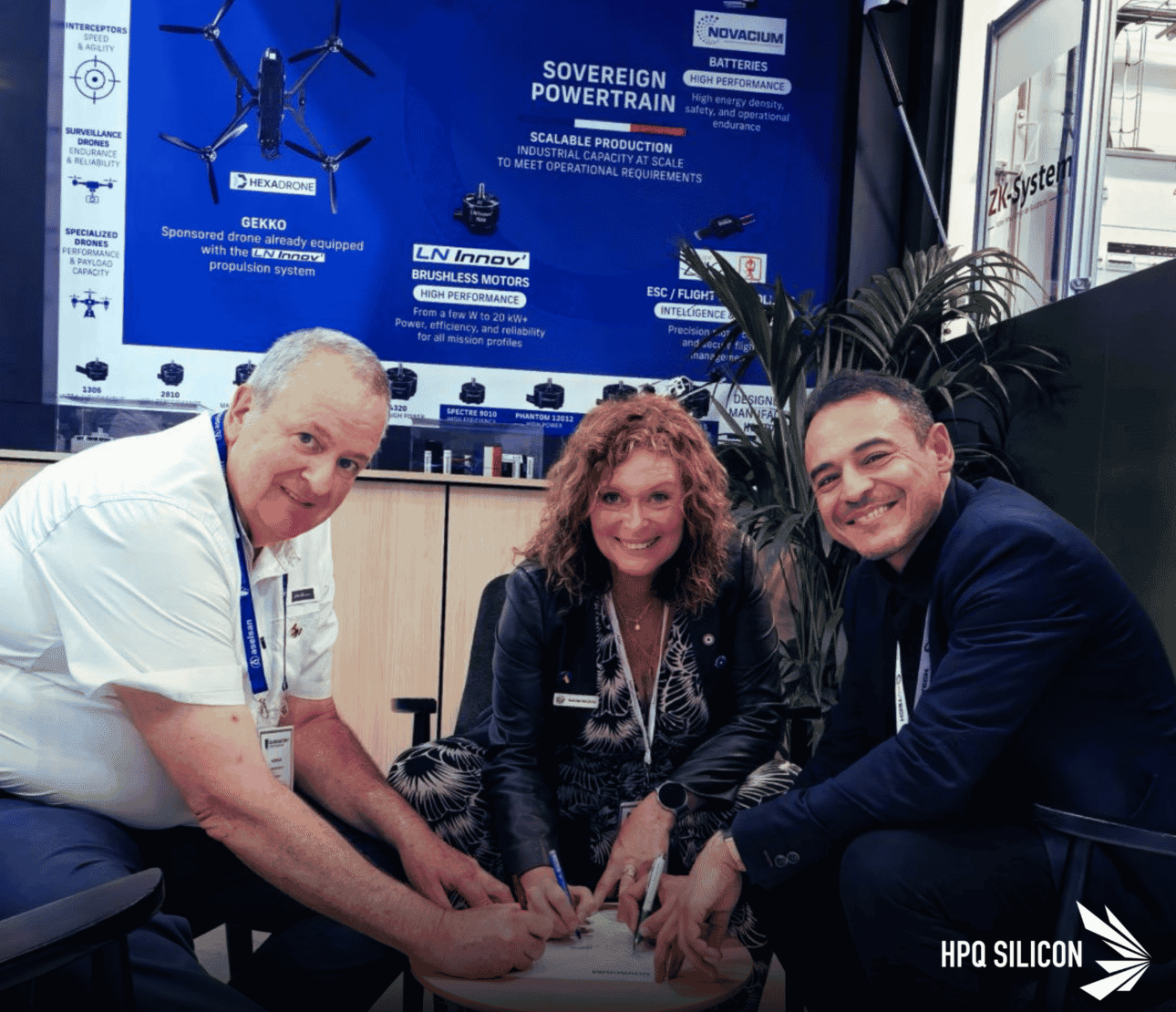
HPQ Silicon Inc. has signed a letter of intent that could push the company deeper into the fast-moving market for drone power systems. The Quebec-based technology firm said it signed the agreement with French propulsion specialist LN Innov’ and battery developer Novacium SAS on June 16, 2026, during the Eurosatory exhibition in Paris. The arrangement sets the stage for a new HPQ drone propulsion effort built around a made-in-Canada platform that would pair advanced batteries with electric motors for North American customers.
HPQ already has a direct line into one side of that equation. The company holds a 36.8 percent equity interest in Novacium and owns exclusive North American commercialization rights to its technologies. Under the new letter of intent, HPQ, Novacium and LN Innov will spend the next 190 days studying whether a Canadian-based platform makes sense, combining Novacium’s battery technologies, to be sold under the HPQ ENDURA+ brand, with LN Innov’s electric propulsion systems for drone, robotics and defense markets. The agreement is non-binding, carries no exclusivity, and includes no financial commitments or minimum purchase requirements.
Inside the HPQ Drone Propulsion Platform Plan
The parties say they completed preliminary technical reviews before signing, and those reviews supported the decision to move ahead with the letter of intent. The evaluation will focus on practical questions that determine whether a North American HPQ drone propulsion platform can stand on its own. Those include industrialization, manufacturing, supply-chain requirements, certification pathways, target applications, business structure and possible commercialization strategies. The companies are clear that any future tie-up would still depend on further study and the negotiation of definitive agreements, and there is no guarantee the work will lead to a commercial arrangement.
Bernard Tourillon, President and CEO of HPQ Silicon, framed the move as part of a broader shift in how governments and industry view battery and propulsion supply chains. He pointed to a heavy concentration of that supply chain in Asia as a vulnerability that many regions now want to reduce.
“As drones become increasingly critical across commercial, industrial and defense applications, governments and industry are recognizing that batteries and electric propulsion systems have become strategic technologies. Today, much of that supply chain remains concentrated in Asia, creating vulnerabilities that many jurisdictions are actively working to reduce. Through our partnership with Novacium and this new collaboration with LN Innov, we have an opportunity to evaluate the adaptation of an industrial model currently being deployed in Europe for North American markets, combining advanced battery technologies with proven electric propulsion expertise. For HPQ, this represents another step in our broader strategy of identifying innovative technologies with demonstrated market potential and positioning the Company to assess potential commercialization opportunities across North America.” Bernard Tourillon, President and CEO of HPQ Silicon
LN Innov Electric Motors Built for Drones
Electric motors sit at the center of any autonomous flying system, shaping performance, efficiency and the all-important thrust-to-weight ratio. LN Innov’ designs and manufactures high-performance propulsion systems for a wide span of uses, including FPV drones, interception systems, surveillance platforms and payload-delivery drones. As HPQ weighs how a comparable UAV powertrain operation might work in North America, that breadth of applications is part of the appeal. The interest is grounded in real demand rather than projections alone.
More than 20 customers across the drone, robotics and defense sectors have tested LN Innov’s motors under real operating conditions, and more than a dozen of them have since placed commercial orders. Those results are feeding the company’s push to expand production in France, where it aims to scale manufacturing to as many as 20,000 drone motors per month by the end of the third quarter of 2026. The three companies intend to study whether parts of that industrial model could be adapted for North American markets.
Nathalie Mazeau, President of LN Innov’, described the partnership as an early but promising step. She tied the company’s confidence to the feedback it has gathered from customers testing its motors.
“We are still at the beginning of this adventure, but the market signals are encouraging. Having more than 20 customers test our motors and seeing more than a dozen subsequently place orders provides valuable feedback regarding the performance of our technology. This Letter of Intent creates an opportunity to explore how our industrial and technological expertise, combined with Novacium’s advanced battery technologies and HPQ’s North American presence, could contribute to the development of an electric propulsion ecosystem in North America.” Nathalie Mazeau, President of LN Innov’
Novacium Batteries and the HPQ ENDURA+ Brand
On the battery side, Novacium is developing silicon-enhanced cells designed for drones and other autonomous systems, where operators want a balance of energy density, reliability, safety and ease of manufacturing. Marketed under the HPQ ENDURA+ brand as part of the company’s silicon-based battery platform, the cells are built to match requirements common in current drone designs. Novacium has already produced configurations delivering roughly 15 Ah of capacity, 21.3 volts of nominal voltage and energy densities near 205 Wh/kg. The technology is meant to meet today’s needs while leaving room for higher-energy versions later.
Novacium’s batteries are currently being evaluated by industrial and defense-sector participants to gauge how well they fit into future drone and autonomous-system platforms. The proposed collaboration with LN Innov would let the partners test how those batteries and high-performance electric motors might be combined into complete systems for drones, robotics and other autonomous applications across North America.
For HPQ, the letter of intent turns the HPQ drone propulsion concept into a defined next step, adding a propulsion layer to a battery program that has already moved from research into early commercial production. Whether the Canadian platform takes shape will depend on the coming months of evaluation and any definitive agreements the parties choose to negotiate.
