

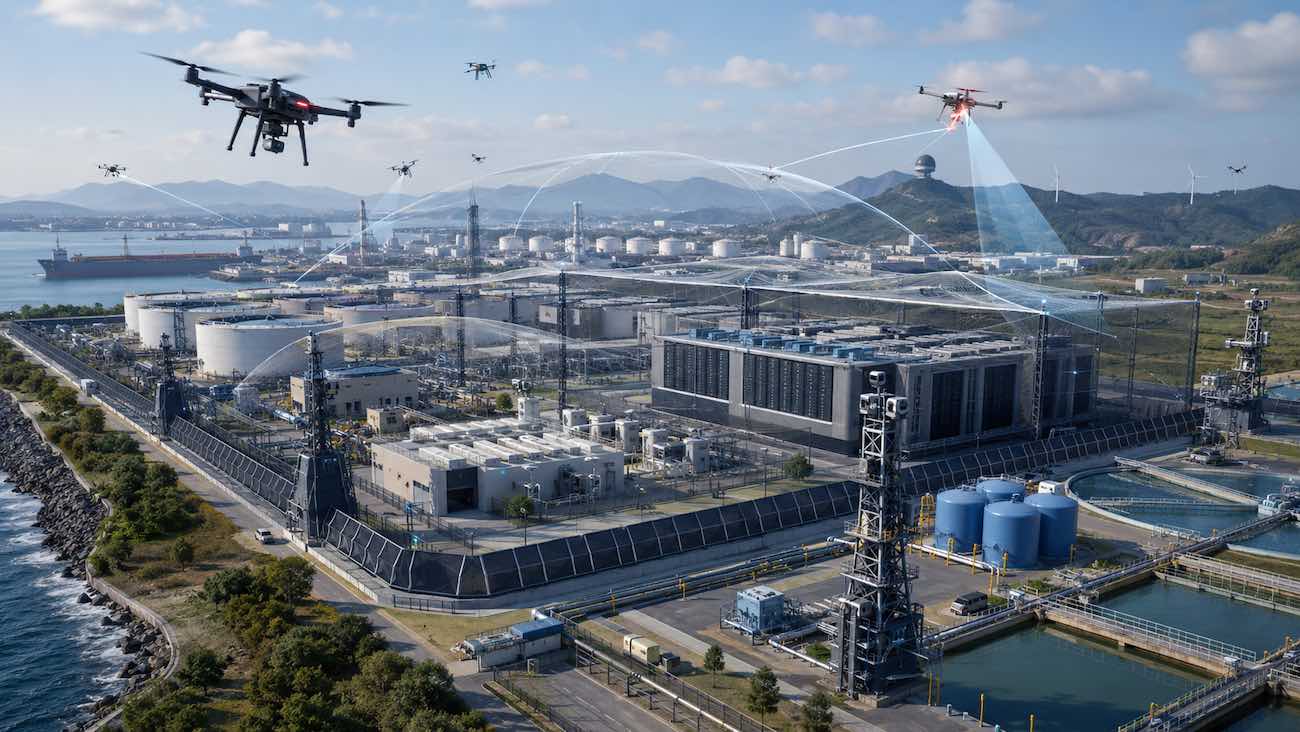
Finnish materials technology company Betolar has introduced a new drone protection solution designed to safeguard large critical infrastructure facilities. The Betolar drone protection system is suited for sites such as oil terminals, energy facilities, data centers, and water utilities, where any operational disruption can carry serious consequences.
The announcement builds on the company’s earlier work in this field. Betolar previously developed a protection product for electrical substations and began bringing it to market in cooperation with Enersense International. According to the company, the latest launch broadens its presence in the growing market for hardening essential sites against unmanned aerial threats and reflects rising demand from operators who want to prepare for a fast-changing risk environment. The shift comes as governments and private operators across Europe weigh how best to defend industrial assets that were not originally designed with aerial intrusion in mind.
How the Betolar Drone Protection System Works
The Finnish company says the Betolar drone protection design is based on a straightforward overall concept that brings together existing commercial products with complementary structural elements meant to enhance overall protective performance. It is positioned as a way to defend against a wide spectrum of aerial threats, ranging from small consumer-grade quadcopters all the way to larger long-range drone systems. The approach also leaves room for evolution, with the company noting that protective designs can be updated as drone capabilities continue to advance.
Rapid deployment sits at the center of the offering. The structures can be installed as either a temporary or permanent solution, and they can also be pre-positioned so they are ready to go when a sudden need emerges. Betolar notes that the system is built with retrofit projects and scalability in mind, which allows operators to expand coverage as requirements change over time.
Critical infrastructure operators have grown increasingly aware that physical damage, operational outages, or security incidents at large sites can carry wide-reaching effects. Because every facility has its own layout, exposure, and risk profile, Betolar develops site-specific configurations together with its partners rather than offering a single off-the-shelf product. The approach reflects how modern counter-drone systems are increasingly tailored to the specific assets they defend. The company describes the launch as one of the first practical options capable of defending extensive and complex industrial sites from aerial intrusion.
Betolar describes its work in this area through its protecting critical infrastructure program, which outlines how the company’s materials technology background feeds into the new offering. The Betolar drone protection approach supports owners and operators in scenarios where the impact of physical damage, operational outages, or security incidents can be significant for surrounding communities.
“As the use of drones continues to grow and the risks they pose become more concrete, the need for effective protection solutions that can be deployed quickly is also increasing. Drone-related threats to critical infrastructure are evolving rapidly, which means large facilities require solutions that can be implemented quickly, adapted to site-specific needs, and scaled as required. Our goal is to expand internationally together with our partners and to identify operators who have an immediate need to strengthen site protection and prepare for a fast-changing threat environment,” Tuija Kalpala, President and CEO of Betolar
Patent Strategy and Market Outlook
The Finnish company has placed clear emphasis on protecting its intellectual property as it scales this business line. Betolar has filed for a patent on the new solution and currently has three additional patent applications pending that relate to the protection of critical infrastructure. The expanded patent footprint signals that the company sees long-term commercial value in the segment, beyond the initial product targeted at electrical substations.
In its earlier release covering the substation product, Betolar estimated the market potential at several hundred million euros across the Baltic Sea region alone. Adding new categories of critical sites broadens that addressable market further by including industries such as energy production, data infrastructure, and water management. Founded in 2016 and headquartered in Kannonkoski, Finland, Betolar is listed on the NASDAQ First North Growth Market and also trades in the United States on the OTCQX International marketplace under the symbol BTLRF.
