

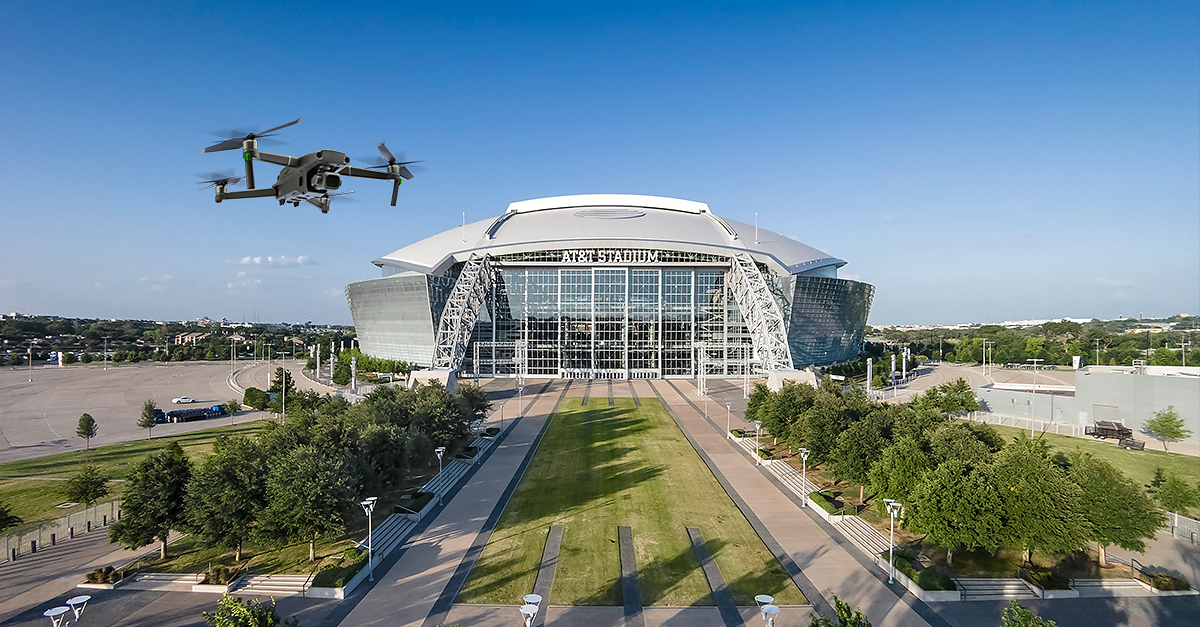
AT&T and Ericsson have carried out a drone detection demonstration outside AT&T Stadium in Arlington, Texas, using their wireless network to spot and follow drones flying nearby. The test took place in authorized airspace during one of the largest global sporting events in the world, and it relied on advanced network sensing running over a 5G network. According to the companies, the setup located multiple drones and then tracked their movement in real time.
The demonstration was announced from Dallas on July 10, 2026, and it points to a future in which everyday cellular equipment does more than carry phone calls and data. By tapping the same radio signals used for communication, the network was able to sense its surroundings and build a live picture of low altitude activity. The companies say this kind of capability could eventually help protect major venues, critical infrastructure, and other important locations without adding separate detection hardware.
How the Drone Detection Demonstration Worked
Ericsson set up the system using massive MIMO radios installed across several existing cellular sites, forming what the company calls a multi-static sensing configuration. Rather than adding standalone radar, the network reused the radio signals it normally sends for communication and paired them with advanced signal processing and AI-enabled sensing algorithms. The approach reflects a wider push by Ericsson to turn mobile networks into sensors that can flag drones and other passing objects. That combination let the system detect, locate, and track the drones as they moved, and the companies note it offers a total cost of ownership advantage for coverage on a national scale.
During the drone detection demonstration, multiple drones flying at altitudes between 300 and 400 feet inside the coverage area were detected, pinpointed, and followed continuously. By blending readings from several synchronized sensing nodes, the technology improved its reliability, sharpened its positioning accuracy, and kept a steady lock on each target. It also produced real-time details for every drone, including location, velocity, and elevation, which gave a complete view of each flight path from start to finish. Because those readings came from the network itself, operators did not need to install extra radar units to gain that picture.
Bringing Early 6G Sensing to Life With 5G
The companies frame the test as more than a single milestone. They argue that features many people file under the label of 6G can begin taking shape today through software, advanced radios, and the continued growth of 5G. That direction builds on the broader Ericsson ISAC work aimed at folding environmental sensing into the networks people already rely on every day. Both companies plan to keep developing Integrated Sensing and Communication, known as ISAC, through further demonstrations and shared learnings, with drone detection standing out as one clear near term use.
“As networks evolve, the opportunity is not just to prepare for 6G someday, but to begin introducing important building blocks now. This demonstration with AT&T shows a product roadmap in action: using advanced 5G capabilities today to explore how sensing and connectivity can work together, then evolving those capabilities over time as the path to 6G becomes clearer.” Dyon Agnew, SVP and Head of Customer Unit AT&T, Ericsson Americas
A Roadmap Aimed at Large Events and Public Safety
Looking ahead, AT&T and Ericsson describe a roadmap that could help event and facility teams plan and staff more effectively by giving them broader visibility into how vehicles move through large spaces. The same network based awareness could improve coordination around temporary event infrastructure and logistics, and support a wide area drone awareness system for public sector groups as the low altitude economy grows across cities and regions. The companies also see the work informing how future 5G and 6G features develop as sensing and communication mature together, and they plan to keep refining the approach toward major event settings, including the next major global sporting event in Los Angeles in 2028.
“Integrated sensing is an important part of the road to 6G, and this work helps show how we can start bringing that future to life right now. By working with Ericsson, we are exploring how advanced wireless networks can add sensing capabilities to connectivity in ways that could support safer operations, smarter venues and stronger customer experiences, while creating a path to evolve these capabilities responsibly over time.” Yigal Elbaz, SVP and Network CTO, AT&T
For now, both companies present the stadium test as a practical step rather than a distant promise, arguing that useful sensing can be added to existing networks and then expanded as standards, ecosystems, and market needs take shape. The goal they describe is a steady path where 6G style capabilities begin delivering value well before full 6G commercialization.
