

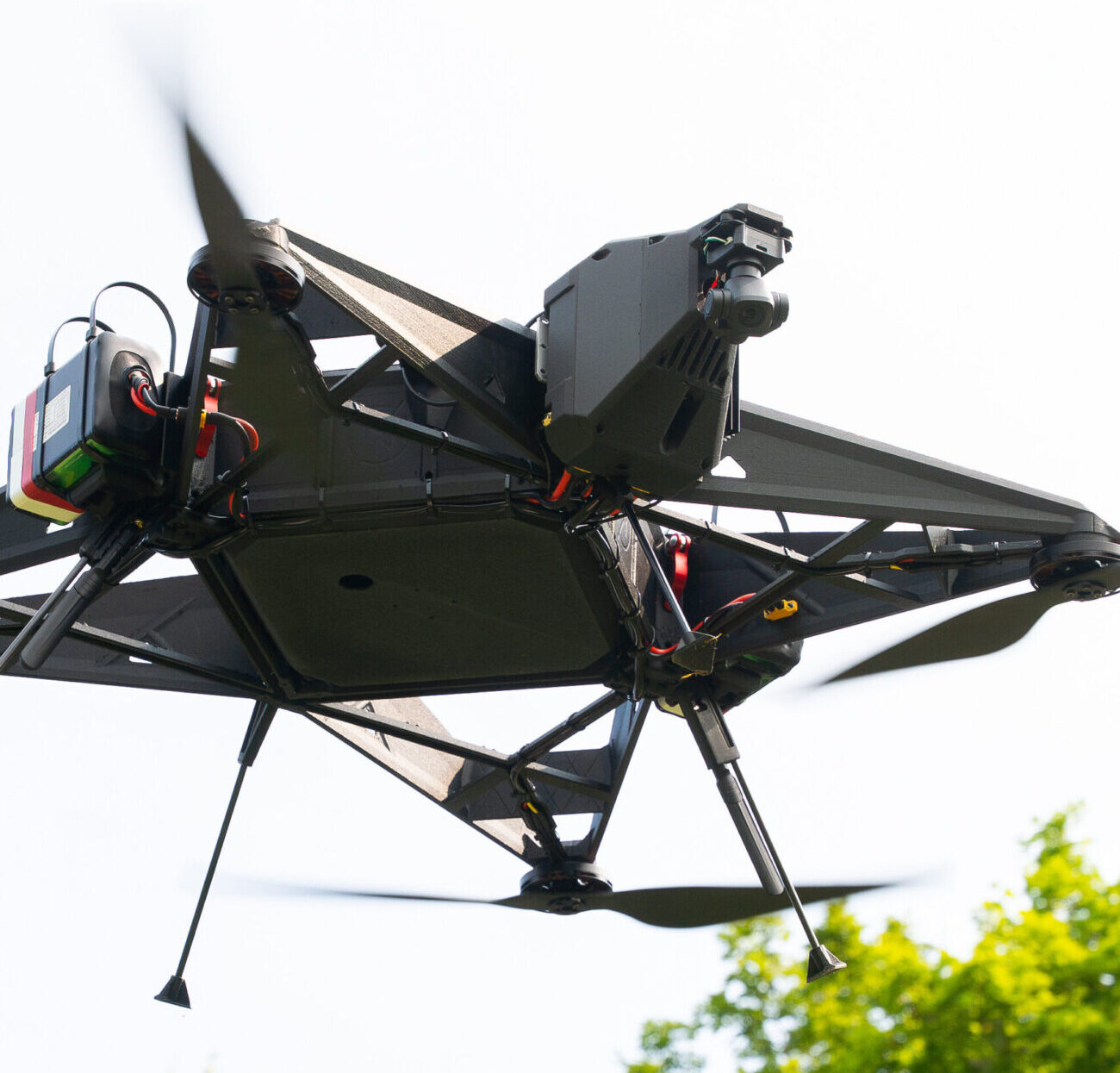
BQP and Modovolo have announced the results of a joint engineering effort that used quantum-inspired simulation software to redesign one of the most demanding parts on a small aircraft. The two New York companies said on August 7, 2026 that Modovolo drone propellers were developed with BQP’s BQPhy platform, allowing the manufacturer to reach state-of-the-art UAV performance in a fraction of the development window such work normally requires. BQP describes itself as a leader in quantum-accelerated simulation software, while Modovolo builds high-performance drones at what it calls a radically reduced cost.
The announcement centers on a problem familiar to anyone working in aerospace and defense engineering. According to BQP, the real obstacle is not how quickly a single simulation runs, but the slow trial-and-error loop that surrounds it, because traditional computational fluid dynamics and structural tools allow engineers to evaluate only a small handful of candidate designs. The BQPhy QuantumNOW solver takes a different route, running quantum-inspired algorithms on existing HPC and GPU hardware and compressing tens of thousands of simulations into a fraction of the usual time and compute budget.
How Modovolo Drone Propellers Were Redesigned
Modovolo builds around what it calls a performance-to-cost philosophy, which aims to maximize flight time and payload while cutting price. That thinking shaped the company’s new patent-pending propellers, which were optimized using BQPhy. The blades are 3D printed through a proprietary process the company developed to keep them affordable, and Modovolo says the finished designs are delivering large gains in both flight time and payload lift capacity. Justin Call, Co-Founder and CEO of Modovolo, said the company had already written its own genetic algorithms for propeller optimization, but running them on local servers could take many days to reach a single design that often turned out to be useless because the calculations became trapped in a local minima.
“We had developed a proprietary process for 3D printing highly affordable propellers, but maximizing their performance through traditional tools was a slow, uphill battle. BQPhy acted as a true force multiplier, giving us a massive competitive leap in UAV market. With the BQP-developed propellers were are seeing large increases in flight time and payload lift capacity.” Justin Call, Co-Founder and CEO of Modovolo
Exploring Every Variable On A Propeller Blade
Arion Mangio, Co-Founder and Chief Technology Officer of Modovolo, described the underlying difficulty in blunt terms. A propeller blade, he said, carries an effectively infinite number of variables, with different stress points, aerodynamic considerations and performance changes at every point along its surface. Existing tools weigh only a small number of those variables, which makes the process both error-prone and slow. Mangio said BQPhy gave the team the computational muscle to explore an unprecedented number of design variables at once, solving immediate performance bottlenecks and leaving behind a scalable engine for the next generation of complex UAV systems.
For BQP, the Modovolo drone propellers project is a demonstration of what its software is meant to do across heavy engineering. The company frames the value not as a faster individual calculation but as total design-space exploration, where thousands of simulations run at once. BQP says the BQPhy platform runs on today’s infrastructure with no quantum hardware required, and the QuantumNOW solver applies quantum-inspired optimization to design problems that classical tools cannot search thoroughly.
“By running thousands of simulations simultaneously, BQPhy eliminates the traditional trial-and-error bottleneck. It gives forward-thinking manufacturers like Modovolo the power to discover radically optimized geometries that were previously computationally invisible, moving from software output to physical testing at a pace the industry hasn’t seen before.” Abhishek Chopra, Founder and CEO of BQP
BQP And Modovolo Inside New York’s Deep Tech Push
Both companies sit in the NY Ventures portfolio, and Modovolo is part of the GENIUS NY program, details the two firms point to as evidence that deep-tech work is reshaping manufacturing across New York State. BQP, formerly known as BosonQ Psi, is headquartered in Syracuse with a hub in Bangalore, India, and describes itself as a quantum-first simulation company building digital twin platforms for mission-critical applications. Modovolo’s flagship product, the Modovolo Lift, is described by the company as the industry’s first payload-centric design, capable of flying hundreds of missions at a cost well below competing aircraft, including those made in China.
The work behind the Modovolo drone propellers also gives the manufacturer a repeatable framework rather than a one-off result. Both companies say the integration produced a scalable approach that can be applied to future designs, which matters for a manufacturer whose entire pitch rests on squeezing more flight time and lifting capacity out of hardware that costs less to build. For BQP, the case adds an aerospace customer to a platform the company argues is already delivering returns without waiting for quantum computers to mature.
