

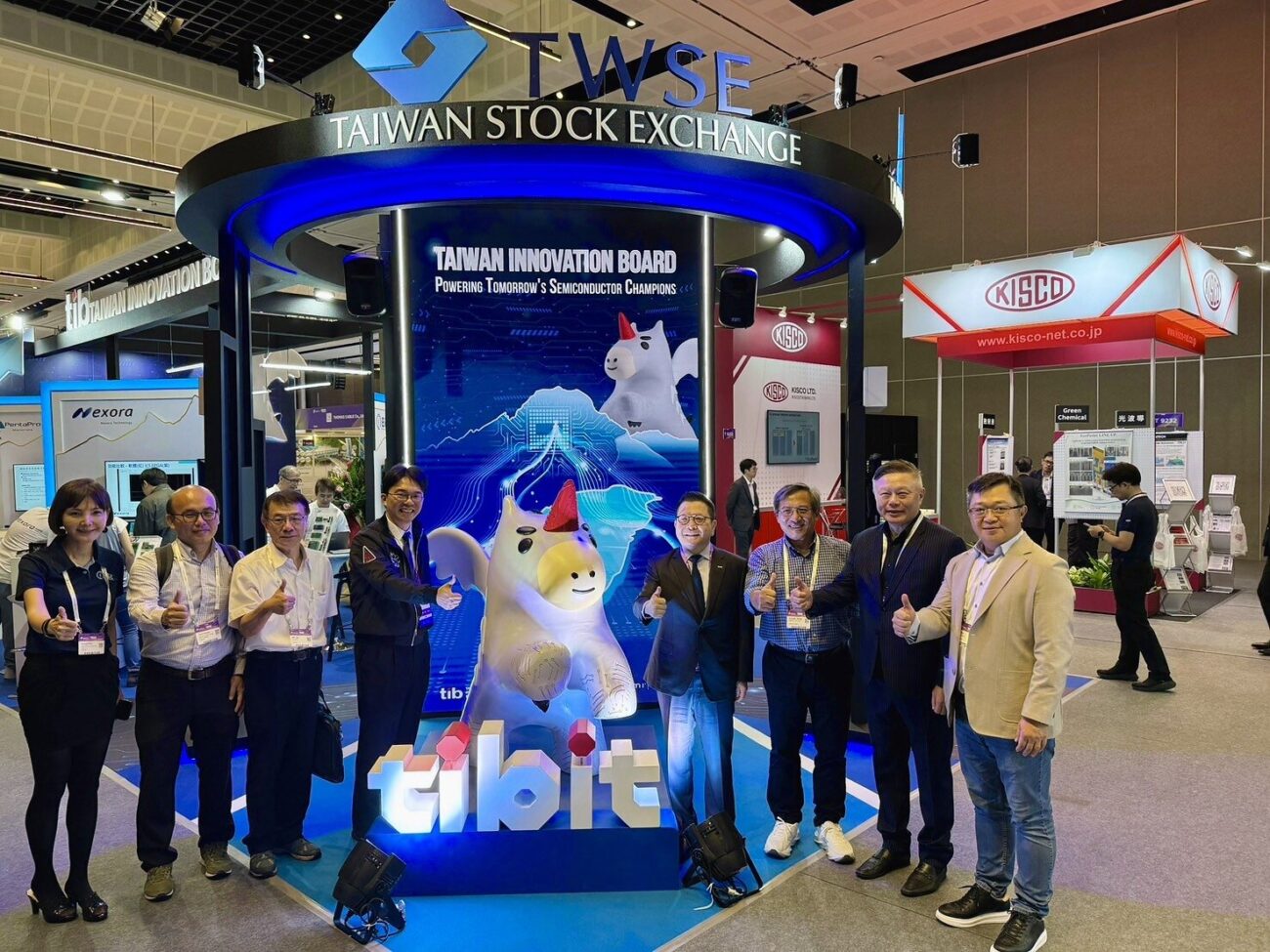
QBit Semiconductor used SEMICON Taiwan 2026 to spell out how it plans to move from imaging silicon into machines that move on their own. The Taipei-based fabless chip designer, traded as TWO: 7913, laid out a QBit Semiconductor drone and robotics chipset roadmap aimed at what the industry has started calling Physical AI. The company made its case inside the Taiwan Stock Exchange pavilion at the show, where chairman Simon Shen appeared alongside TWSE chairman Sherman Lin. Its core argument is that functions normally spread across several boards can be pulled onto one piece of silicon.
The robotics side of that roadmap centers on the QB88XX series, built for dexterous robotic hands carrying more than 20 degrees of freedom. Hands like that leave very little physical space and very little power headroom for control electronics, so QBit designed the part to consolidate multi-joint control onto a single system on chip. The company says that consolidation reduces both system cost and energy consumption. The design is based on a Cerebellar Model Articulation Controller architecture, which is where the cerebellum comparison in the company’s messaging comes from, since the chip is meant to carry out movement commands rather than generate high-level intent.
Inside the QBit Semiconductor Drone Chip Roadmap
The silicon detail explains how that division of labor works. The QB88XX combines quad-core Arm Cortex-A78 processors and a neural processing unit that execute brain commands, then adds an Arm Cortex-M7 core, a TGEN block and a second NPU dedicated to motor servo control. Brain commands in this framing come from higher level planning, while the servo side deals with how each motor actually gets there. That kind of split shows up elsewhere among AI chips aimed at compact machines, where a general purpose cluster handles planning and smaller cores stay tied to real-time tasks. The part supports up to 32 motors and AI servo tuning, and it integrates PCIe, USB, CAN Bus and camera interfaces for robotic arms and industrial automation.
The QBit Semiconductor drone plan runs on a two-phase timeline. From 2026 through 2028, the company is targeting entry-level platforms with the QB77XX, which supports up to 32GB of LPDDR5 or LPDDR5X memory along with PCIe, USB 3.2 and gigabit Ethernet. Real-time flight control on that part runs through the TGEN block and a Cortex-M33 core, and QBit frames it as a way to reduce board counts across mission computers and flight controllers. Phase two starts in 2029, when a drone-dedicated QB88XX SoC is due to unify flight control and mission computing on one chip, with optical flow control and target tracking built in. Optical flow control reads camera imagery to judge movement relative to the ground below, a task closely tied to steady low-altitude flight.
Object Tracking Demos and Quantum-Safe Boot Protection
QBit also demonstrated a single-object tracking solution running on the QB77XX at the show. Imaging and precision motion control sit at the center of the company’s IC product lineup, and the tracking work draws directly on that background. During testing the system held its lock on a target through visual occlusions, at relative speeds reaching 60 km/h and with flight times of 10 to 15 minutes. Tracking several objects at once is the next step, and the company says that version will be shown during the fourth quarter of 2026.
Security makes up the other pillar of the QBit Semiconductor drone offering. The company’s QB7 series passed U.S. NIST CAVP validation for post-quantum cryptography ML-DSA algorithms in 2025, and its drone products carry PQC-secured boot for device authentication and firmware defense. Post-quantum cryptography covers algorithms built to hold up against future quantum computers, and ML-DSA is one of the digital signature schemes in that group. QBit describes itself as a fabless IC design company working across high-end image processing, precision motion control, Edge AI and post-quantum cryptography, with one-stop ASIC design and system integration for robotics, drones and secure terminals.
