

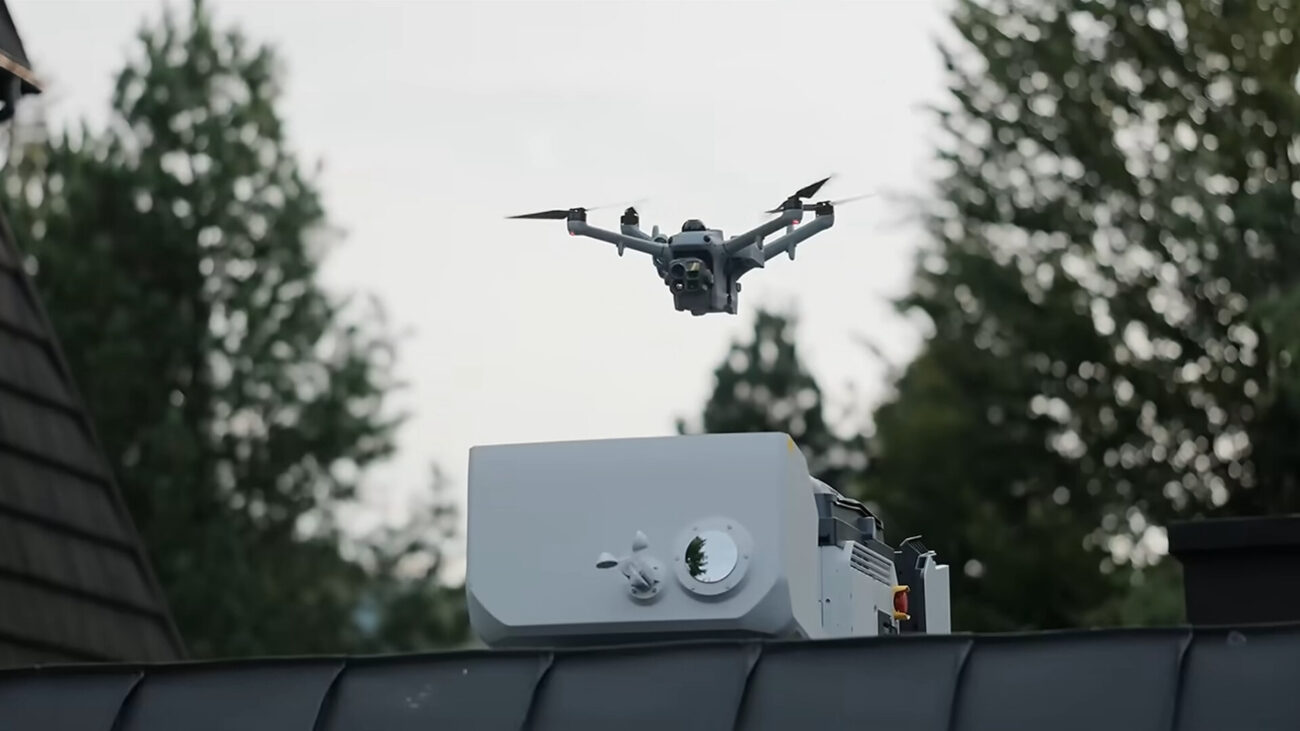
Poland’s volunteer mountain rescue service is testing whether TOPR rescue drones can reach an accident in the Tatra Mountains before any rescuer has left the base. Working with DJI Enterprise, the group known as TOPR, short for Tatrzańskie Ochotnicze Pogotowie Ratunkowe, has started a pilot program built around the newly released DJI Dock 4, an automated station that launches an aircraft from a rooftop on its own. DJI shared details of the trial from Shenzhen, China on November 3, 2026.
The Tatras make rescue work difficult, with sharp peaks, deep valleys, and harsh winter weather that can slow every stage of a mission. TOPR is headquartered in Zakopane, Poland, and focuses on mountain search and rescue across the range. The organization was already flying DJI Enterprise equipment, including the DJI Dock 3, before taking this latest step. The new trial builds on that automated setup with a dock that can keep its drone ready for repeated flights.
How TOPR Rescue Drones Reach Accident Sites in Minutes
Time has always been the hardest thing to win back in the mountains. Some places in the Tatras cannot be reached by car, bike, or even snowmobile once winter arrives, according to Marcin Józefowicz, a TOPR rescuer who serves as Head of Cybertech. Under the traditional approach, a full mountain deployment could need as long as two hours just to gather the team and hike to the trailhead, long before anyone reached the person in trouble.
The pilot program changes the order of events. Instead of waiting for people to reach the scene first, TOPR rescue drones lift off from the rooftop dock and can arrive at a reported accident in minutes rather than hours. That early view from above lets duty officers decide whether a rescue is truly needed, how many volunteers should head out, and which pieces of equipment the team will have to bring along.
“Crucially, we can assess the situation before we begin a physical operation.” Marcin Józefowicz, TOPR Rescuer and Head of Cybertech
Once it is over the scene, the DJI Matrice 5TD gives rescuers a way to communicate with people on the ground. Operators can use its loudspeaker to pass along instructions and ask whether help is needed, and hikers reply with gestures. If someone signals that they are fine, the team can move on and keep searching other areas. In complete darkness, thermal fusion imaging gives operators a picture close to daylight quality, so they can spot a hiker by the glow of a headlamp while reading the shape of the terrain at the same time.
DJI Dock 4 and Relay Stations Extend Range Across the Tatras
Mountain terrain often blocks the signals that standard drone flights depend on, so the trial adds a network of DJI O4 video transmission ground stations. Relay stations sit on observation towers and on distant peaks, and the drone can move between them smoothly as it flies. Józefowicz says this infrastructure lets the team stretch its flight range all the way into neighboring valleys, which gives TOPR rescue drones far more ground to cover from a single dock.
Automation handles much of the remaining workload. Flights can be started through automated triggers, and DJI Dock 4 can trade a drained battery for a fresh one in just 25 seconds, which allows the aircraft to keep running in continuous operation. DJI says its figures were measured on a production model in a controlled environment, and its DJI Dock 4 overview explains that some features only work with specific DJI drones and may not be offered in certain countries and regions. DJI, which has been building civilian drones since 2006, now also serves areas such as public safety, agriculture, renewable energy, surveying and mapping, and infrastructure inspection.
The trial also reaches beyond emergency calls. TOPR is using the automated fleet to explore daily hazard reconnaissance and regular trail monitoring across the range. For the organization’s volunteers, every new tool serves the same purpose of getting to injured people in the Tatras faster, more safely, and more effectively. A multimedia case study covering the work was produced jointly by DJI Enterprise and INNPRO.
