

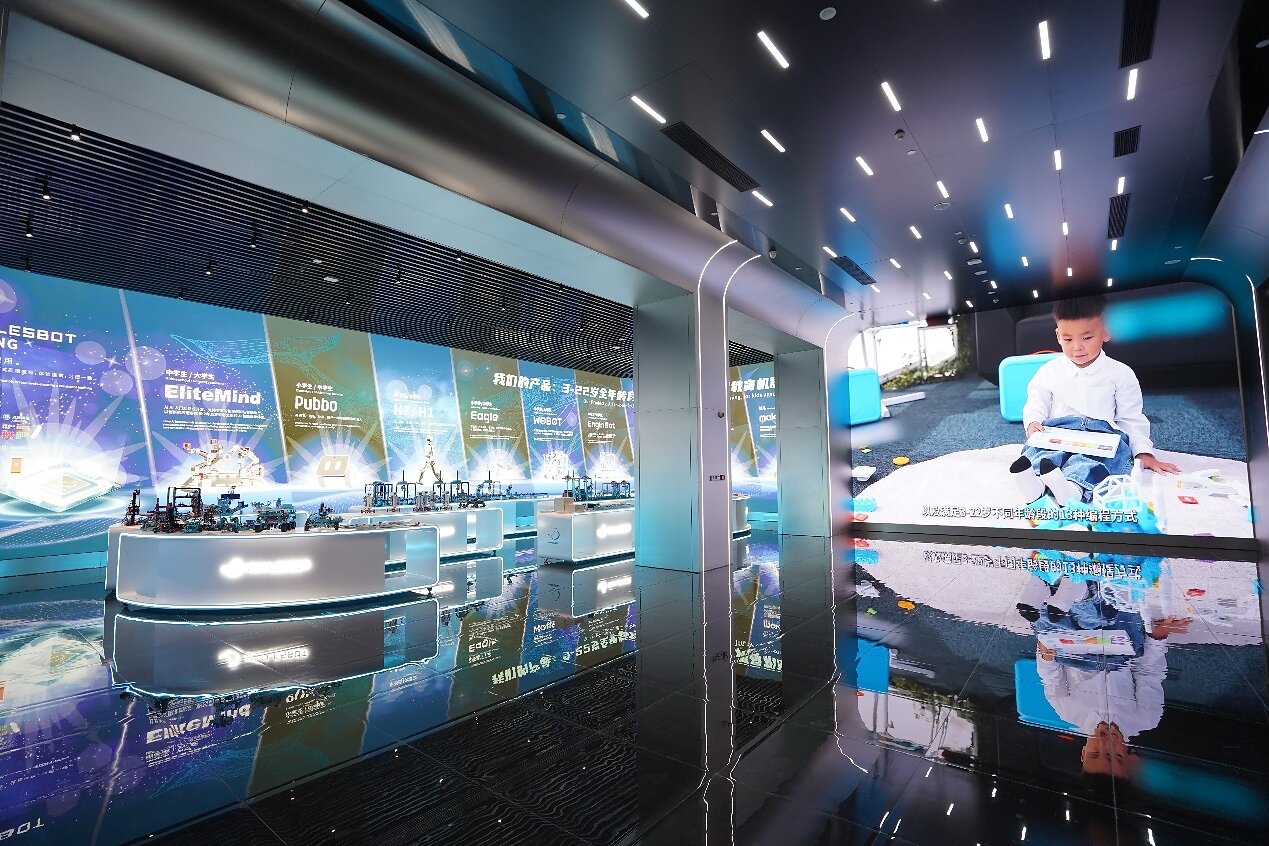
A leading Chinese robotics company is betting that the next stage of artificial intelligence learning will happen with hands on hardware rather than glowing screens. WhalesBot, a Shanghai based firm that builds robots and runs AI education programs, is expanding a network of physical learning centers across China where coding, engineering, competitions, and WhalesBot drones sit at the center of how students explore technology. The effort reflects a question now moving through the education world: what should children actually learn as machines grow more capable every year?
On June 27, the company opened its second AI+Robotics Exploration Center in Jiaxing, located in Zhejiang Province. That launch follows a recent project in Anhui Province that houses a center of nearly 5,000 square meters, built around robotics exhibitions, immersive learning rooms, competition zones, AI and robotics classrooms, and project based exploration for learners aged 3 to 22. WhalesBot is also involved in a collaboration connected to Peking University, where a three floor AI and technology learning center is under development with more than 1,800 square meters on each level. The company says similar centers and regional partnerships are being explored in other cities across the country.
How WhalesBot Drones Fit Into Hands-On Learning
Inside these spaces, the aim is to pull students away from passive screen time and closer to real machines that do not always cooperate. Learners test robots, debug sensor behavior, fly drones, and assemble systems that fail on the first attempt before they finally work. That trial and error is a deliberate part of the design. The WhalesBot drones used in the centers give students a moving, unpredictable tool that reacts to their code in real time, so a small mistake shows up immediately as a wobble, a drift, or a crash rather than a quiet error message.
Educators involved in the programs describe a move away from purely on screen coding toward exercises that force students to account for the physical world, where weight, balance, and timing all matter. A drone that lifts off and then tilts in an unexpected direction becomes a problem to diagnose instead of a fact to memorize, and that change in posture is part of what the centers are trying to encourage.
Beyond the classroom builds, WhalesBot drones also feed into competition, which the company treats as a core teaching tool rather than an afterthought. The company points to its ENJOY AI program, described as the largest robotics competition in the world, where teams solve challenges together, test ideas under pressure, and rebuild after failure. The event now includes categories shaped specifically around drone challenges, giving young builders a structured reason to keep improving their machines. Rising interest in this kind of training mirrors a wider trend, with the drone youth market steadily pulling more students into robotics. The through line is learning by doing, not learning by watching.
The Shift Toward Physical AI In Education
Across the technology industry, terms such as physical AI and embodied AI now describe intelligence that acts in the real world instead of living only inside software. WhalesBot argues that a similar change is taking shape inside classrooms. As AI tools generate answers, images, and code within seconds, the company suggests the value of learning is moving toward skills that resist automation, including reasoning, experimentation, judgment, curiosity, teamwork, and the ability to adapt when a plan falls apart.
WhalesBot calls its combined model AI Foundations Learning, a pathway that links robotics, coding, engineering, AI concepts, competitions, and project based work instead of treating AI as a separate, isolated subject. Founded in 2018, the company focuses on learners aged 3 to 22 and describes itself as the largest manufacturer of educational robots in the world, with more than one million units sold across over 80 countries. Its team expects the underlying technology to keep changing faster than schools can fully absorb. Even so, the idea behind the new exploration centers stays simple. Students still need to build real things, test ideas in messy conditions, and work through uncertainty rather than read about it on a display.
