

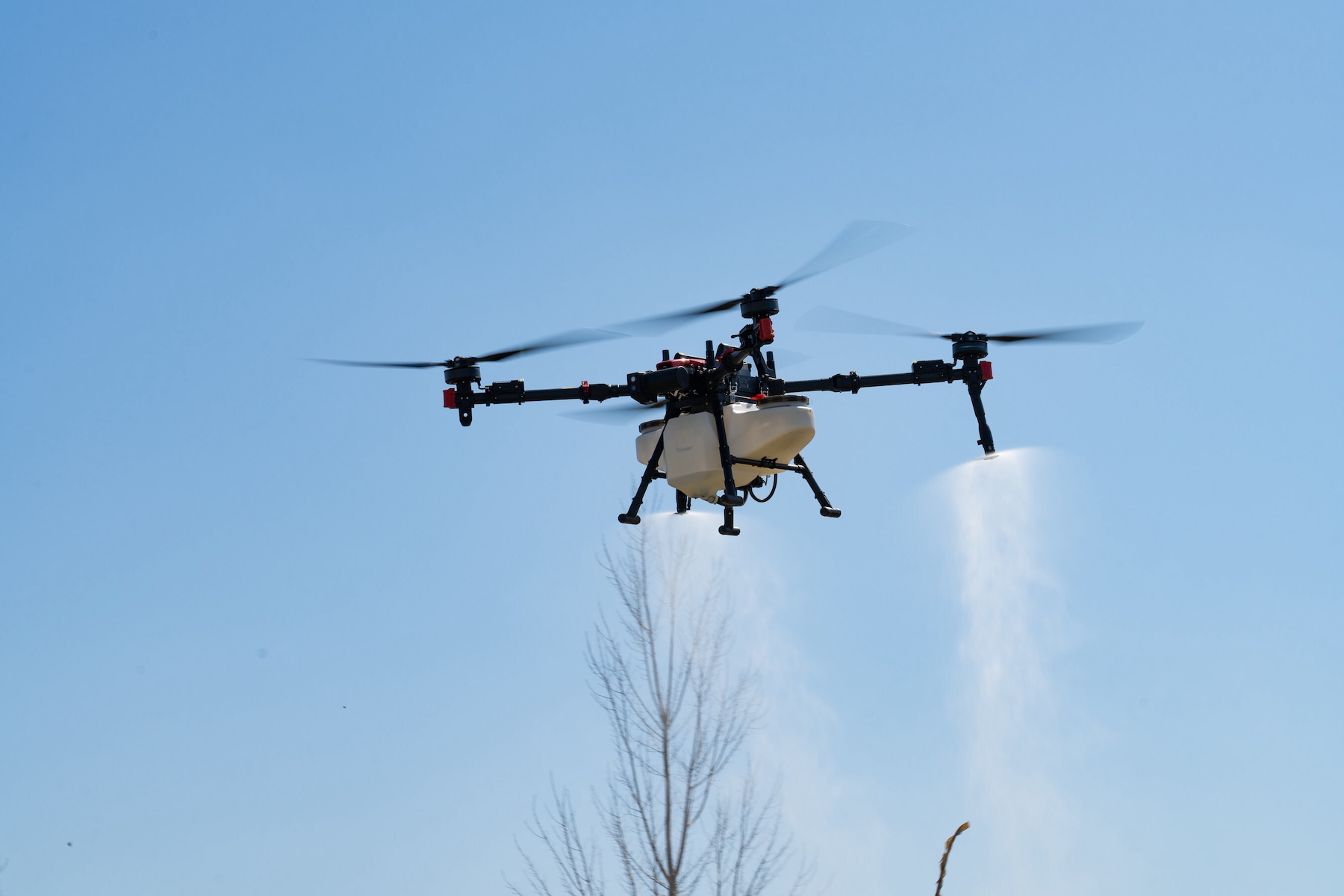
As the U.S. cattle herd drops to a 75-year low and beef prices reach record highs, Texas ranchers face mounting pressure to protect every acre of usable grazing land. Invasive brush species continue to spread across the state, and conventional control methods are often too expensive, too imprecise, or too limited by rough terrain. XAG drones are now offering a more practical solution, delivering precision herbicide treatments to dense brush and hard-to-reach areas without damaging the soil or grass underneath.
The growing demand for effective brush control has created new opportunities for specialists like Curtis Schramm, owner of Texas Agridrone Services. Schramm operates in Gonzales County, a region where livestock accounts for 93 percent of agricultural sales and crop rows make up just 10 percent of farmland. In that part of Texas, brush encroachment is both visible and relentless.
XAG Drones Take on Brush Encroachment in Texas Cattle Country
According to Texas A&M research, a single adult mesquite tree can consume up to 20 gallons of water per day during peak growing season. Prickly pear density can increase 25 to 30 percent each year during prolonged drought. In a region that depends almost entirely on rainfall, that kind of water loss steadily reduces the amount of pasture available to ranchers.
Traditional methods of brush control work only when the economics line up. In Schramm’s experience, a 29-acre brushy pasture is too small for a half-million-dollar ground rig to justify the trip. A helicopter can cover hundreds of acres an hour but cannot spray precisely over a dense thicket. Shredding with a tractor often makes things worse by stressing the plants, accelerating regrowth, and leaving behind stumps that prevent other equipment from entering the field afterward.
“A lot of my work is a fix to poor management practices from decades, even lifetimes of ranchers and landowners mismanaging property. Letting native brush and other invasive species come in and take over.” Curtis Schramm, Owner, Texas Agridrone Services
Schramm chose the XAG P150 and began operations in August 2025. The quad-rotor design generates a strong, concentrated downdraft that pairs with the RevoSpray System to reach a maximum flow rate of 7.9 gallons per minute. That force pushes herbicide uniformly through canopy layers all the way to the understory below. Schramm says that when landowners watch the drone fly over a dense mesquite stand, they expect the spray to drift down gently like rain under a tree. What actually happens surprises them every time. The plants swirl, dust kicks up from the ground, and the chemical reaches every part of the plant rather than just settling on the soil.
Brush control work comes with a different set of demands than open-field spraying. Schramm’s jobs involve dense, irregularly shaped thickets, damaged terrain, and pastures crossed by electrical lines. The P150’s 4D imaging radar detects obstacles between 5 and 328 feet along the flight path, allowing safe operation across the kind of uneven, obstacle-heavy ground he navigates daily. Real-time 3D terrain mapping enables autonomous flight without a preloaded map, adjusting continuously to each new field’s contours. Schramm says the drone’s ability to calculate speed, height, and other variables in a millisecond to make adjustments still impresses him every time he watches it work.
How XAG Drones Handle Rough Terrain and Solo Operations
The P150’s foldable design also lets Schramm load, launch, and manage a full day of operations by himself. For a small-business owner in his first years of operation, working solo means lower overhead and more profit per job. It is also a practical necessity, since many of his jobs are on properties where larger equipment simply cannot reach. He has brought his refill cycle down to under 32 seconds, with batteries swapped, the tank refilled, and the drone back in the air in under a minute.
The results from his first season speak clearly. Between August and December 2025, Schramm completed 682 acres of brushwork without losing a single client. His first job involved a shredder-damaged pasture filled with mesquite, prickly pear, and huisache. One month later, the treated area looked completely transformed. The brush was dead, but the grass survived. For each of those ranchers, recovered pasture means more grass, more cattle weight, and more income per head.
Schramm did not arrive at this career through a straight line. He spent decades connected to the land, first through his family’s poultry operation for Tyson Foods from 1977 to 2015, and before that through his grandfather, a county conservation resource manager for 31 years. His grandfather taught him to identify grasses, understand invasive plants, and know when and how to treat them. All of those techniques from his childhood turned out to be exactly what he needed when he entered the drone spraying business in his late 40s and early 50s.
For Schramm, the work has always been about more than clearing brush. He sees it as part of a chain that starts with the land and ends with a rancher’s ability to feed a family. Getting brush out means more grass grows, cattle gain weight faster, and ranchers earn more at market. He has built his entire operation around that idea, and it drives him out of bed before dawn to get the drone in the air.
