

DJI Agriculture has unveiled its fifth annual Agricultural Drone Industry Insight Report for 2025 and 2026, with figures showing that DJI Agriculture drones have helped farmers cut 51 million tons of carbon emissions and save roughly 410 million tons of water across global operations. The findings were presented at Agrishow 2026 in Ribeirão Preto, Brazil, where the Shenzhen-based company also confirmed that more than 600,000 of its aerial platforms are in active service across over 100 countries and regions, supported by a similarly large pool of certified pilots and a worldwide service infrastructure built up over the past decade.
The numbers are framed in striking environmental terms throughout the report. The water savings are described as roughly equivalent to the annual drinking water needs of 740 million people, while the carbon reduction matches the yearly absorption capacity of around 240 million trees. Alongside those headline figures, the company says it now operates a network of 3,500 service and repair centers worldwide and continues to support over 600,000 trained operators, an infrastructure footprint that suggests aerial spraying has settled into routine farm use across multiple continents rather than remaining a fringe pilot technology.
DJI Agriculture Drones Reshape Brazilian Crop Operations
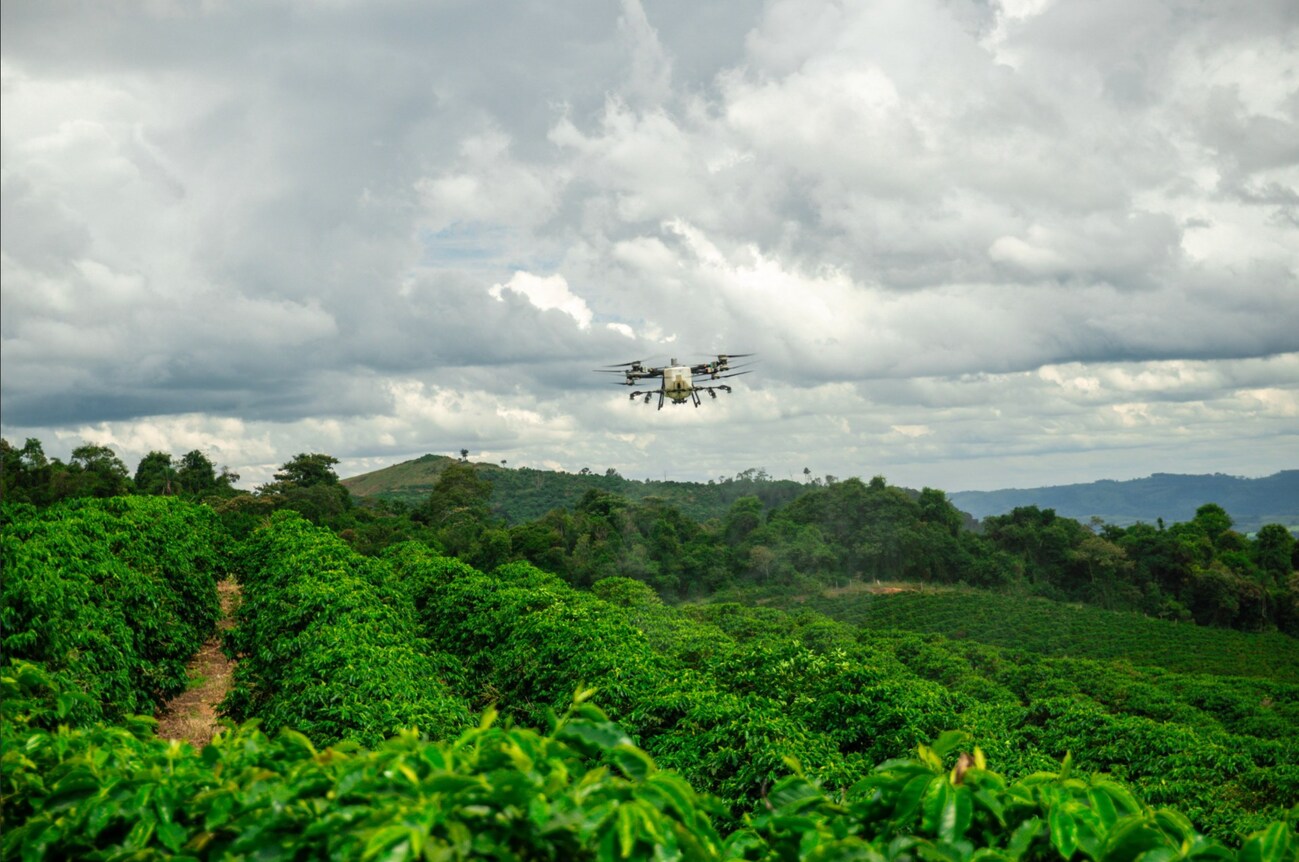
Brazil has emerged as a flagship market for the technology, with growers deploying the DJI Agras T25P, T70P, and T100 platforms on coffee, soybeans, corn, sugarcane, and forage grass. According to the report, full-cycle precision operations in forage management are lifting renewal efficiency and pasture productivity, with spot-spraying of weed patches reducing herbicide use by as much as 35 percent. Operators are also reporting wider environmental gains beyond chemical inputs, including less soil compaction, reduced chemical drift near sensitive ecosystems, and a smaller overall carbon footprint for livestock operations that rely on healthy grasslands and consistent forage supply.
Yuan Zhang, who leads global sales at the company, framed the report’s release as evidence that aerial spraying has shifted from novelty equipment to standard farm machinery in many markets. He pointed to the steady spread of DJI Agriculture drones across major Brazilian crops and connected the trend to continued investment in operator training, certification programs, and a growing after-sales footprint that aims to keep equipment in the field rather than parked for repairs during peak season.
“Agricultural drones are no longer a novelty – they are essential farm equipment worldwide. In Brazil, DJI Drones are now widely applied on the country’s major crops, including coffee, soybeans, corn, sugarcane, and forage grass. As the global adoption continues to grow, DJI Agriculture will continue to strengthen our support network for operators while offering training through our global network of over 7,000 certified instructors. These investments underscore the company’s commitment to helping farmers improve efficiency and sustainably increase their yields through innovative drone technology.” Yuan Zhang, Head of Global Sales at DJI Agriculture
Field Trials Validate Drone Spraying Performance
The report compiles a wave of new field trials and peer-reviewed academic studies that back the case for agricultural spray drones across precision application, operational efficiency, economic returns, and environmental performance. These findings sit alongside broader projections for the agricultural drones market, which industry analysts expect to keep expanding through the end of the decade as more governments approve commercial spraying operations. Industry organizations such as UAPASTF have also built fresh guidelines for the safe and effective application of pesticides, drawing on updated drift studies that allow for tighter, safer crop protection in the field.
Better drift testing is described as a key enabler of compliant field work and environmentally responsible chemistry application across the sector. Researchers say the new data also strengthens the case for drone use in mixed terrain, where conventional ground rigs can struggle with tight row spacing, uneven slopes, or wet soils that put heavy machinery at risk of damaging both the field surface and the standing crop above it. The trial results are increasingly cited in policy reviews and farmer training programs alike.
Global Regulators Standardize Drone Farming Rules
Policy frameworks are starting to catch up with the hardware. Brazil’s National Civil Aviation Agency, known as ANAC, has updated its drone rules to create so-called standard scenarios for recurring agricultural operations, simplifying approvals for growers who run repeat missions across the same fields. In Canada, Transport Canada has amended the Canadian Aviation Regulations to streamline rules for spraying, mapping, monitoring, and other precision farming work, with documentation about the company’s spray platforms hosted on the DJI Agriculture portal. The company says global regulators are trending toward liberalization, standardization, and strategic integration of unmanned aircraft into farming.
Founded in 2015, DJI Agriculture grew out of spray drone research that began at parent company DJI in 2012. The firm estimates that around 600,000 agricultural drones are currently treating more than 300 types of crops in over 100 countries and regions, with operator certification handled through a network of more than 7,000 instructors worldwide who train new pilots on safety, equipment handling, and field protocols. The latest report positions that footprint as the foundation for the next phase of agricultural modernization.
