

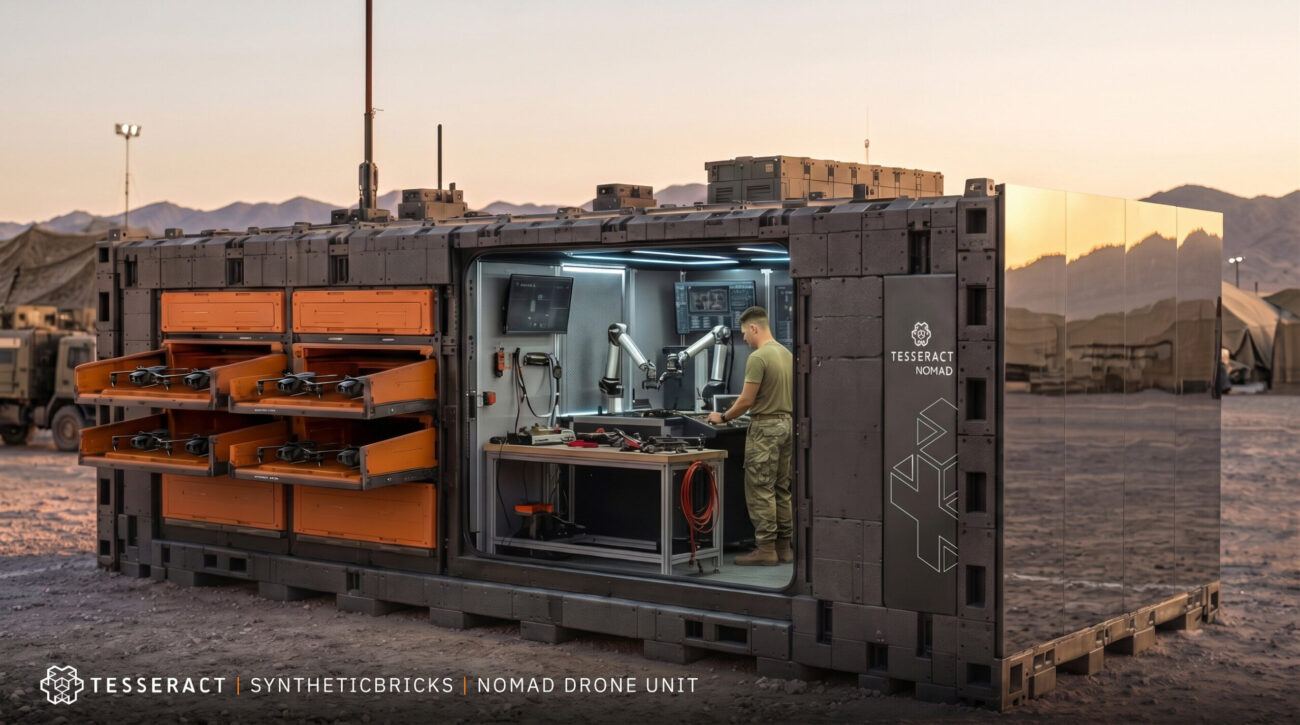
Tesseract Ventures has launched a strategic innovation initiative to build a new class of rapidly deployable infrastructure that blends modular construction with drones, sensors, and software. Announced on October 27, 2026, from Tampa, Florida, the effort centers on Tesseract Synthetic Brick Technology Kits, which pair a synthetic building system from Lok-N-Blok with the company’s own hardware and autonomous systems. The kits are aimed at four sectors: defense, construction, critical infrastructure, and agriculture.
The idea flips the usual approach to field structures. Teams typically start with a steel shipping container, a trailer, or a permanent building and then retrofit it to hold their equipment. With the Tesseract Synthetic Brick kits, the structure and the technology inside it are meant to be engineered together from the very beginning, so each unit is purpose-built for its job instead of being adapted after the fact.
How Tesseract Synthetic Brick Kits Support Drone Operations
Under the proposed setup, Lok-N-Blok would act as a strategic supplier of the modular structural parts, while Tesseract would lead application design, technology integration, customer configuration, software, autonomous systems, deployment, and lifecycle support. Lok-N-Blok’s product is a mortarless interlocking wall system intended to go up faster and stand up well, with easier project review than conventional framing. Tesseract would then shape each finished unit around what a specific customer needs.
Depending on the mission, a kit could carry RF shielding, power, communications gear, sensors, cameras, displays, access control, and edge computing, along with drone storage and launch hardware, robotic fabrication equipment, and Tesseract software. The broader aim of the company’s synthetic brick technology program is to produce systems that can be planned digitally, packed efficiently, and shipped in compact form. Units would then be assembled close to where they are needed, expanded as requirements change, and potentially taken apart and redeployed somewhere else.
That shift in thinking sits at the heart of how the company is presenting the project. John Boucard, Founder and CEO of Tesseract Ventures, described the initiative as a chance to reconsider how physical infrastructure and technology fit together.
“We see an opportunity to rethink the relationship between infrastructure and technology. Instead of putting our technology inside a box that was designed for something else, Tesseract Synthetic Brick Technology Kits allow us to design the structure around the mission. Lok-N-Blok gives us an exciting modular foundation from which we can create intelligent environments for some of the most demanding industries in the world.” John Boucard, Founder and CEO of Tesseract Ventures
Defense, Construction, Infrastructure, and Farm Uses for the Kits
Early concepts for the kits cover four core markets. On the defense side, Tesseract lists Nomad drone operations systems, forward command environments, communications nodes, sensor hubs, Smart Secure Spaces, and Tesseract Forge fabrication and maintenance capabilities. Construction concepts include secure environments, modular NODE guard stations, workforce access-control areas, project command centers, meeting and training spaces, digital plan rooms, and autonomous drone inspection stations.
For critical infrastructure, the plans call for remote operations centers, utility inspection hubs, distributed sensor stations, emergency-response facilities, drone deployment systems, and communications infrastructure. In agriculture, Tesseract Ventures sees uses such as field operations centers, autonomous drone stations, equipment and sensor hubs, communications facilities, and distributed farm intelligence environments. Drone systems turn up in the plans for every one of the four markets.
The kits are also built to grow over time. A single Tesseract Synthetic Brick unit could begin as a fairly small access-control or monitoring station and later expand into a larger, connected secure operating environment as a customer’s needs evolve. Because standardized structural components can be combined with standardized technology packages, new layouts could be created without redesigning an entire system for every deployment.
Tesseract also sees room to develop repeatable technology packages that slot into different structural configurations. Possible examples include Access & Security Kits, Smart Space Kits, Drone Operations Kits, Communications Kits, Sensor Kits, and Forge Fabrication Kits. The company describes itself as an American invention and manufacturing company that builds integrated hardware, software, autonomous systems, artificial intelligence, and command-and-control technologies for the same four sectors the kits are meant to serve.
