

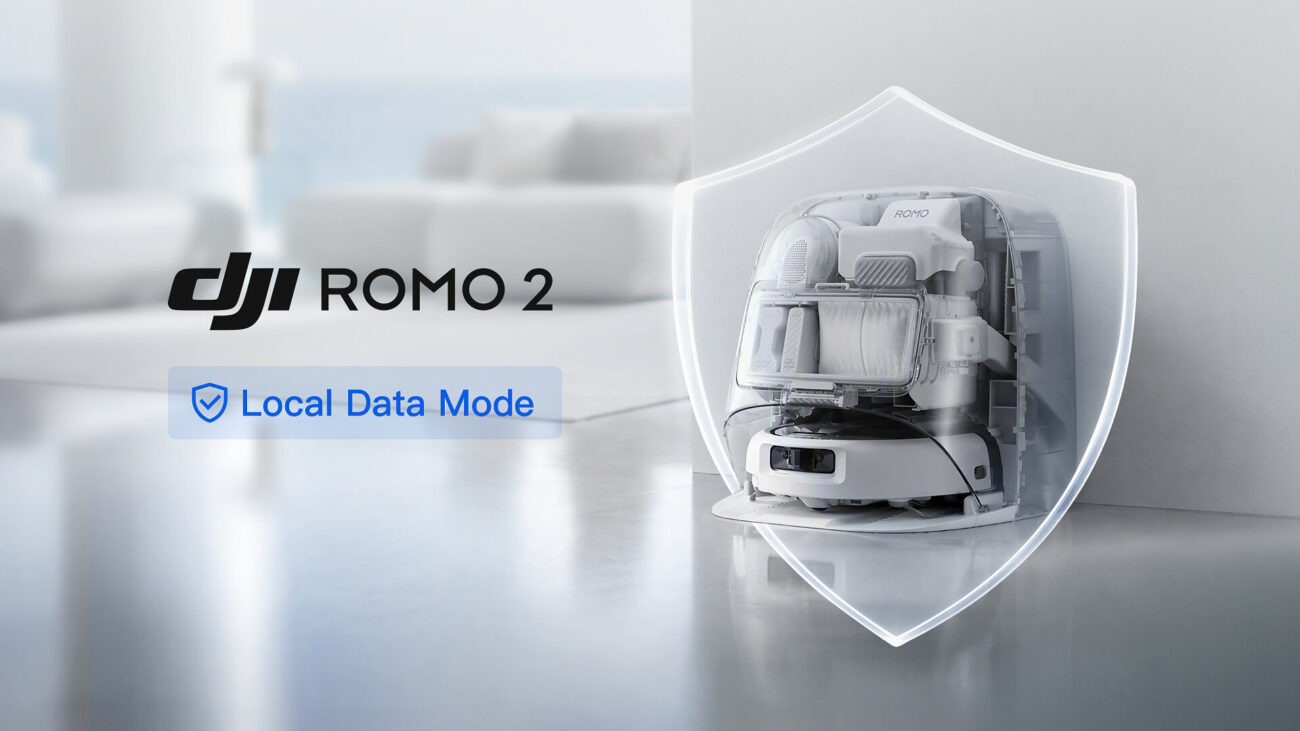
DJI has rolled out DJI Local Data Mode for ROMO 2, its new line of AI robot vacuums, giving owners a way to keep household data off the internet. Announced from Shenzhen, China on October 29, 2026, the setting cuts the DJI Home app’s internet connection so the information a robot gathers is saved and handled on the device itself. DJI describes the feature as an industry first for smart home products.
The idea did not start with vacuums. DJI first developed Local Data Mode for its drones in 2017, and the company says the setting now has close to ten years of proven use in the field. ROMO 2 is the first home robot to receive it, and the machine arrives with an advanced self-cleaning base station and an ultra-wide swing robotic arm. DJI says the launch sets a new privacy standard as the feature moves into a brand new product category.
How DJI Local Data Mode Works on ROMO 2
Setup still needs a short trip online. The first time ROMO is powered on, it connects to the internet to build a map of the home. Once DJI Local Data Mode is switched on, that map stays on the robot instead of going to the cloud. From that point forward, the maps, images, and other information the vacuum relies on to find its way and steer around obstacles are saved and processed locally. According to DJI, this hands owners more control over their data and lowers the chance of outside exposure or access by unauthorized third parties.
Much of ROMO comes straight from the company’s aircraft. The award-winning vacuum line runs on the same technology used in DJI’s flagship camera drones, including built-in high-precision LiDAR and obstacle sensing that works down to the millimeter level. Local Data Mode itself was first built for DJI drone hardware, and the vacuum borrows its sensing from the same aircraft. With DJI Local Data Mode active, navigation and obstacle avoidance keep running without an internet connection, even when the home network goes down. Owners can still start and adjust cleaning cycles and send the robot back to its dock to recharge while staying fully offline.
The Privacy Layers That Surround ROMO 2
DJI Local Data Mode is one part of a broader, multi-layer privacy system that ROMO has used for a long time. That system is built to guard user data at every stage, from the moment it is captured to when it is used, stored, and finally deleted. Access is protected by a passcode, or owners can choose a one-time code sent to their phone number every time they sign in. ROMO 2 also asks owners for clear permission before it can capture, use, or store the data its cleaning functions depend on, covering its camera, voice features, obstacle recognition, and Wi-Fi connection.
Several other safeguards round out the system. A setting called On-Site Photo in the DJI Home app decides whether pictures of detected obstacles are sent to the app for viewing, and turning it off has no effect on how the robot spots or avoids those objects. When ROMO 2 is online, end-to-end encryption shields data while it travels, and when the robot is offline, nothing is uploaded to the cloud. An optional auto-delete tool clears out photos older than 14 days each day, while a factory reset wipes every piece of data from the device for good.
Security Certifications, Matter Support and Rollout
Independent testers have reviewed the product as well. ROMO devices and the DJI Home app are certified to the ETSI EN 303 645 standard, meet EU RED (EN 18031) requirements, and hold UL Solutions Diamond IoT Security certification. In 2026, TÜV SÜD ran a full penetration test on the DJI ROMO P2 and the DJI Home app and found no critical, high, or medium-risk security issues. DJI has sent its products for third-party security audits and certification on a regular basis since 2017, and its DJI Trust Center page for ROMO collects more detail on these protections. The British Standards Institution has also certified DJI to ISO 27701:2025 and ISO 27001:2026.
ROMO now supports Matter, the universal connectivity standard for smart homes. Through Matter, every ROMO device can link with compatible controllers in ecosystems such as Apple Home, Google Home, Amazon Alexa, SmartThings, and Home Assistant, although the available features depend on each platform and its level of Matter support. Owners can add the robot to a supported setup and use compatible controls and automations across those ecosystems.
DJI Local Data Mode is available for ROMO 2 starting October 29, 2026. Owners need to update the robot to the latest firmware that supports the feature, then turn it on under Security Settings in the Device Settings menu of the DJI Home app. DJI says the mode will also reach future ROMO models after its ROMO 2 debut, bringing the same privacy option to the next generation of its home robots.
