

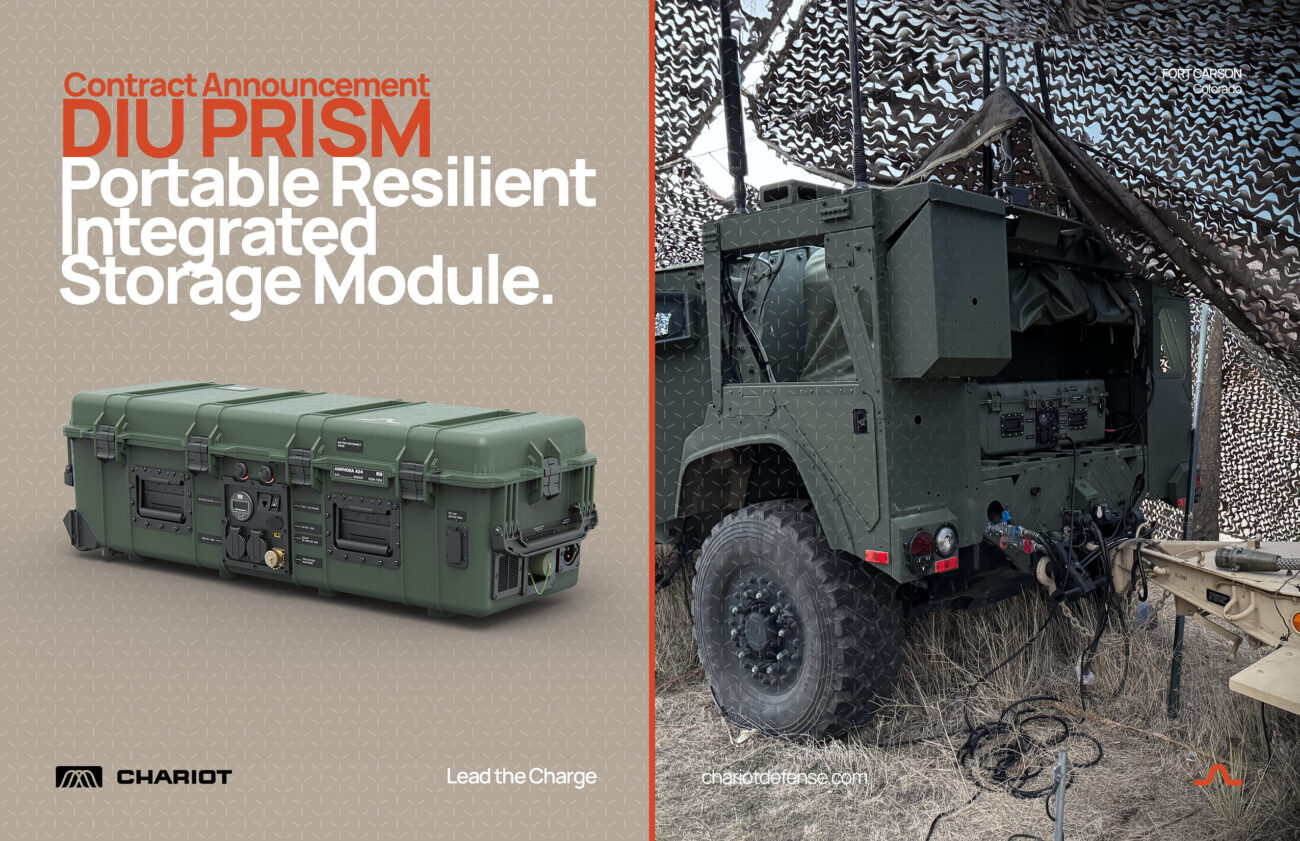
Chariot Defense has been awarded a $7.6 million contract by the Department of War Innovation Unit (DIU) under the Portable Resilient Integrated Storage Module (PRISM) program. The San Bruno, California company will deploy its flagship Amphora power systems to U.S. Army brigades this fall, delivering hybrid power at the tactical edge where drones, sensors, and other electronics all compete for a limited energy supply.
The venture-backed startup describes itself as a defense technology company pioneering next-generation software-defined power distribution for modern warfare. The award, announced on August 24, 2026, places the young firm at the center of one of the military’s most persistent equipment problems: keeping a growing stack of battlefield electronics running without dragging along noisy, fuel-thirsty generators that put soldiers at risk.
“Our mission is to build the power infrastructure layer supporting our troops in modern warfare. Today’s battlefield technology demands integration of intelligent power control and distribution to extend the endurance of constrained energy supplies. Our Amphora systems are a software-defined combat multiplier, enhancing warfighters’ capability to see, sense, strike, and survive in contested environments.” Adam Warmoth, Founder and CEO of Chariot Defense
Why Chariot Defense Is Targeting Battlefield Power
The PRISM contract is structured as a rapid 12-month delivery effort aimed squarely at what the company calls the military’s critical battlefield electric-power crisis. Distributed forces now depend heavily on power-hungry drones, electronic warfare equipment, and edge AI compute networks. Legacy battlefield power, however, still leans on loud and heavy liquid-fuel generators whose constant acoustic and thermal signatures can expose a unit’s position to the enemy. The tactical energy problem has drawn attention from multiple suppliers, with systems such as the Power HIVE mission power node also chasing edge power demands, but Chariot is betting that software control of energy already on the battlefield is the path the Army will take.
“Power availability decides what equipment troops get to bring to the fight. A formation should not have to choose which systems stay powered-up. When that happens, soldiers fight with their hands tied and commanders can’t use the advanced equipment they need to perform their missions. Amphora takes the energy already on the battlefield and puts it under optimized software control, so units run their drones, their EW kit, and their compute from one system seamlessly. We are bringing the commercial power technology revolution directly to defense, enabling operators to run critical systems quietly and reliably, and doing so with a secure supply chain, without dependence on Chinese components.” Adam Warmoth, Founder and CEO of Chariot Defense
Amphora Hybrid Power Built for the Tactical Edge
Amphora hardware integrates with existing tactical generators, solar arrays, and all military vehicles, acting as a bi-directional intelligent power controller that requires no specialized training or maintenance. In combat scenarios, the company reports the platform has demonstrated fuel consumption reductions of up to 60 percent and silent operations stretching up to 36 hours. Chariot positions its Amphora systems as a single hub from which units can run their drones, electronic warfare kit, and computing loads without juggling separate power sources. The hardware also reports tactical energy data into next-generation command and control networks, which allows commanders to optimize power and energy across an entire theater.
The company behind the contract is remarkably new. Chariot Defense was founded in August 2024 by Warmoth, a Stanford-trained engineer who previously scaled the counter-unmanned drone Programs of Record at Anduril Industries. The firm is backed by $41 million in total venture funding, including a $34 million Series A led by Andreessen Horowitz, and is headquartered in the San Francisco Bay Area. Its hardware is NDAA, BAA, and TAA compliant, a point the company highlights as supply chain security becomes a growing factor in defense purchasing decisions.
With deliveries to Army brigades scheduled for this fall, the PRISM award moves Amphora from field trials toward operational use on a compressed timeline. For soldiers running drones and other electronics far from any established grid, the arrival of quiet, software-managed hybrid power will be measured in the simplest of battlefield terms: how long their equipment stays on, and how hard they are to find while it runs.
