

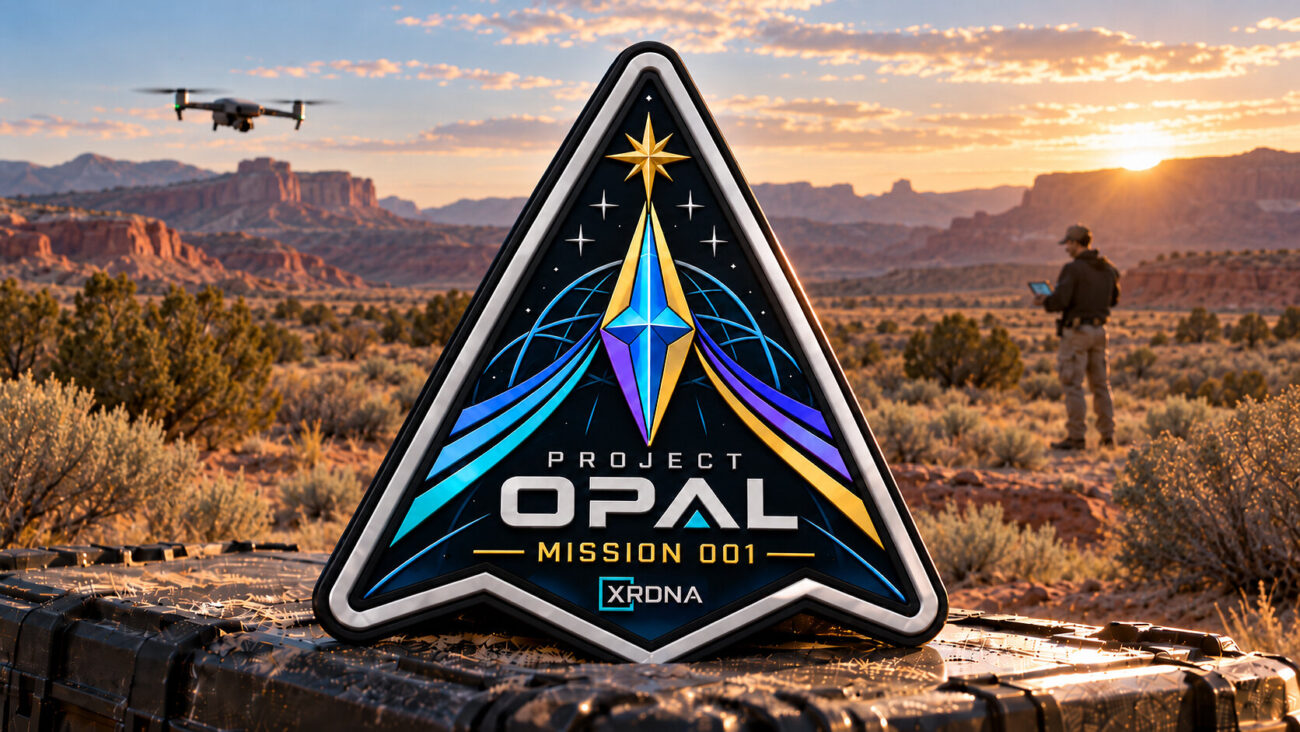
XRDNA Inc. has completed Phase I of Project OPAL, the first mission field test of its Mission Fabric technology. The company announced the milestone from Salt Lake City on October 6, 2026, and described the phase as a success. During the test, drones were linked with personnel, sensor nodes, and other assets inside a single live mission. XRDNA said the initiative moves its persistent identity, sensor fusion, and AI-assisted mission infrastructure into the field.
Project OPAL stands for Operational Prototyping for Advanced Logistics. XRDNA describes itself as a developer of persistent identity and mission-context infrastructure for complex physical and digital systems, and the project is its ongoing field prototyping initiative for Mission Fabric and related technologies. Phase I moved that work past laboratory and software demonstrations and into a live field environment, where the company operated alongside participating mission partners. XRDNA said the development was internally funded.
How Mission Fabric Connected Drones and Sensors in the Field
The first phase tested whether XRDNA could create and maintain a common digital representation of a real mission. That representation had to cover people, places, things, sensors, and operational activities at the same time. To do it, the company built and ran a live mission and manifest inside Mission Fabric. Personnel, field locations, mobile assets, sensor nodes, drones, and simulated downrange payloads were all tied together through persistent identities that the company calls eVa, short for Elastic Vector Addressing.
The approach differs from handling sensor feeds and mission systems as isolated sources of information. As the mission changed, Mission Fabric kept track of how the connected elements related to one another. XRDNA lists four core technologies, which are eVa, SoI (Spheres of Influence), MoE (Map of Everything), and the Mission Fabric platform itself. According to the company, they work together to connect people, places, things, systems, sensors, and autonomous platforms across physical, digital, autonomous, and simulated environments.
MoE served as the AI-assisted interaction layer during the test. It allowed operators to work with the mission context produced by the platform and the underlying eVa identities. Sensor observations and field inputs could be associated with the people, places, and things they represented, which XRDNA said created a continuously evolving mission picture instead of a collection of disconnected data feeds. The field setting also let the company evaluate the system under practical operational constraints. Those constraints included mobile devices, distributed sensors, changing asset relationships, communications limitations, and field-driven mission workflows.
Project OPAL Future Phases and Warfighter Feedback
Charles Adelman, CEO and Co-Founder of XRDNA, called Phase I an important transition for the company. He said the team was not demonstrating the technology against a scripted software environment. Instead, it was used to represent an actual mission as that mission unfolded around the people taking part.
“People moved. Assets moved. Sensors generated observations. Communications changed. Mission relationships evolved. The underlying identity of those elements had to remain persistent throughout all of it. That is exactly the problem Mission Fabric was designed to solve.” Charles Adelman, CEO and Co-Founder of XRDNA
XRDNA intends for Project OPAL to continue as an iterative operational prototyping effort. Future phases are planned to expand the complexity of what gets evaluated in the field. The company named mission scenarios, participating systems, sensor integrations, communications environments, and operational mission workflows as the areas that will grow. Phase I also gave the company field observations and warfighter feedback. XRDNA said that input will inform continued development of Mission Fabric, MoE, eVa, Field View, sensor integration, and its broader mission infrastructure.
The company framed the field test as a necessary validation milestone for its larger vision. That vision is an identity, resolution, and trust infrastructure capable of connecting heterogeneous systems across terrestrial, airborne, space, and simulated environments. By maintaining identity, relationships, authority, and context as missions evolve, XRDNA says it enables continuity across heterogeneous systems and operational domains. The company describes its work as building persistent identity, trust, and mission-context infrastructure for complex systems, and it sums up the goal as mission context without boundaries.
