

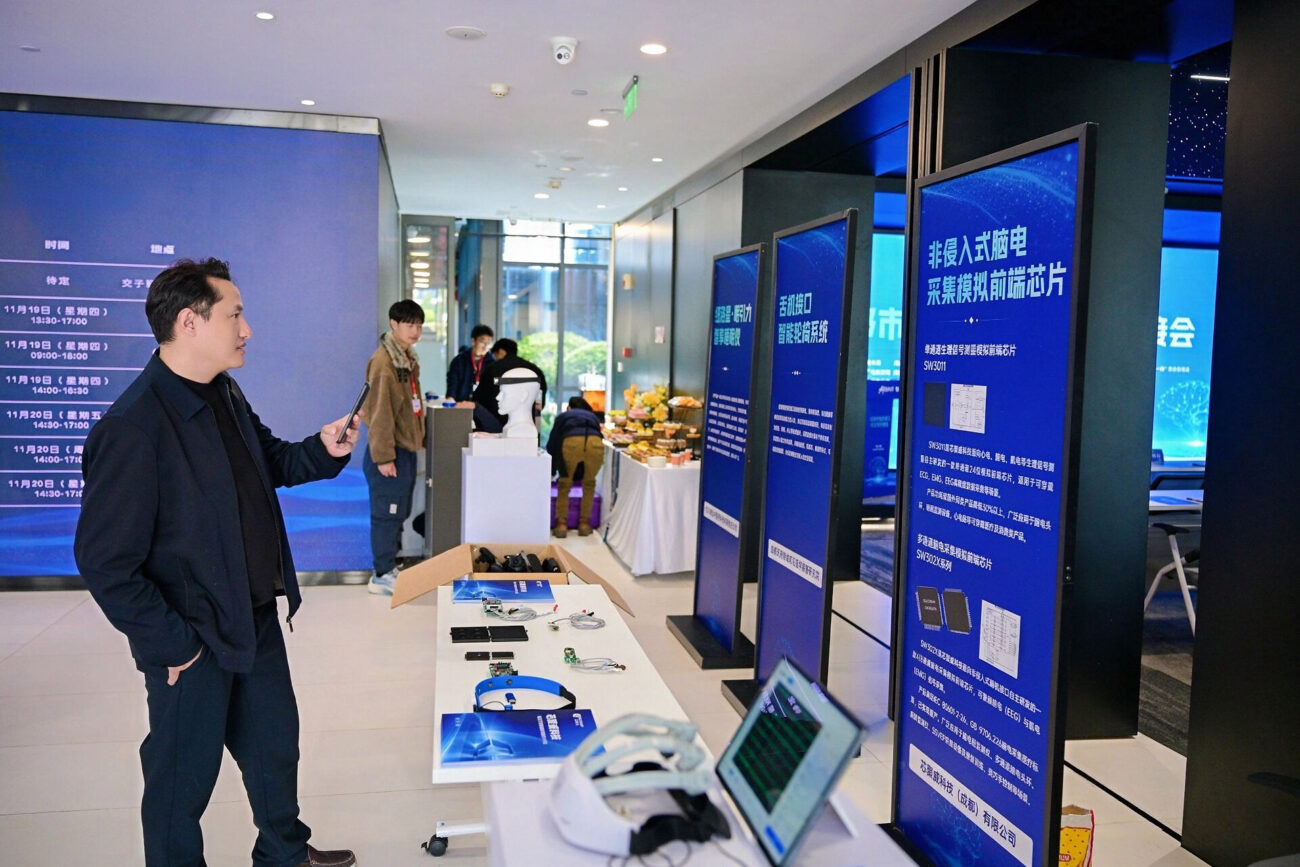
Chengdu, the capital of Sichuan province, has set its sights on becoming the leading center for brain-computer interface (BCI) development in western China. As a step toward that goal, the city has formed a new university-enterprise innovation group, and the Chengdu BCI alliance is intended to build a complete industrial ecosystem around the technology. The alliance was formally launched on November 20 during a matchmaking event organized by the Chengdu Science and Technology Bureau.
The gathering pulled in participants from every corner of the field, including universities, research institutes, hospitals, private companies and government departments. For drone fans, one of the more eye-catching items on display came from Chengdu Wabo Technology, which demonstrated a headband designed to let a wearer control drones with nothing more than their thoughts. That device was one of more than a dozen BCI and related products presented to attendees as the alliance got underway.
How Universities, Companies and Hospitals Will Share the Work
The Chengdu BCI alliance was initiated by Yao Dezhong, a professor at the University of Electronic Science and Technology of China. Yao also directs the China-Cuba Belt and Road Joint Laboratory on Neurotechnology and Brain-Apparatus Communication, and he has built the new group around a closed-loop model. In that model, universities carry out the research, companies turn the results into products, hospitals handle clinical validation, and government agencies support the wider ecosystem that ties those pieces together.
Under the proposal, members will concentrate their core research on brain signal analysis and BCI modeling. The group also plans to produce independently patented innovations along with consumer products that can hold their own in the market. Partners are expected to pool research equipment, experimental data, innovation resources and policy channels, while training people who can work across several disciplines and encouraging cooperation along the full industrial chain.
Yao made the case that Chengdu already has solid footing for this kind of work. He pointed to the city’s large pool of brain science talent, its strength in materials science and its wide range of clinical settings as the main advantages. He also described how the alliance would work alongside government departments, including those responsible for healthcare security and market regulation, to help move BCI technology from the lab toward clinical use.
“The alliance will help all parties find their roles and work together. Through government policy support and coordination with departments such as healthcare security and market regulation, it will clear the bottlenecks between technology and clinical application,” Yao Dezhong, Professor at the University of Electronic Science and Technology of China
A white paper on Chengdu’s emerging BCI industry was also released at the event, and it counts more than 60 BCI companies now based in the city. Lu Jing, deputy director of the China-Cuba joint laboratory, shared an update on the lab’s own progress. According to Lu, components developed at the lab have reached performance levels that lead the domestic field, and the lab has already incubated several technology-intensive companies. Lu added that products aimed at sleep regulation and autism intervention are close to reaching the market.
Drone Headband and Sleep Device Shown at Chengdu BCI Alliance Launch
Hospitals are set to play a central part in the Chengdu BCI alliance. Three hospitals presented clinical application scenarios at the event and said they want to deepen their collaboration with universities and enterprises. Their plan is to speed up the clinical use of BCI technology by opening up clinical research resources and by carrying out prototype validation and product testing. The announcement did not identify the three hospitals by name.
The product showcase gave attendees a direct look at where local developers stand today. Chengdu Wabo Technology presented its headband as a way for users to operate drones through thought alone, which brings the idea of mind controlled drones into a lineup that otherwise leaned toward health and consumer devices. The release did not provide technical specifications for the headband or explain how it translates brain activity into flight commands.
Sleep was the focus of another product on display. Sichuan Jinhong Traditional Chinese Medicine Technology presented a non-invasive sleep headband built on research from Yao’s team. Taken together, the drone headband and the sleep device gave visitors a view of how companies in the city are applying BCI technology to very different everyday uses, as the Chengdu BCI alliance works to move more research out of laboratories and into finished products.
