

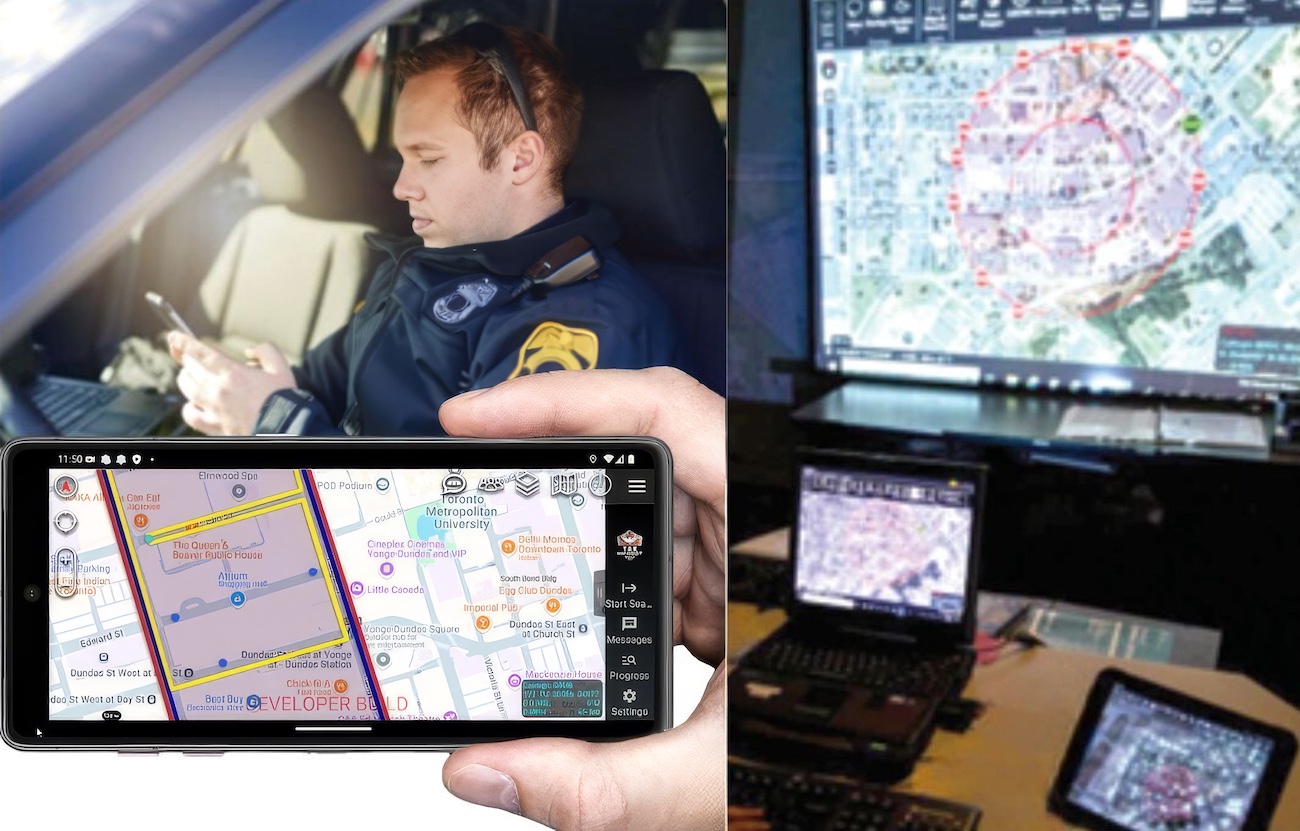
DEFSEC Technologies Inc. has announced the commercial release of DEFSEC Lightning, a cloud-hosted situational awareness platform aimed at first responders across North America. The Ottawa-based defence and security firm unveiled the system on May 6, 2026, positioning it as a digital coordination tool for police, fire, and emergency medical agencies during critical incidents.
The platform is built on the Team Awareness Kit, often shortened to TAK, a software ecosystem already used by the United States and Canadian militaries as well as allied NATO forces. According to the company, its version strips away the deployment complexity that has historically kept civilian agencies from adopting TAK directly. Instead, DEFSEC Lightning runs as a turnkey subscription service that works on smartphones, vehicle systems, and command center workstations without requiring dedicated hardware or local software installation.
How DEFSEC Lightning Coordinates Field Response
At its core, the system gives every officer, paramedic, and firefighter a shared operational map of any unfolding incident. Real-time location tracking, sometimes referred to as Blue Force Tracking, shows where responders and assets sit at any given moment. Encrypted text, voice, photo, and video traffic flow through a single unified interface, which the company describes as a step beyond voice-only radio coordination.
A central feature is Lightning’s ability to fuse encrypted imagery and data from a wide range of sources. That includes drone video feeds, surveillance cameras, body-worn cameras, fixed sensors, and sniper scopes, all overlaid on the same map that every responder can see. The product builds on prior work by DEFSEC in the TAK ecosystem, supporting both military and civilian users. Specialized toolkits ship alongside the main platform, including a Ground Search and Rescue module and a TAK-enabled sniper and surveillance feature called T-SAS that distributes live spotter-scope video across the command chain.
A geofenced incident call-out function lets commanders draw an area on a map, prompting Lightning to instantly message every responder inside the chosen boundary, even those not actively logged in at the time. Additional architecture, design, and security details for the platform are published on the company’s Lightning product page. The company says the platform is also configured with a battery-aware wake-up feature, allowing the system to scale from a 50-officer detachment to a 30,000-officer metro service while keeping device batteries from draining mid-shift.
“The system is designed for simplicity and easy on-boarding, with virtually zero time to value and tools specifically for first responders.” Sean Homuth, DEFSEC President and CEO
Pricing, Markets, and Defence Applications for DEFSEC Lightning
The platform is sold through a subscription model that runs from approximately CAD $15 to $50 per device per month, with the price depending on configuration, scale, and required service response level. The company has already brought on an Ontario border police agency as its first subscription customer, with the official commercial release following that initial deployment.
DEFSEC pegs the addressable market for sworn police officers in the United States and Canada at roughly 779,000 personnel, representing what it estimates as a CAD $140 million to $467 million annual recurring revenue opportunity. Expanding the view to include fire and emergency medical services across the continent, the company calculates a North American total of more than 2.5 million uniformed personnel, which it values at roughly CAD $450 million to over CAD $1.5 billion in annual recurring opportunity.
Beyond civilian agencies, DEFSEC believes the platform has clear applicability in defence settings, citing potential use cases with the Canadian Armed Forces, Reserve units, and joint Arctic operations. Because the system is engineered to work in low-bandwidth environments, it can support coordination between military, law enforcement, disaster relief, and search-and-rescue organizations operating in remote regions. The company also notes that its existing relationships through the ARWEN less-lethal product line, currently deployed across Canadian and U.S. law enforcement and corrections agencies, give it a ready customer base to approach with the new digital offering.
