

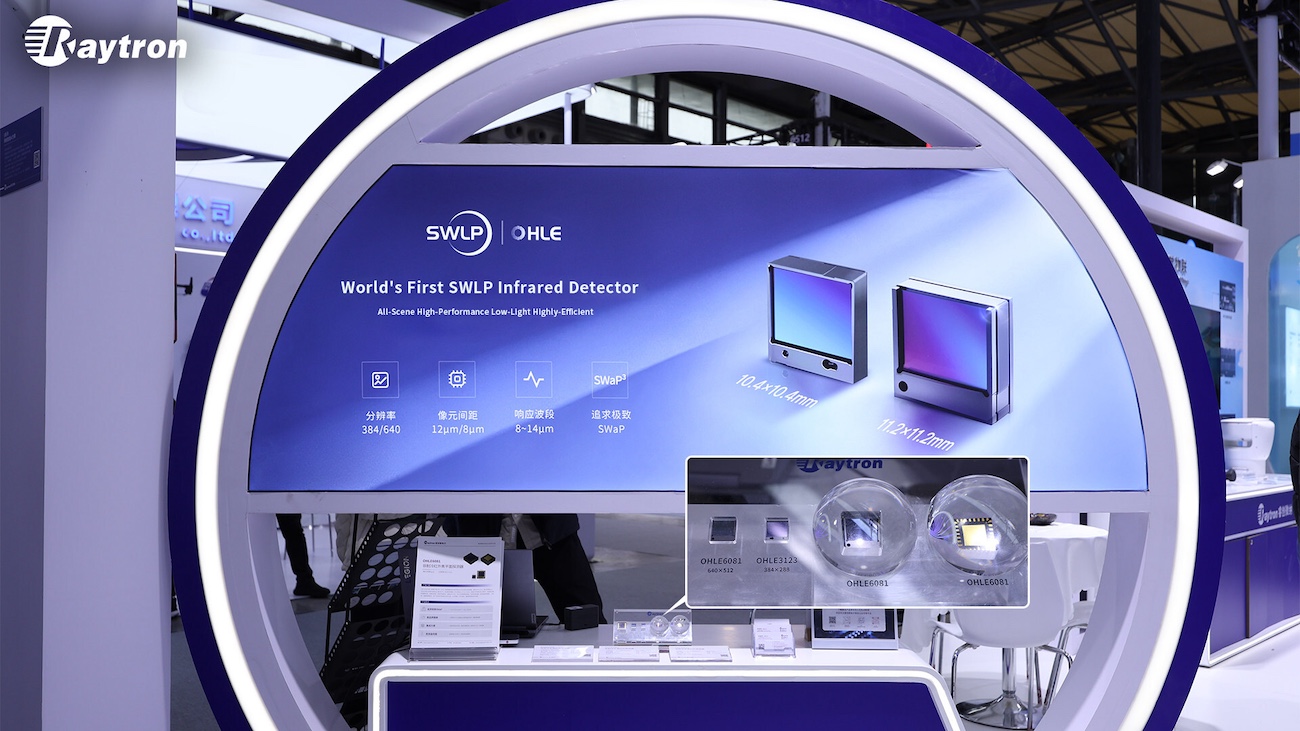
Chinese imaging specialist Raytron used its appearance at LASER World of PHOTONICS CHINA 2026 in Shanghai this week to introduce a new component aimed squarely at the next wave of compact thermal cameras. The new Raytron infrared detector, branded the OHLE6081, is described by the company as the world’s first second-generation uncooled infrared detector built on SWLP wafer-level packaging technology. It is designed to give thermal cameras inside drones, vehicles, and handheld devices a smaller footprint and a lower bill of materials without giving up imaging performance, a balance that has become increasingly important as thermal sensing pushes into mainstream consumer and industrial applications.
The OHLE6081 pairs an 8 micron pixel pitch with a 640 by 512 resolution, all packed into an 11.2 by 11.2 millimeter footprint. Raytron is targeting customers in commercial drone manufacturing, industrial thermography, outdoor night vision, and advanced driver assistance systems. The launch builds on Raytron’s earlier work in small pixel pitch detectors, including what the company has previously claimed as the world’s first 8 micron and 6 micron infrared detector chips. With this new device, Raytron is pushing past pixel size and tackling the packaging side of the equation, where bulky housings and cleanroom-only assembly have historically slowed adoption beyond defense and premium industrial markets.
Why the New Raytron Infrared Detector Matters for Drones
For drone makers, the appeal of a sub-gram thermal core that can be reflowed onto a circuit board using standard surface mount technology lines is significant. Every gram of weight saved on a payload directly extends flight time or leaves room for additional capabilities like batteries, optics, or extra UAV sensors. Raytron describes the OHLE6081 as weighing under one gram, with power consumption below 120 milliwatts, which fits the strict size, weight, and power envelope that small commercial UAVs operate within. That kind of efficiency matters most when integrators are trying to squeeze thermal capability into multi-sensor gimbals or fixed-mount payloads on lightweight quadcopters.
Image quality has not been sacrificed for that compactness, according to Raytron. The detector is built around a vanadium oxide sensor with a noise equivalent temperature difference under 50 millikelvin, which the company says delivers low-noise imaging suitable for precise target detection. Resolution lands on the 640 by 512 figure that is now considered the mainstream standard for thermal imaging across security, inspection, and aerial platforms. The detector also covers a wide measurement window stretching from minus 40 degrees Celsius to 800 degrees Celsius, opening it up to industrial customers monitoring high-temperature equipment without needing to step up to a more expensive cooled detector.
SWLP Packaging Targets Mass Production Bottlenecks
The technical headline of the announcement is the move to SWLP, or wafer-level packaging, in a dual-layer configuration. Traditional uncooled thermal detectors typically rely on Class 100 cleanroom environments and complex integration steps that limit scalability. Raytron’s approach allows assembly in standard environments without that cleanroom dependency, and it is compatible with the same surface mount technology lines that handle consumer electronics components. According to the Raytron infrared product line, the new packaging cuts module size by roughly 74 percent compared with a conventional 640 by 512 ceramic-packaged thermal detector, which in turn lowers cost and shortens delivery cycles for OEM customers.
That manufacturing pivot connects to three trends Raytron sees reshaping the broader infrared market. The first is steady miniaturization, with handheld thermal imagers, portable instruments, and commercial drones all facing tighter size, weight, and power constraints than fixed installations ever did. The second is a push for cost-effective manufacturing, since cleanroom-bound processes have long been viewed as a barrier to scale beyond defense and high-end industrial markets. The third is rising performance expectations, where 640 by 512 resolution is now treated as baseline alongside higher demands on temperature range and overall image fidelity.
Raytron framed the OHLE6081 as a building block aimed at OEM partners rather than a finished consumer product, and the company is positioning it for use across UAV payloads, driver assistance modules, outdoor night vision optics, and industrial inspection gear. Pricing details and broad availability dates were not disclosed in the announcement. With second-generation uncooled detectors moving toward SMT-compatible packaging, drone designers and other OEM integrators may soon have more freedom to build thermal capability into smaller and cheaper end products without overhauling their existing manufacturing lines.
