

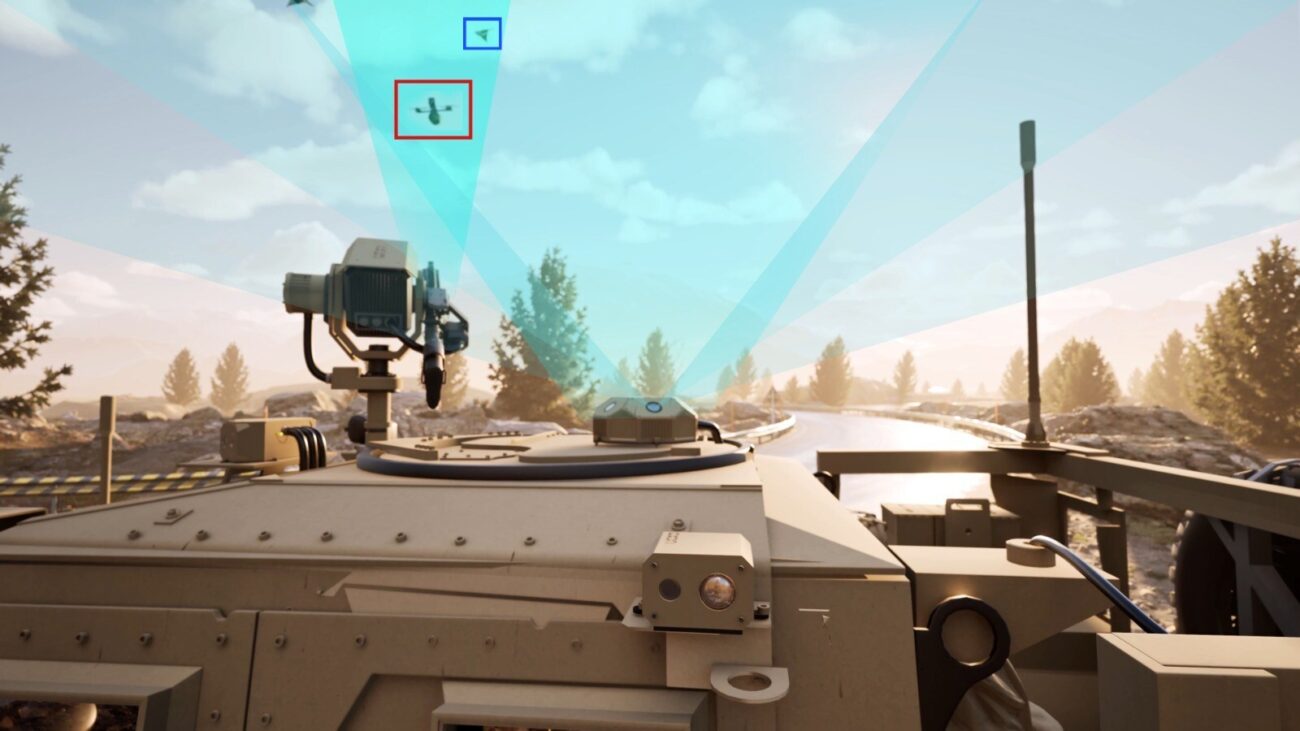
Axon Vision has successfully completed operational demonstrations for its EDGE ClearSky drone detection system, marking a major milestone in the platform’s path toward wider deployment. The Israeli defense AI company, which trades on the Tel Aviv Stock Exchange under the symbol AXN, announced that a leading defense force conducted an extensive operational assessment of the system against a range of first-person view (FPV) drone threats. The evaluation focused on aerial dangers targeting maneuvering forces, an area that has become one of the most pressing operational problems in modern combat environments.
The successful evaluation supports the continued operational maturation of the platform, which sits within Axon Vision’s broader EDGE AI family of computer vision solutions. The system is designed to detect, identify, and support interception of aerial threats directly from armored platforms. By placing this capability on the vehicle itself rather than relying on distant sensors, the company aims to give crews the rapid response options they need when small drones appear with little warning. The latest evaluation provides further evidence that the design choices behind the system can hold up under realistic combat scenarios.
How the EDGE ClearSky Drone System Works
The platform combines thermal sensing with AI-driven real-time processing. This pairing allows the system to spot incoming threats quickly and pass that information to onboard weapon systems for engagement. The result is an automated closed-loop detect-to-intercept cycle, which compresses the time between identifying a target and responding to it. With FPV drones becoming faster, smaller, and more numerous on the battlefield, that shortened timeline is increasingly critical for force protection on the move. By integrating thermal imagery and AI processing on the vehicle itself, the system avoids the delays that come from sending data to remote servers and waiting for a response.
FPV drones have emerged as a defining feature of modern warfare, used for both reconnaissance and direct attacks. Maneuvering forces face new risks because these small aircraft can approach low and fast, often beneath traditional air defense coverage. Other counter-UAS platforms address the problem through different sensing methods, including acoustic-based drone detection systems that listen for rotor signatures. The EDGE ClearSky drone system instead combines thermal imaging with computer vision to track aerial targets based on heat patterns and visual cues, working in conditions where other sensors may falter.
Leonardo DRS Partnership and Future Trials
Axon Vision is not pursuing this market on its own. The company maintains a strategic partnership with Leonardo DRS to supply counter-UAS systems for the U.S. military market. As part of that cooperation, Axon Vision has already received an initial order for demonstrator systems that provide end-to-end detection and interception capabilities for airborne threats requiring rapid response. The arrangement gives Axon Vision a route into U.S. defense programs through an established American partner, while Leonardo DRS gains access to AI technology that has already been tested in combat conditions. More details about the broader range of vision-based AI products are available on the Axon Vision website, which outlines the EDGE AI family and its applications across armored platforms.
“We are very pleased with the results of this operational evaluation and view this as an important milestone in the operational maturation of EDGE ClearSky. With EDGE ClearSky, Axon Vision is addressing one of the most significant operational challenges facing maneuvering forces in today’s modern combat environments. As FPV drone threats increasingly become a defining feature of modern warfare, strong, rapid, and reliable detection capabilities are no longer optional — they are an operational necessity. We believe EDGE ClearSky represents an important addition to Axon Vision’s AI-driven operational portfolio.” Neri Zin, CEO of Axon Vision
The EDGE ClearSky drone platform will continue progressing through its operational maturation phase as Axon Vision runs additional trials with military customers in key strategic markets around the world. The system’s modular, platform-agnostic architecture is designed to integrate with both legacy and next-generation vehicles, manned or unmanned, without requiring changes to existing infrastructure. Axon Vision develops AI-driven operational systems trusted by the Israel Defense Forces and other international customers, and the company is now positioning itself for a larger role in the global market for AI-powered counter-drone protection.
