

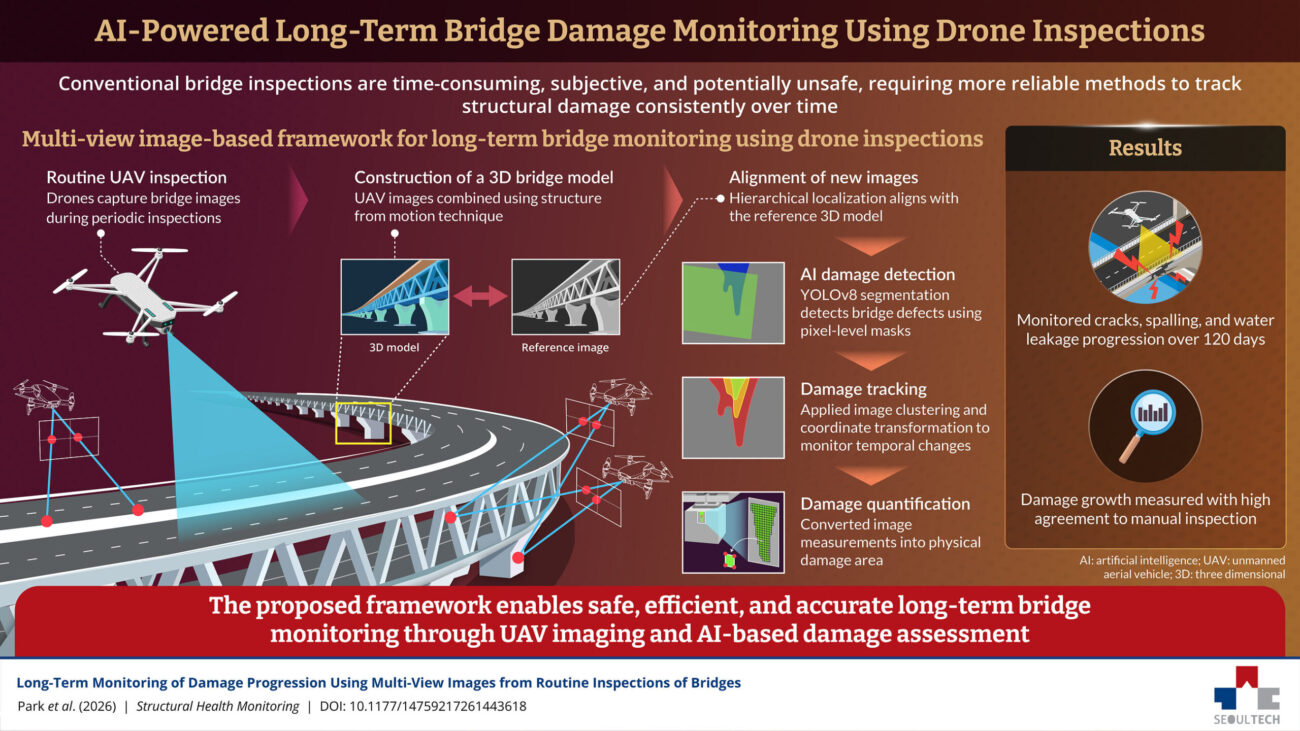
Researchers in South Korea have built an artificial intelligence framework that turns routine SEOULTECH drone inspection photographs into a running record of how bridge damage grows over time. The team at Seoul National University of Science and Technology, led by Assistant Professor Hyunjun Kim, paired computer vision with three dimensional bridge reconstruction and satellite positioning data so engineers can track the same crack across separate flights taken months apart. The findings were made available online in the journal Structural Health Monitoring on April 27, 2026.
Bridges form a critical part of road networks, and they steadily accumulate cracks, concrete spalling, and water leakage as traffic loads, weather, and environmental exposure take their toll. Keeping tabs on that decay has traditionally meant sending crews out for visual checks, work that is labor intensive, costly, and at times hazardous. Automated computer vision has already made parts of the job more practical. The sticking point has been comparison, since photographs captured months apart are rarely taken from the same position or viewing angle, which makes lining up one inspection against the next unexpectedly difficult.
How SEOULTECH Drone Inspection Photos Feed a Single 3D Model
The method begins with the first inspection, whose images are used to build a three dimensional model of the bridge. Pictures gathered on every later visit are then matched automatically to that original model through hierarchical localization and image clustering, allowing the software to recognize that a defect recorded in one month is the same defect it logged earlier. The matching holds even when the camera sat closer, farther back, or at a different angle. Global Navigation Satellite System data is folded in to convert measurements taken in pixels into real world dimensions.
That structure separates the approach from conventional practice, which either examined damage at one fixed point in time or required a new three dimensional model to be rebuilt for each round of work. Relying on a single reference model instead keeps results consistent between successive bridge inspections and sharply reduces the computing effort demanded by long term assessment. The researchers note the method suits relatively flat structural components best, and accuracy may vary on highly curved surfaces, though it covers most elements encountered on a routine visit.
Field Results From a 120 Day Test on a Working Bridge
Seoul National University of Science and Technology, which houses a dedicated civil engineering department, validated the framework over 120 days on an in service prestressed concrete bridge using SEOULTECH drone inspection imagery. The system tracked the progression of cracks, spalling, and water leakage across the whole period despite shifts in camera viewpoint. Measured against conventional manual measurement, the largest error in damaged area came to 4.61 percent.
Kim framed the problem as one of change rather than detection, arguing that spotting a defect is only the starting point for engineers responsible for a structure’s condition over many years. The value, in his description, lies in watching how a flaw behaves between visits.
“Long-term structural monitoring requires more than simply detecting damage, it requires understanding how that damage evolves. Our framework allows engineers to visualize damage progression and measure its severity using images collected during routine inspections.” Dr. Hyunjun Kim, Assistant Professor, Seoul National University of Science and Technology
The team suggests the results point toward predictive maintenance, an approach that would let transportation agencies act on damage trends rather than waiting for the next scheduled report to reveal a problem. With aging infrastructure and mounting maintenance demands pressing on budgets, the researchers argue that the work could improve public safety while trimming inspection and repair costs over the long run. Kim tied that outcome directly to the decisions engineers face when they weigh repair against replacement.
“We believe this framework can help engineers make more informed maintenance decisions and contribute to extending the service life of critical infrastructure.” Dr. Hyunjun Kim, Assistant Professor, Seoul National University of Science and Technology
Looking ahead, the group sees room to adapt the technique beyond road spans to other categories of infrastructure, including tunnels, dams, and elevated rail systems. The original paper, titled Long-term monitoring of damage progression using multi-view images from routine inspections of bridges, appears in Structural Health Monitoring. Because a SEOULTECH drone inspection cycle already produces the photographs the framework needs, the data collection step fits into work that agencies carry out anyway.
