

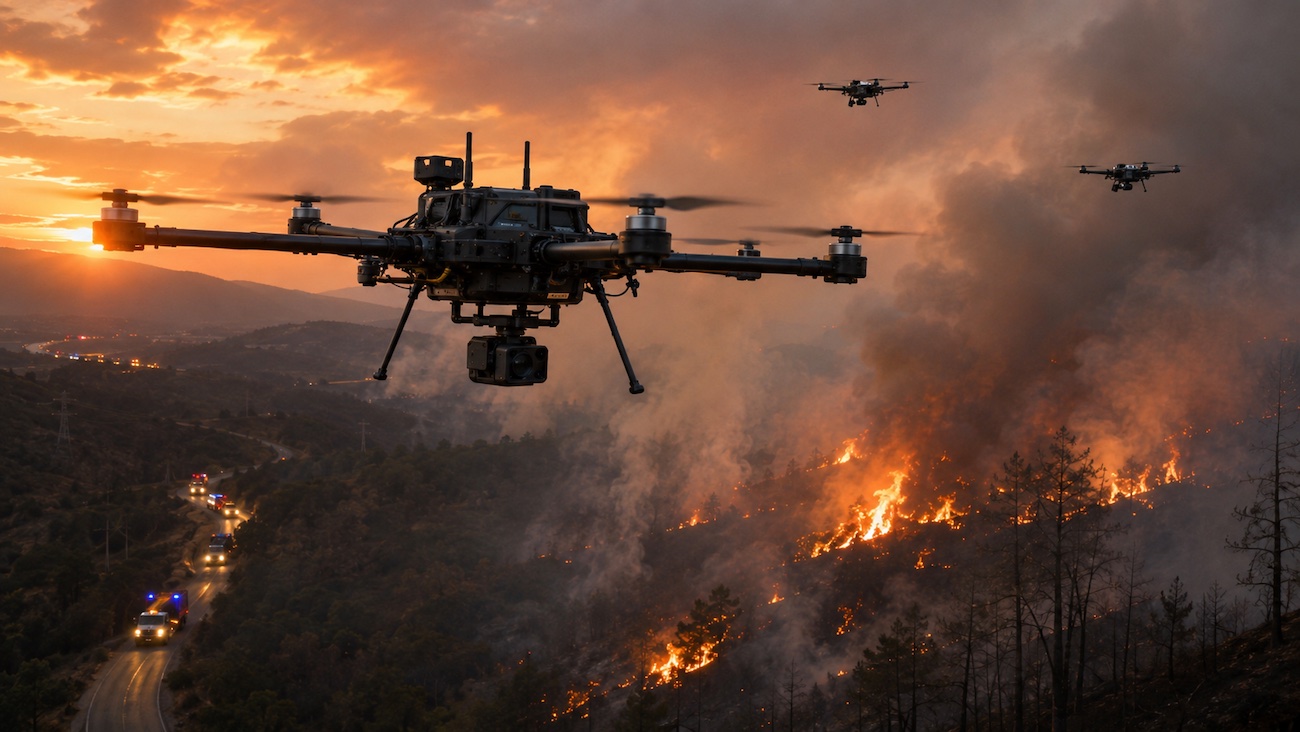
ZenaTech drone patents are the latest sign that wildfire response is moving into the sky. The company, which trades on the NASDAQ under the ticker ZENA, announced that five United States provisional patents have been filed covering a portfolio of acoustic fire suppression and aerial wildfire assessment technologies. The filings are intended for integration with the drone platform built by its ZenaDrone subsidiary, where soundwave-based fire management tools mounted on the ZenaDrone 1000 are designed to support rapid initial attack and strengthen emergency response alongside traditional ground firefighting.
The timing lines up with a broader shift in how agencies handle wildfires, which are growing in frequency, intensity, and containment cost. Rather than depending only on crewed aircraft or putting firefighters in harm’s way, response teams can send drones out quickly to spot new outbreaks, find hot areas, track fire movement, and stream live video back to command centers. Drones can also fly at night when conventional aircraft sit on the ground, and market watchers expect the firefighting drone sector to expand from roughly $2.5 billion today to more than $8 billion by 2032.
ZenaTech Drone Patents Center on Acoustic Fire Suppression
Acoustic fire suppression is a newer approach that uses low-frequency sound instead of water, foam, or chemicals to disrupt a flame at its source. Because nothing is sprayed or discharged, the method can work in places where conventional suppression cannot, such as electrical substations, data centers, archives, battery storage sites, and home ember defense. The company sees room to grow into aviation, marine, and industrial fire safety as well, and believes that whoever first engineers the technology to perform at real-world range and scale could gain a first-mover position in a largely untapped category.
“Wildfires are one of the most urgent and costly natural threats facing communities today and we believe autonomous aerial drone technology has an important role to play in how they’re detected, contained, and extinguished. Our R&D engineering teams are developing proprietary acoustic-based suppression and assessment technologies for the ZenaDrone 1000, an approach we believe can complement, and over time, help reduce reliance on traditional water- and chemical-based methods, while keeping firefighters farther from the most dangerous conditions. We believe a coordinated swarm approach could also extend acoustic suppression’s effective range and coverage well beyond what a single drone can achieve today, potentially advancing the technology from short-range, lab-scale results toward broader, real-world perimeter defense.” Shaun Passley, Ph.D., CEO of ZenaTech
Inside the ZenaDrone 1000 Wildfire Platform
The ZenaDrone 1000 is a 7 foot by 12 foot multifunction autonomous AI drone that can carry up to 40 kg of payload, including acoustics technology, and it is capable of operating in coordinated swarms. The ZenaTech drone patents are meant to pair that airframe with the new acoustic payloads. It can be fitted with thermal imaging and LiDAR sensors and engineered to combine detection, targeting, and suppression in a single autonomous system for rapid initial attack in wildfire-prone regions, including areas near critical infrastructure, energy facilities, and government lands. Coverage of drone-based wildfire detection elsewhere in the industry shows how quickly aerial fire technology is maturing.
ZenaTech plans to keep advancing the research, engineering, and field testing of the wildfire suppression technology throughout 2026 as it works toward future commercial and government pilots, and additional announcements are posted in the company’s newsroom as milestones are reached. The economic case behind the effort is stark, since climate-exacerbated wildfires cost the United States between $394 billion and $893 billion each year according to the U.S. Congress Joint Economic Committee, and the January 2025 Los Angeles wildfires alone caused an estimated $250 to $275 billion in damage. Grand View Research projects the global firefighting drone market will grow from $1.2 billion in 2024 to nearly $2.8 billion by 2033.
Other Wildfire Aviation Moves Across the Market
ZenaTech is not the only company positioning for this demand. Bridger Aerospace, one of the nation’s leading aerial firefighting companies, recently secured a $58 million contract with Texas A&M Forest Service to acquire, modify, and deliver three King Air 360 multi-mission aircraft over the next three years. The award follows a $257 million Texas appropriation for wildfire suppression aircraft after the state responded to 5,187 wildfires that burned more than 1.3 million acres in 2024.
Elsewhere, San Diego County completed $12 million in renovations at the Ramona Airbase and is working with Perimeter Solutions to apply PHOS-CHEK long-term fire retardant along high fire-risk county roads for the sixth straight year. Lockheed Martin, PG&E, Salesforce, and Wells Fargo also launched EMBERPOINT, a venture that will pair artificial intelligence, autonomous systems, and integrated command-and-control tools to help first responders detect fires earlier and coordinate their efforts. Taken together, the activity points to a wildfire technology market where autonomous aircraft are now a central part of the plan.
