

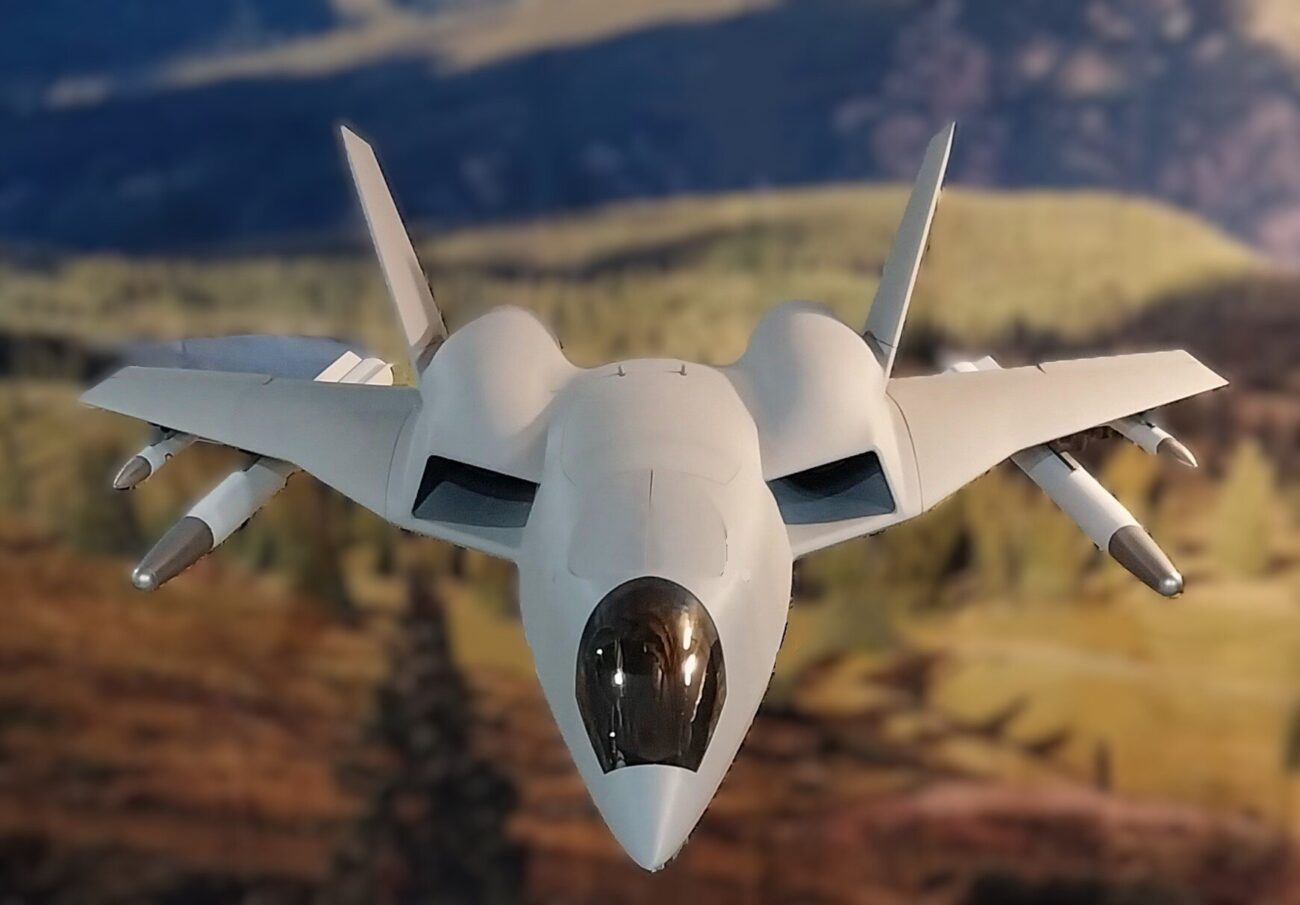
SkyDefense CobraJet has been unveiled as an AI-powered VTOL counter-swarm interceptor jet built to take on hostile drones at high speed. SkyDefense, Inc., headquartered in Brighton, Colorado, announced the tactical multirole aircraft on July 6, 2026. The autonomous jet is engineered to detect, identify, track, and neutralize enemy drones, and it can run on battery power or turbojet power depending on the configuration. The unveiling positions the platform as a direct answer to the growing threat that hostile unmanned aircraft pose around the world.
The jet is aimed at defending critical infrastructure, borders, airports, military bases, and public venues from drone threats. It comes in five trijet versions, labeled V4, V6, V8, V10, and VT10, and every model is built around a 3D-printed carbon-fiber modular core structure the company calls the nucleus. Vertical takeoff and landing capability, paired with thrust-vectoring nozzles, gives the aircraft the agility needed to chase down and defeat multiple fast-moving, evasive unmanned aerial systems using its on-board air-to-air weapons.
SkyDefense CobraJet Interceptors Built for Low Cost
Two propulsion options define the performance envelope. Electric duct fan motors powered by high-energy density solid-state batteries push the jet to 360 kph, or 225 mph, while a hybrid configuration with gas-powered turbojets raises the top speed to 560 kph, or 350 mph. An AI-enabled autopilot works with NDAA-compliant electro-optical and infrared cameras and other advanced sensors so the CobraJet platform can fly autonomously day and night in extreme weather. For short-range missions, operators can also fly the jet by manual remote control with AI assist.
The weapons package centers on affordable interceptors rather than expensive missiles. A PYTHON electro-mechanical launcher fires 18mm COPPERHEAD rounds, patented 40mm CUDA guided rounds that reach Mach 0.5, and 45mm VIPER solid-propellant guided missiles that hit Mach 1.0 and carry kinetic or non-kinetic payloads. SkyDefense says these munitions can disable or destroy Group 1, 2, and 3 UAVs, fiber-optic FPV drones, jet-powered drones, and full UAV swarms with a low probability of collateral damage. The focus on affordable mass echoes the thinking behind the Pentagon’s Replicator program, which has pushed for large numbers of low-cost unmanned and counter-unmanned systems. Nick Verini, President of SkyDefense, Inc., explained how the company plans to keep those munitions cheap.
“Our CobraJet™ on-board munitions are in fact low-cost attritable air-to-air drone interceptors that can be produced at scale in thousands per month using 3D printing and other efficient workflow methods without sacrificing quality.” Nick Verini, President of SkyDefense, Inc.
At the top of the lineup, the V10 and hybrid VT10 carry a 10 ft wingspan along with longer flight time and a heavier payload capacity. These larger models can also perform as a drone mothership, hauling high-speed attritable low-cost drone interceptors in an internal weapons bay and under the wings.
VRAM Command System and the Road to Production
Controlling the aircraft is SkyDefense’s command system, known as VRAM, short for Visual Realtime Area Monitoring. The portable laptop operating system pairs AI-powered data analysis with a control interface that keeps human operators in the decision-making loop. Anti-jam features, including AI-assisted visual navigation called SmartVision and satellite communication through Starlink and Starshield, allow the jet to keep working in contested electromagnetic environments. Designed and manufactured in the USA, the aircraft can deploy in minutes from mobile platforms such as trucks, ships, or other aircraft, and VRAM can also integrate with long-range command-and-control systems and ground-based sensors.
The company also frames the jet as one layer in a broader defense network. Short-range man-portable CUDA guided rounds fired from 40mm M32 or M79/M203 launchers, along with surface-to-air 55mm RAPTOR guided missiles that fly at Mach 1.0 and can be rail or tube launched, are designed to catch any drones that slip through the distributed area defense.
Counter-UAS field tests with the jet and VRAM are planned for the fourth quarter of 2026 at a UAS test site, and production is scheduled to begin in the first quarter of 2027. That timeline would move the SkyDefense CobraJet from public unveiling to the production line in under a year.
