

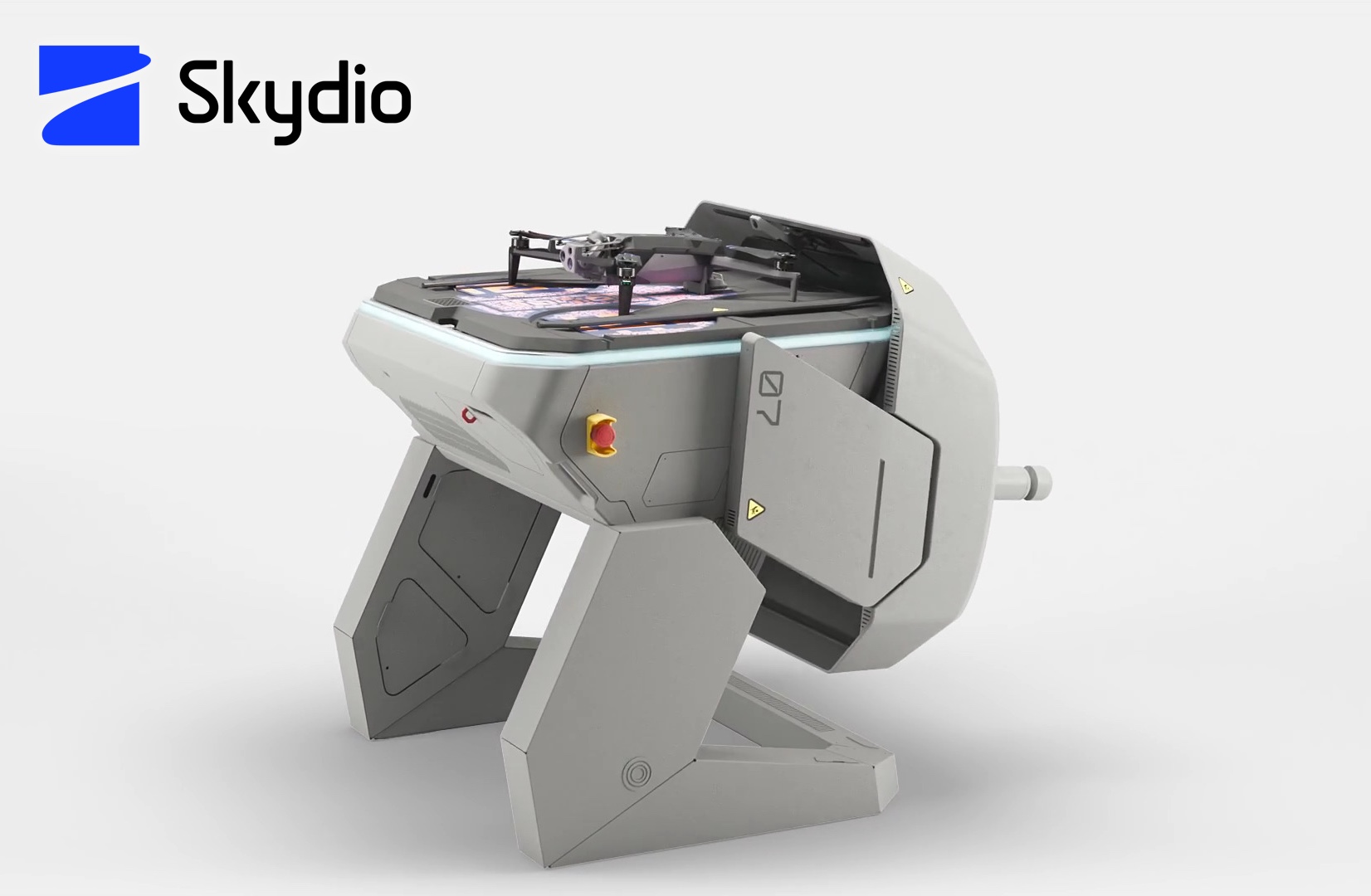
Skydio has announced an order exceeding $9 million from U.S. Air Forces Central (USAFCENT) for its Dock and X10 drone systems. The contract will bring autonomous drone security to U.S. airbases across the Middle East, marking one of the largest deployments of its kind for international base protection by the U.S. Air Force. USAFCENT serves as the air component of U.S. Central Command (USCENTCOM).
The deal represents the first time Skydio’s dock based autonomous capability has been applied at scale for an overseas force protection mission. Deployed at strategic positions across airbases, the Skydio Docks will enable fully remote operation, launching X10 drones in under 20 seconds to patrol, verify, and respond to security threats. A single operator can manage multiple drones at the same time, maintaining a shared operating picture across an entire installation while reducing the number of personnel required on the ground.
How the Drone Security System Works
When integrated sensors detect a potential threat, the drones launch immediately and stream live high definition and thermal video to the Base Defense Operations Center (BDOC). They maintain continuous visual contact with the situation until the incident is fully resolved. This combination of autonomous launch, real time video, and persistent coverage allows security forces to monitor large areas with fewer resources deployed in the field.
“Skydio has supported the U.S. military for years with powerful small unmanned aircraft systems operated directly by Airmen for intelligence, surveillance, and reconnaissance. This contract ushers in a new era of remotely operated solutions. Skydio’s Dock-based capability is already deployed across hundreds of state and local agencies nationwide. We’re proud to bring this proven solution to the U.S. Air Force to help keep Airmen safe.” Justin Jordan, Vice President of Federal Sales, Defense, and Critical Infrastructure at Skydio
Jordan added that the deployment represents the future of installation security. The system builds on Skydio’s existing presence within the Air Force. The Skydio X10D is already the most widely deployed Group 1 UAS for USAF Security Forces. It has been selected as the small UAS of choice for Air Combat Command Tactical Air Control Party Specialists and PACAF Security Forces. Additionally, the company previously received a multi million dollar, multi order delivery contract for USAF Explosive Ordnance Disposal units.
The USAFCENT order extends that footprint into persistent base infrastructure, moving beyond handheld drone operations into a fully networked, dock based base security model. This shift from operator launched flights to automated, always ready systems marks a significant change in how the Air Force approaches perimeter defense and threat response overseas.
Skydio’s Growing Drone Security Role Across the Military
This latest contract adds to a rapidly expanding relationship between Skydio and the U.S. Department of Defense. The company says it is trusted by every branch of the U.S. military and the armed forces of 29 allied nations. Its products are designed, assembled, and supported entirely in the United States, with all drones and docking systems produced at Skydio’s manufacturing facility in Hayward, California. The company recently secured a $52 million order from the U.S. Army for X10D systems, which was the largest single vendor tactical drone order in Army history.
Founded in 2014, Skydio has positioned itself as the leading American drone manufacturer with a focus on autonomous flight technology. The company uses artificial intelligence to build drones that are designed to be easier to operate, safer to fly, and more capable in complex environments. Skydio drones are currently trusted by more than 3,800 agencies and organizations spanning the U.S. military, public safety, and critical infrastructure sectors.
The USAFCENT deployment is notable because it transitions the Air Force from using small drones as hand launched tools for individual missions to deploying them as persistent infrastructure woven into the daily drone security operations of a base. Rather than relying solely on human patrols or fixed cameras, the dock based system offers a response capability that is always charged, always ready, and able to reach remote corners of an installation within seconds of an alert. For the Air Force, the contract signals a broader commitment to integrating autonomous systems into routine force protection, particularly in overseas environments where threats can emerge quickly and manpower is at a premium.
