

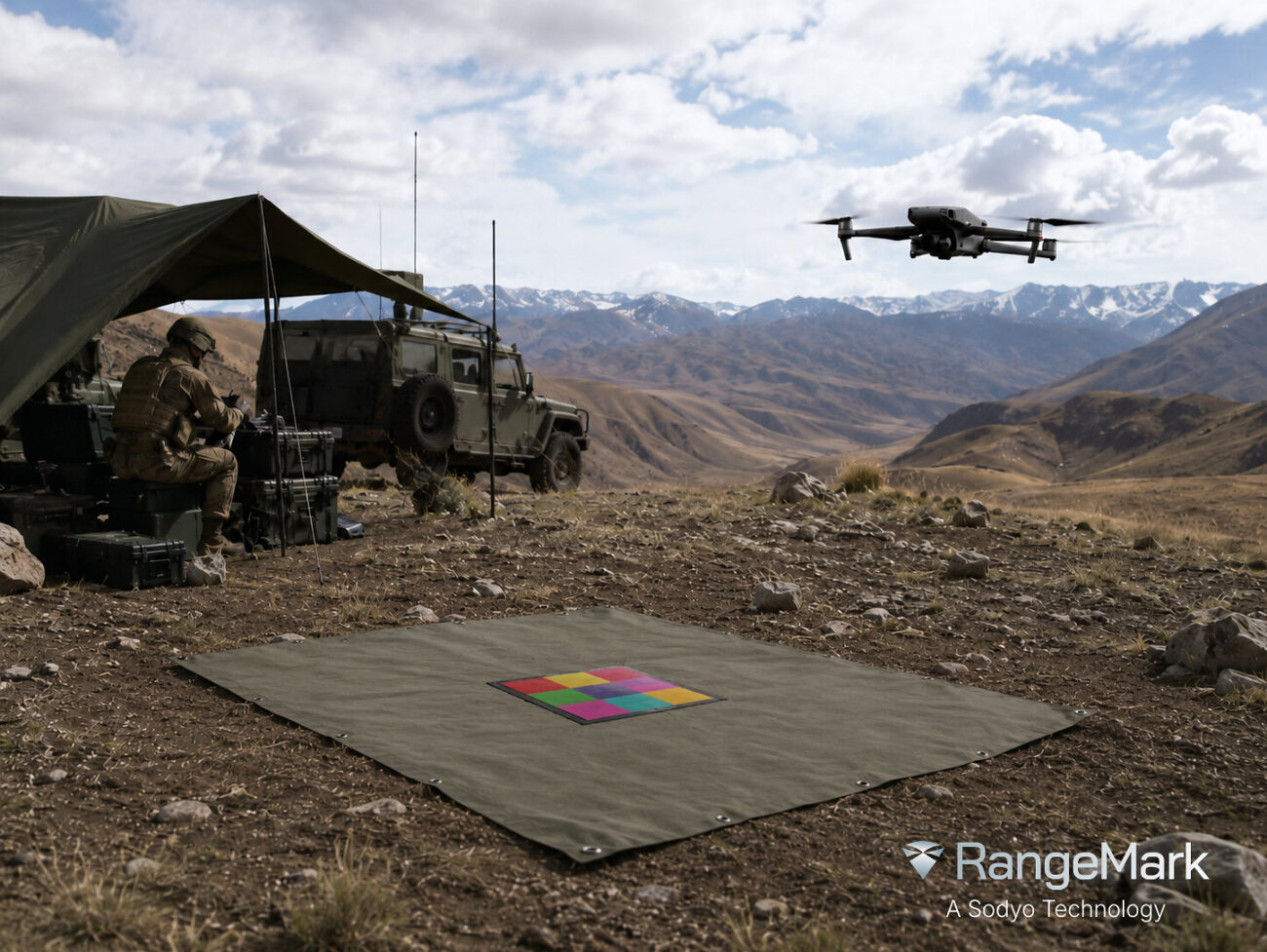
Sodyo Ltd. has introduced RangeMark, a patented visual identification technology that lets drones spot and decode a passive printed marker from as far as 1 kilometer away. The Tel Aviv company announced the launch on August 5, 2026, positioning Sodyo RangeMark as an answer to a stubborn weakness in autonomous flight. A drone can capture a sharp image of an object hundreds of meters out and still have no reliable way to confirm exactly what it is looking at.
Modern AI vision systems can detect, track, and classify objects with impressive skill, but they deal in estimates rather than certainty. According to Sodyo, that gap matters more as autonomy scales up. An AI model can tell a drone that it is probably seeing a rooftop, a vehicle, or a person. RangeMark is built to tell it which rooftop, which vehicle, and whether that person is a friendly force, returning a deterministic verification result instead of a probabilistic guess.
How Sodyo RangeMark Works Without GPS or RF
The system relies on nothing more than a camera and a printed marker. The markers are fully passive, with no power source, no transmission, and no emission of any kind. On the aircraft side, the technology needs no GPS, no cellular link, no RF, and no network connectivity, which makes it relevant for environments where those signals are unavailable. The approach fits alongside broader industry work on GPS-denied navigation, where developers are trying to keep aircraft operating when satellite positioning cannot be trusted. Sodyo describes the result as deterministic identification at ranges conventional visual codes were never built to reach.
Sodyo currently offers two marker formats. Color Code is a high-density option designed for visible light, while Carbon Code uses a duo-tone design intended for challenging visibility conditions, and additional spectrum formats are in development. The company has been proving out long-range detection from moving aerial platforms through Sodyo Labs, its research arm, which tests marker recognition under real flight conditions. The intellectual property behind the launch runs deep, covering more than 35 global patents with priority dates reaching back to 2012.
“The industry has done extraordinary work teaching drones to see. But seeing was never the hard part – knowing is. RangeMark turns a marked point anywhere in the physical world into a point of certainty, from up to a kilometer away, with nothing but a camera and a printed marker, something no existing visual technology can deliver at that range. It took more than a decade of patented work to make it that simple. When a machine can be certain, it can be trusted to act on its own.” Alon Raz, CEO of Sodyo
Flight Testing Results and a Las Vegas Debut
Sodyo RangeMark has already been validated in flight. A 100 cm marker was detected at distances up to 500 meters, while a 50 cm marker was picked up at ranges up to 250 meters. Long-range detection was achieved within a camera field of view covering roughly 20 hectares, or about 49 acres, and the full system supports locating a marker in the visual field at up to 1 kilometer. Flight testing covered hover, transit, and search-pattern modes at speeds reaching 20 meters per second.
Rather than selling hardware directly, Sodyo is taking a partner-led licensing approach to market. The company is targeting drone OEMs, autonomy platforms, camera vendors, and system integrators as licensing partners. RangeMark will make its public debut at Commercial UAV Expo Americas 2026, which runs September 1 through 3 at Caesars Forum in Las Vegas, where Sodyo will exhibit at Booth #1005.
The company says the technology took more than a decade of patented work to reach its current simplicity. For Sodyo, the argument behind Sodyo RangeMark comes down to trust. A machine that can confirm what it is looking at, the company contends, is a machine that can be allowed to act on its own.
