

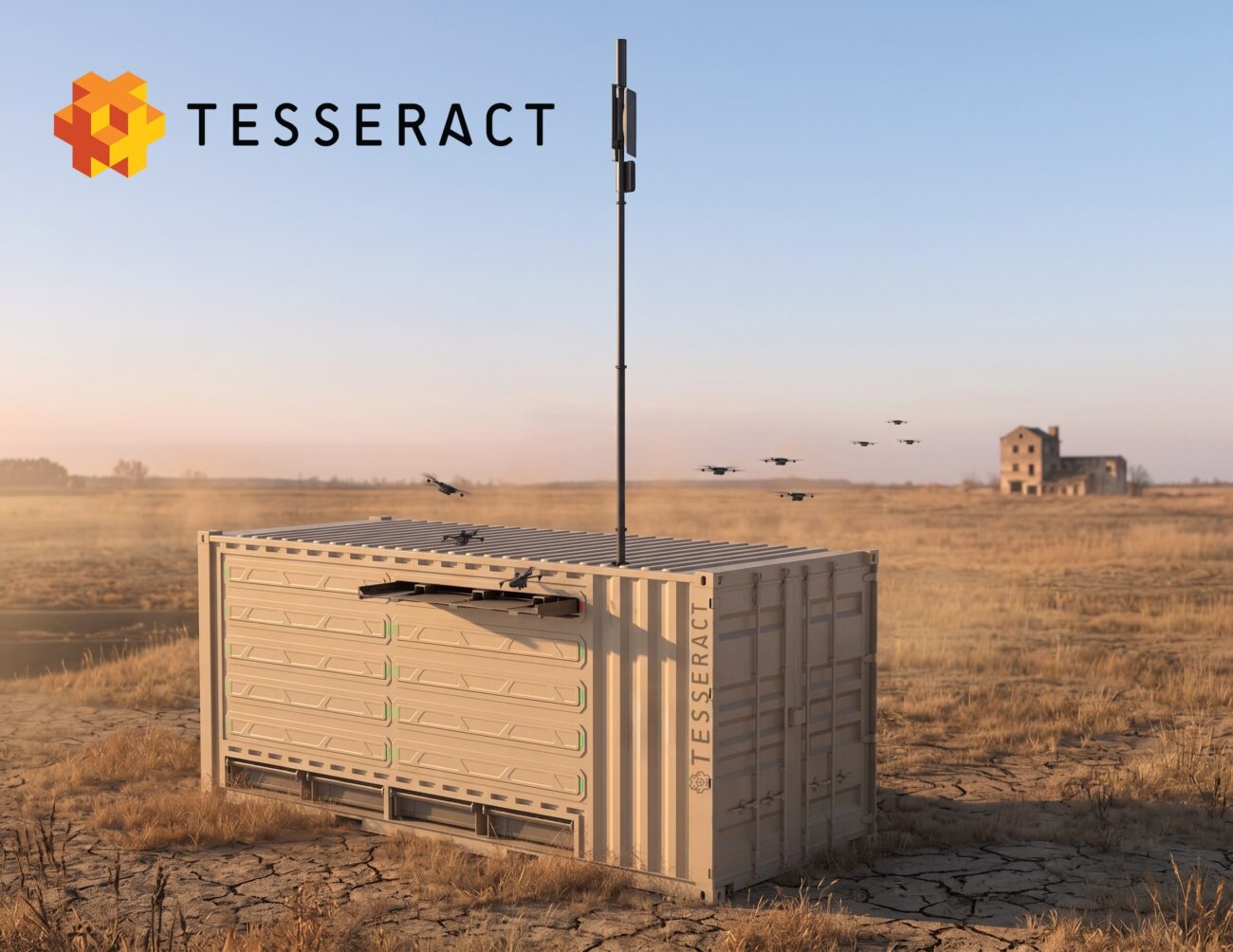
Tesseract Ventures has been selected by the Defense Innovation Unit (DIU) to advance in the Containerized Autonomous Drone Delivery System (CADDS) prototype project, the company announced on July 14, 2026. Described as a highly competitive initiative, the program is designed to speed up next-generation autonomous capabilities for rapidly deploying, sustaining, and managing unmanned aerial systems in contested and austere environments. For the Tampa-based company, the selection places its containerized approach to drone operations in front of one of the Pentagon’s most active technology pipelines.
The CADDS effort takes aim at a core Department of War challenge. Today, most unmanned aircraft still rely on a one-operator-per-aircraft model, which limits how quickly large numbers of drones can be put into the field. The project seeks scalable autonomous systems that can deploy and sustain large drone fleets with minimal human intervention, and it prioritizes modular, open-architecture solutions that support distributed military operations while allowing new technology to be integrated quickly. For a military rethinking how it fields unmanned systems at scale, the ability to ship, launch, and manage entire fleets from standardized containers offers a practical answer to that problem.
How Tesseract Ventures Will Manage Drone Fleets
Under the prototype project, Tesseract Ventures will demonstrate its modular autonomous platform, which simplifies the deployment, launch, recovery, and management of multiple drones from containerized systems. The company calls this platform the Tesseract NOMAD, a mobile, containerized system that deploys and manages large drone fleets across air, land, and sea using onboard intelligence and secure real-time data sharing. The work extends the command and control technology Tesseract has built for military customers, combining open systems architecture, advanced autonomy software, resilient command and control, and scalable mission management to increase operational flexibility while reducing the cognitive workload placed on operators.
That last point matters because traditional drone operations demand heavy operator involvement. Tesseract’s approach instead uses intelligent automation to raise the operator-to-aircraft ratio, which the company says enables persistent autonomous operations while reducing risks to personnel. John Boucard, CEO and founder of Tesseract Ventures, framed the selection as a validation of that strategy.
“This selection is an important milestone for Tesseract Ventures and validates our vision of delivering scalable autonomous systems and drones that meet the evolving needs of the U.S. military. We are honored to support DIU’s mission of rapidly fielding commercial technology to the warfighter.” John Boucard, CEO and Founder of Tesseract Ventures
Inside the CADDS Prototype Project
The requirements behind CADDS are broad. Solutions must be capable of transporting, storing, launching, recovering, refitting, and managing diverse autonomous aircraft across both land and maritime environments with minimal personnel. In practical terms, that means a single containerized system has to handle the full lifecycle of many different aircraft types, a shift that echoes the wider industry move toward centralized drone fleet operations rather than single-pilot flying.
The solicitation also puts heavy emphasis on the Modular Open Systems Approach, known as MOSA. By requiring open standards, the Department of War aims to maximize interoperability between systems, keep the door open for future upgrades, and allow new technology to be inserted rapidly as it becomes available. For companies competing in the program, that means building platforms that can grow and adapt rather than closed systems locked to a single vendor.
As part of the prototype effort, Tesseract Ventures will participate in demonstrations designed to validate operational performance in the conditions the program is built around. The stakes extend beyond the demonstrations themselves. Because the program runs under the Commercial Solutions Opening process, successful prototypes may become eligible for follow-on production opportunities without further competition, giving participants a direct path from prototype to fielded capability.
Tesseract describes itself as an American invention company that builds advanced hardware, software, and AI-driven systems for construction, defense, infrastructure, and agriculture. Its integrated platforms combine real-time sensing, digital twins, robotics, and automation to give organizations a complete operational picture, and the company works with field teams, military partners, and enterprise clients on technologies aimed at improving safety, clarity, and productivity.
