

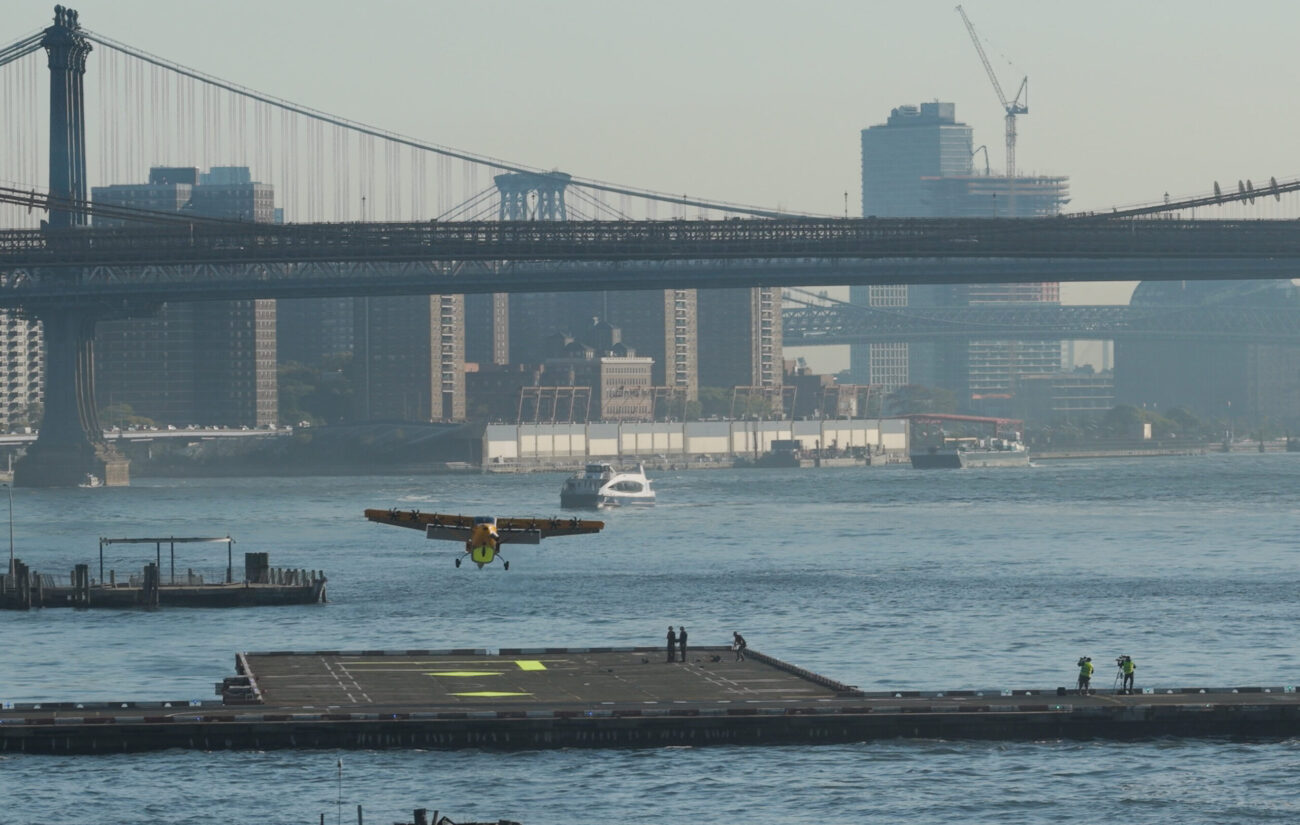
Electra has flown its hybrid-electric Electra Ultra Short aircraft in and out of Downtown Skyport, a heliport in Lower Manhattan, in a demonstration the company announced on October 26, 2026. Electra believes it is the first time a fixed-wing airplane without vertical takeoff capability has landed at the site, which is operated by a company that builds and runs infrastructure for helicopters and eVTOL aircraft.
The flight is the newest stop in Electra’s Life Beyond Runways demonstration series. The series promotes a regional travel model the company calls Direct Aviation, where passengers board a short flight close to where their trip begins and land close to where it ends. The goal is to let travelers skip crowded highways and busy airport hubs on trips that would otherwise take most of a day.
How the Electra Ultra Short Lands Without a Runway
The Electra Ultra Short pairs a hybrid-electric propulsion system with blown-lift technology, which lets the aircraft take off and land in just 150 feet. That short footprint means places such as heliports, barges, open fields, and parking lots could serve as access points without any runway at all. Electra says this independence from runways matters for both commercial passenger service and defense missions.
The company argues its design is the first airplane to meet six requirements it sees as essential for advanced air mobility to grow. Those are helicopter-like access, quiet operations, the affordability of a fixed-wing aircraft, safety, payload, and range. In Electra’s view, only aircraft that check all six boxes will become practical at scale.
“Today we made aviation history in downtown Manhattan by landing a fixed-wing aircraft on a heliport. This same capability will fundamentally transform how people travel in our nation by making it faster and easier to get them to their destinations. What’s even more interesting is that we didn’t need to build a new runway to do it. We worked with partners who see new possibilities in existing infrastructure. There are places like this all across the country. Communities and aviation operators are beginning to see what they could become. That’s how Direct Aviation takes shape: not by asking people to travel farther or wait longer to catch a flight, but by bringing flight closer to where they live, work and want to go.” Marc Allen, CEO of Electra
Direct Aviation Demand and the Downtown Skyport Partnership
Electra pointed to strong existing demand for shorter regional trips. Americans take more than 35 million car trips every day that cover 50 to 500 miles, and thousands of those routes are heavily traveled. The company’s Direct Aviation Market Outlook estimates that flying direct could save travelers roughly 3 hours and 45 minutes between New York City and Boston, about 3 hours and 30 minutes on a trip to Washington, D.C., and around 45 minutes on a trip to Philadelphia.
Downtown Skyport is run by Skyports Infrastructure, which designs, builds, and operates heliports and vertiports and has active sites in the United Kingdom and the United States. The company has also built a profile in vertiport development for next generation aircraft, with projects underway in the Middle East, Europe, and Asia. Robbie Ladov, its general manager for U.S. heliports and vertiports, described the Manhattan site as New York’s hub for advanced air mobility, supporting everything from electric air taxis and cargo drones to new types of regional passenger service. Skyports joins a partner list that already includes state aviation and airport authorities, FBO operators, real estate developers investing in urban and residential access points, and more than 60 airline operators that plan to fly regional Direct Aviation routes.
Where Else the Electra Ultra Short Design Has Flown
The Manhattan landing follows a string of earlier demonstrations. Electra has used its EL2 technology demonstrator to show the same short takeoff and landing capability at Downtown Charleston, Bader Field in Atlantic City, Watertown International Airport, and Snowshoe Mountain Resort. As an inaugural participant in the FAA’s advanced air mobility integration pilot program, the company also showed helicopter-like instrument flight performance at Roanoke-Blacksburg Regional, taking off from and landing on heliports at a commercial airport. On the defense side, Electra says the same performance could help move people, power, and payload to places where runways are unavailable, damaged, threatened, or impractical, using small operating areas instead of large fixed runways.
Electra plans to keep its demonstration series going at both traditional airports and new access points as it moves its EL9 aircraft toward certification, production, and service. The company says its Ultra Short technology carries 2.5 times the payload and offers 10 times the range of helicopters and eVTOLs, with operating costs that are 70% lower. Its contracted customers include the U.S. Air Force, U.S. Army, U.S. Navy, and NASA, along with more than 2,200 letters of intent from over 60 commercial customers such as airlines and helicopter operators.
