

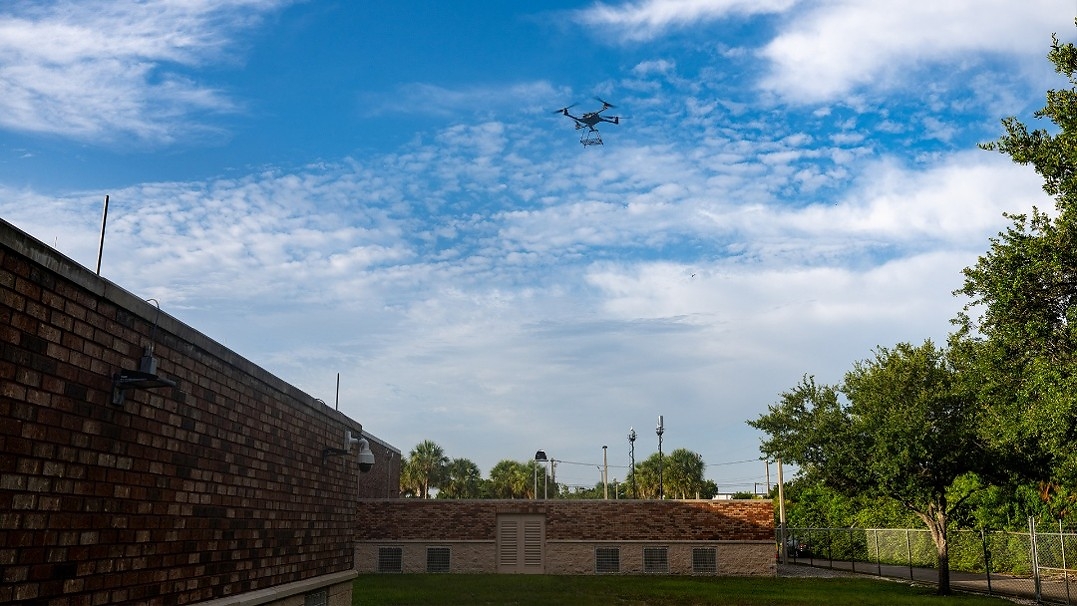
Lockheed Martin NetSense has moved out of the laboratory and into a busy American city. The defense company announced on August 12, 2026 that it had carried out a live demonstration of the system in the Miami area during July, working alongside Verizon, NVIDIA, Keysight Technologies, ODC and Astris AI. The test showed an artificial intelligence system that could identify, track and monitor unmanned aircraft systems using 5G networks that are already in place, rather than purpose built sensors installed for that job alone.
The full name of the product is the NetSense Airspace Awareness-as-a-Service system, and the companies behind it argue that commercial off the shelf technology can make drone detection cheaper to buy, faster to install and easier to spread across many locations. Lockheed Martin points to a long list of places that could use that kind of coverage, including critical infrastructure, large scale events at stadiums, utilities such as power plants, and everyday places like schools, hospitals and airports. City, state and federal government customers are also named as potential users who would receive proactive monitoring and alerts from the service.
Inside the Miami Area Demonstration
The Lockheed Martin NetSense demonstration took place in what the company describes as a critical, high traffic urban area that matters to American protection, and it put the system’s components through their paces in real time. During the flights, the platform detected the presence of drones, alerted the team and held track custody from start to finish. The company says the result matters because the sensing worked without any changes to the cellular radio equipment already installed in the area, which removes one of the largest costs normally attached to building a wide area detection network.
Several companies supplied pieces of the setup. Verizon provided the existing 5G network spectrum that carried the signals, ODC contributed its AI native Radio Access Network software, NVIDIA supplied its AI Aerial platform, and Keysight brought an advanced radio frequency simulation platform used to model and test the design. Astris AI, a wholly owned Lockheed Martin subsidiary, is described as the commercial home of the NetSense offering.
How the Lockheed Martin NetSense System Detects Drones
At its core, the technology pairs Lockheed Martin’s warning and tracking systems with artificial intelligence that reads disturbances in radio frequency signals. NVIDIA AI Aerial analyzes those disturbances as they happen and passes the results to the NetSense algorithms, which then predict a flight path, follow the aircraft and push out automatic alerts. Lockheed Martin has been building toward this point for some time, and its own account of 5G drone detection work traces the effort back through earlier trials of the same underlying idea.
“As drones become more affordable and accessible, airspace awareness technology needs to evolve rapidly to outpace potential threats. That’s why we developed the NetSense solution. By working within the established 5G network spectrum, we’re able to collaborate with the commercial technology industry and deploy a solution that’s ready at the time of need.” Sarah Hiza, Senior Vice President, Technology and Strategic Innovation at Lockheed Martin
Lockheed Martin lists a handful of reasons it went the commercial route. Buying and fielding off the shelf parts is quicker than building a custom system from scratch, and a competitive commercial market tends to push prices down while encouraging new ideas. The open architecture design lets new interceptors and other technologies be added to the existing platform without replacing hardware, and it leaves room for continuous upgrades that improve how data is interpreted and how targets are classified. The company also says the approach can scale from guarding a single site up to supporting a mobile command and control setup for larger operations.
What Comes Next for Airspace Awareness
One of the more forward looking claims involves 6G. Integrated Sensing and Communication, usually shortened to ISAC, is expected to arrive with future networks, and Lockheed Martin argues that NetSense delivers useful sensing ahead of that timeline while remaining complementary to ISAC once it exists. That framing echoes a wider industry push seen in recent network based detection work by AT&T and Ericsson, and it explains why the roadmap runs from Verizon’s current 5G spectrum toward broader deployment across both 5G and future 6G networks.
Commercially, Lockheed Martin NetSense will be sold as a subscription that plugs into a customer’s existing security operations rather than as a standalone product that has to be managed separately. Pilot deployments are planned for the second half of 2026 and early 2027, with general commercial availability targeted for 2027. Early access will be limited to a small group of customers that urgently need the capability, and interested organizations are directed to Astris AI. For now, the test stands as evidence that a network built to carry phone calls can also keep watch on the sky above it.
