

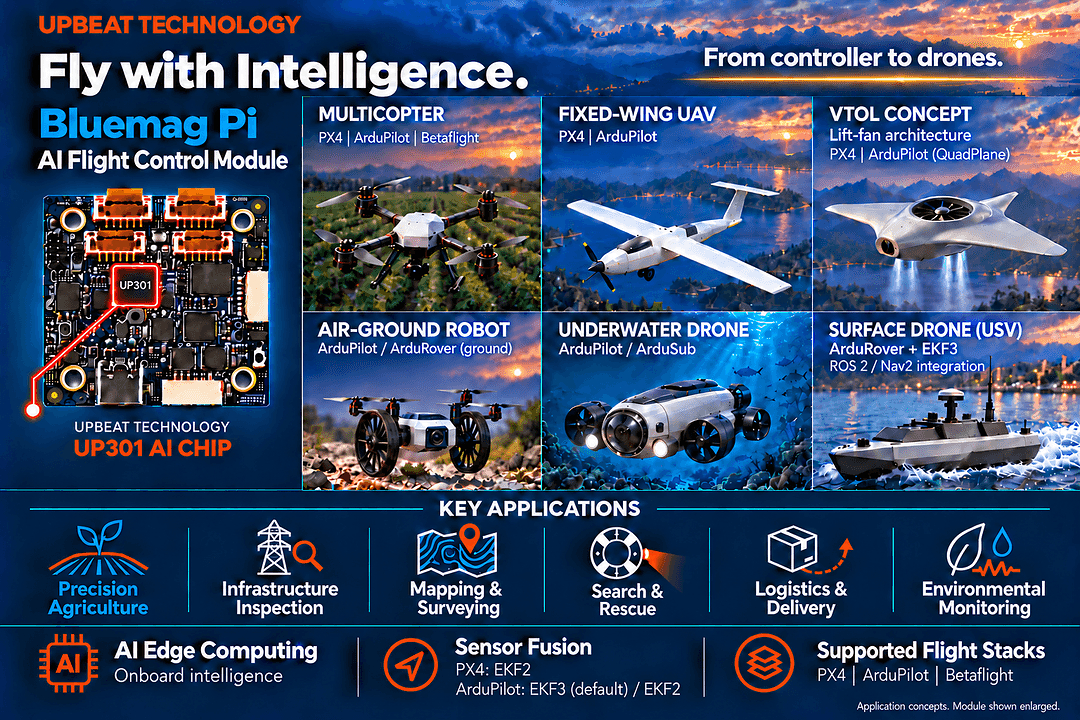
Upbeat Technology has launched Bluemag Pi, a sensor-integrated AI flight controller designed for long-endurance fixed-wing aircraft, commercial multirotor drones, and unmanned surface vessels. The company, which is based in New Taipei City, Taiwan, announced the product on October 7, 2026, and is pitching it to developers who want a dependable replacement for older autopilot hardware.
The board is built around Upbeat’s own UP301 system-on-chip, which combines SiFive’s E3 and E2 RISC-V processor cores in a dual-core layout intended for flight-critical work. That multicore design keeps time-critical flight tasks apart from communication, navigation, and system-management functions. According to Upbeat, the separation improves both responsiveness and reliability.
Bluemag Pi Hardware and Open-Source Flight Stack Support
On the processing side, the board offers ample RAM, nonvolatile storage, hardware floating-point capability, timers, direct memory access, and interrupt resources to handle advanced flight operations. It runs the Apache NuttX real-time operating system and works with the leading open-source flight-control stacks, including PX4, ArduPilot, and Betaflight. Developers already familiar with those ecosystems can therefore bring existing software to the new hardware.
Sensing is built in rather than added later. The Bluemag Pi module carries two independent inertial measurement units, a barometer, and dual global navigation satellite system receivers, along with sensor-fusion software that continuously cross-checks their readings. Upbeat says this lets the board keep producing dependable altitude, attitude, and velocity estimates even when a single sensor drifts or fails.
For connectivity, the controller sends telemetry to a ground station or companion computer over a standard MAVLink radio link and accepts input from common remote-control receivers. Motors are driven through an integrated four-in-one electronic speed controller for precise throttle response. Extra interfaces allow expansion sensors and peripherals to be attached, and onboard storage continuously records flight data for diagnostics, tuning, and post-flight analysis.
Why Upbeat Put AI Inference on a Drone Flight Controller
Upbeat tied the launch to a fast-growing market. Citing Grand View Research, the company said the global drone market was valued at approximately $96.4 billion in 2026 and is projected to reach $182.4 billion by 2033, a compound annual growth rate of roughly 9.5%. That growth is being driven by AI-enabled, long-endurance platforms used in agriculture, infrastructure inspection, logistics, and defense.
The company argues that flight-controller hardware has not kept pace. Most widely used autopilots still rely on general-purpose processors with no dedicated AI acceleration. Without AI chips on the autopilot itself, drone makers end up attaching a separate companion computer just to add onboard intelligence. Bluemag Pi is meant to close that gap with a single board that handles both flight-critical control and AI inference.
“We chose Upbeat’s Bluemag Pi flight control board over standard solutions because it’s remarkably easy to integrate yet built with the real-time performance and robust feature set advanced drone development demands. That combination of dependable performance and comprehensive capabilities has made it the right platform for building sophisticated UAV solutions,” Steven Yen, Founder and CEO, Drone Dynamics
Flight Modes, Availability, and Upcoming Trade Show Demos
Upbeat is selling the product in two forms. The standard board fully supports secondary development, so engineers can implement their own custom flight algorithms on it. Customers who would rather design a proprietary carrier board can buy the UP301 chip directly instead.
With suitable hardware and firmware integration, the UP301 platform supports manual, stabilized, altitude-hold, position-hold, mission, return-to-home, and autonomous flight modes. Bluemag Pi is available for purchase now through the Upbeat Technology website. Martyn Stroeve, Vice President at SiFive, said the dual-core approach lets Upbeat dedicate one core to flight-critical control and the other to AI and system tasks, so neither workload compromises the other.
Upbeat plans to demonstrate the flight controller at CEATEC 2026, Japan’s largest annual electronics and IT trade show, which runs October 13 to 16 at Makuhari Messe in Chiba. Visitors to booth 7H215-01 will be able to see its real-time performance and onboard AI inference, alongside the company’s humanoid robotic hands, headphones, and other new products. Upbeat will also attend TAITRONICS & AIoT Taiwan from October 20 to 22 at booth J0102.
Founded in 2017, Upbeat Technology designs extreme-low-power integrated circuits, AI accelerators, and MEMS sensors for wearables, robotics, hearables, industrial sensing, edge AI applications, and drone flight-controller boards. Its robotics work earned the Robot Intelligent Mobility System Excellence Award this year for a MEMS edge AI module used in robot health monitoring and tactile friction sensing. The company says it is now extending that same sensing platform beyond UAVs into humanoid robotics, demonstrating tactile and vibration sensing in robotic hands and feet.
