

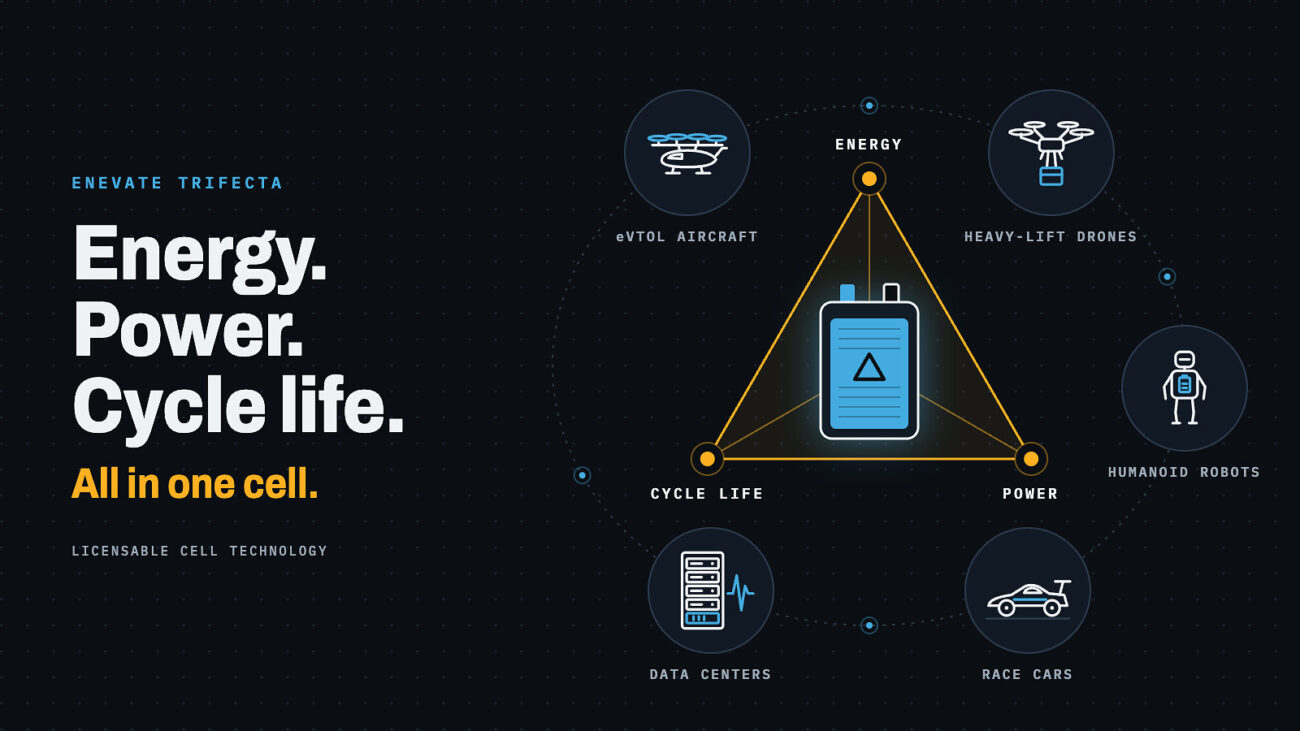
Enevate Technologies has introduced Enevate Trifecta, a licensable battery cell technology that the Irvine, California company says is built to remove a long-standing compromise for engineers designing drones and other demanding electric machines. Announced on October 27, 2026, Trifecta is aimed at teams that need more stored energy packed into less weight and space, along with enough power on tap to actually use that energy. Beyond drones, Enevate is pitching the technology to developers of humanoid robots, race cars, data center power systems and electric aircraft.
The problem Enevate is going after is a familiar one in battery design. Cell engineers have traditionally been able to optimize for only two of three qualities at a time: energy density, power output and cycle life. At the leading edge of performance, the company says, designers often end up with just one of those strengths, and they pay for the gap with packs that are bigger than they should be, missions that end sooner and payload capacity that has to be given up.
How Enevate Trifecta Balances Energy, Power and Cycle Life
According to Enevate, Trifecta designs can equal or surpass the energy density of leading lithium-metal and solid-state cells while avoiding the safety and charge-rate problems that usually come with those chemistries. Versions built for longevity are rated to reach 1,000 cycles. Instead of a single cell, the company has laid out five modeled configurations, each tuned to a different mix of energy, discharge rate and lifespan so that customers can pick the balance that fits their platform.
Trifecta Surge is the most power-focused option, pairing 400 Wh/kg of energy density with a 40C rate and 500 cycles, and it is listed for racing, data center power and heavy-lift drones. Trifecta Prime raises energy density to 425 Wh/kg with a 20C rate and 1,000 cycles, with humanoid robots, commercial drones and eVTOL aircraft named as example uses. Trifecta Sprint climbs to 480 Wh/kg at 20C but is rated for 20 to 50 cycles, which places it in high-power systems that see only limited use.
Two lower-rate designs complete the lineup. Trifecta Endurance delivers 475 Wh/kg at a 1C rate with 1,000 cycles and is meant for long-life platforms running at moderate power. Trifecta Range posts the highest figure in the family at 545 Wh/kg, also at 1C, with a rating of 20 to 50 cycles. Of the five, Range speaks most directly to drone performance on extended flights, since it is the only configuration Enevate lists specifically for long-endurance and single-mission drones. The company notes that all of these numbers describe modeled designs, which build on a successful proof of concept carried out with earlier prototype cells.
“Engineers have spent years designing around their batteries. Trifecta flips that. We want to have open conversations about how our technology can change how you design things.” Benjamin Park, CEO, Enevate Technologies
Licensing Options Bring Enevate Trifecta to Drone Builders
Enevate Trifecta is offered as a licensable technology rather than as one fixed product. The company says it works with each customer to either match an existing configuration or tailor a new one to the job, and then helps arrange production. Cells can be made by one of Enevate’s licensees, produced through a custom build or manufactured by the customer’s current battery supplier, which gives drone makers and other hardware developers several possible paths for getting the technology into their designs. Battery manufacturers that want to produce Trifecta cells for their own customers are also being invited to discuss licensing terms.
The company behind Trifecta develops and licenses high-energy, high-power battery cell technology, and it draws on both the technology and the team members of Enevate Corporation. That earlier company spent 20 years on battery innovation, work that Enevate says was validated by global automakers and cell manufacturers and that produced more than 700 patents issued and pending. Enevate Technologies also describes its culture as open and cooperative, and says that approach gives customers a direct path to its battery experts.
Engineers who want a technical briefing on Trifecta, along with battery makers interested in a license, are being asked to contact Enevate directly by email. With five modeled configurations that cover heavy-lift drones, commercial drones, long-endurance drones and eVTOL aircraft, the Enevate Trifecta lineup gives aircraft designers a defined set of energy, power and cycle life combinations to weigh against the cells they rely on now.
