

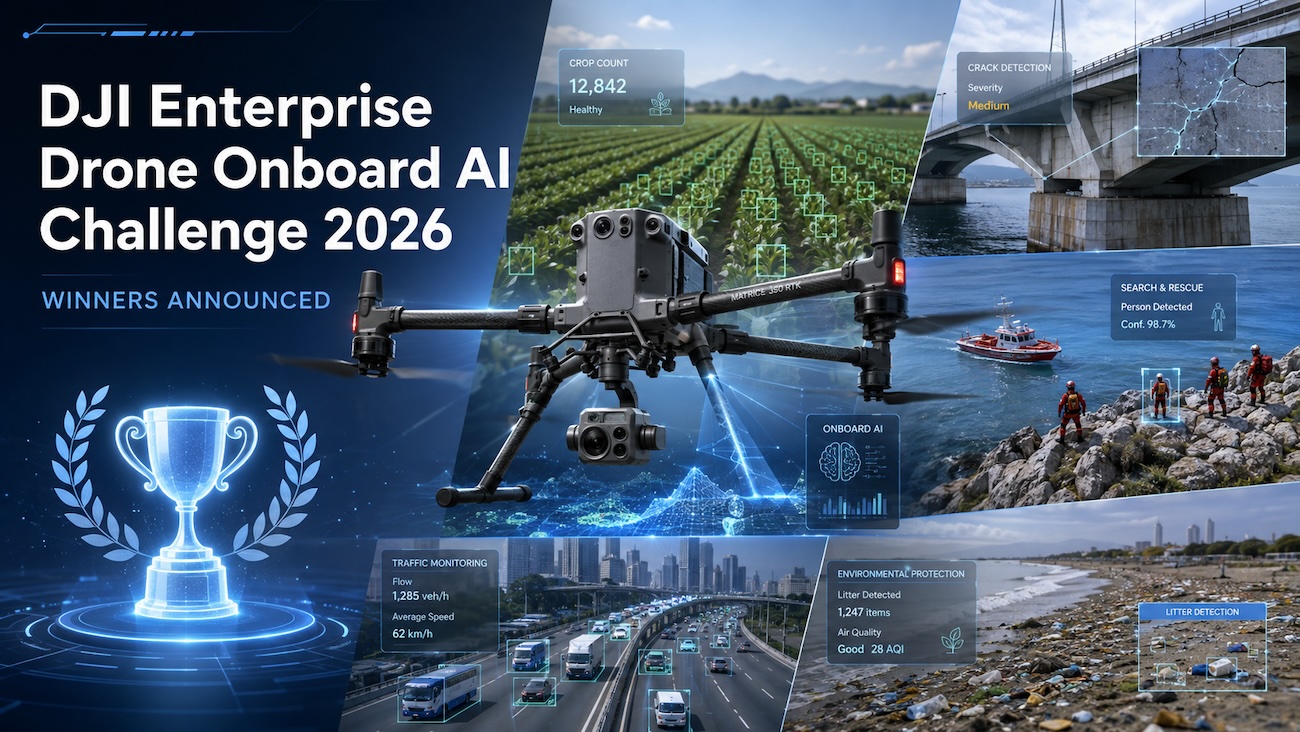
DJI has named the winners of its DJI Enterprise Drone Onboard AI Challenge 2026, a global competition centered on DJI onboard AI models that run directly aboard the company’s enterprise aircraft. The announcement came out of Shenzhen, China on August 20, 2026. Entries opened in early 2026, and a panel of ten judges drawn from the artificial intelligence and drone industries reviewed the submissions before selecting five recipients of the Best Onboard AI Model Award and ten recipients of the Industry Application Excellence Award.
The stated aim of the competition was to close the distance between collecting aerial data and producing the kind of insight that leads to a decision. DJI, which describes itself as the global leader in civilian drones and creative camera technology, argues that frontline operators understand their own industries better than anyone and are therefore the people best placed to build practical applications. For that reason DJI Enterprise has opened its drone SDK and its computing power to outside developers, giving them a route to build software that fits the specific problems they face at work. DJI onboard AI tools are meant to let that work happen without a separate ground station doing the heavy lifting.
How the DJI Onboard AI Challenge Worked
Submissions had to rely on onboard AI algorithms that could be deployed on specific DJI Enterprise hardware, namely the Matrice 4 and 4D Series, Dock 3, and Matrice 400, or on the Manifold 3 computing platform. With access to onboard chip computing power, algorithm deployment tools, and simplified model customization, operators can run models directly on those platforms rather than sending everything back to a server for processing. DJI hosts the program on its own innovation contest page, and entrants were encouraged to aim at genuine field use across industries ranging from agriculture to public safety.
The results reflect that spread. Winning submissions covered tracing air pollution, spotting litter on beaches, finding cracks on bridges, supporting search and rescue teams, and counting crops from the air. Readers who follow DJI’s other competitions can also look back at DroneArticles’ coverage of the SkyPixel drone contest and its winning aerial imagery. The onboard AI challenge takes a different angle, rewarding software that turns what the camera sees into a usable result while the aircraft is still flying.
Crop Counting and Traffic Inspection Among Top Entries
One highlighted project was AgroCount AI, an onboard crop counting system built by Daniel Tovar. It was developed and validated at Finca La Suiza, a 50 hectare commercial banana plantation in Colombia, and it brings together drone hardware, computer vision, and geospatial analysis. The job it replaces normally takes four to six field workers about four days, or roughly seven days of counting by hand from aerial imagery. The planned setup pairs a DJI Matrice 4E with the Manifold 3 so that imagery is processed and plants are GPS tagged onboard while the flight is underway, turning raw aerial data into something a grower can act on in the field. The entry was presented as a demonstration of what DJI onboard AI can do for routine monitoring work that is otherwise slow and labor heavy.
A second example came from Hangzhou New Modal Technology Co., which entered a nine in one onboard fusion algorithm paired with edge and cloud collaboration for smart transportation inspection. Developed in China on DJI FlightHub 2 and Manifold 3, the system rolls nine separate inspection capabilities into one workflow covering traffic enforcement, road maintenance, facility management, and traffic flow control. The result is a closed loop process that moves from automated detection through evidence collection to alerting and resolution without breaking the chain between steps.
What the DJI Onboard AI Winners Receive
Five teams took the Best Onboard AI Model Award, which recognizes models built for deployment on DJI enterprise drones and onboard computing platforms. Those winners were Aoshi Cangqiong, Cheng’an Zhilian (Chongqing) Information Technology Co., Ltd., Hangzhou New Modal Technology Co., Ltd., Huineng Technology, and Zhongke Beiwei (Beijing) Technology Co., Ltd. The Industry Application Excellence Award went to ten entrants for applying onboard AI to practical industry problems, among them Bridge Inspection Master, Daniel Tovar, the East China Normal University Estuarine and Coastal Data Center Team, the Lanzhou University Grass Flying Team, and the Shenzhen Public Welfare Rescue Volunteer Federation.
Beyond DJI products, winners receive exposure through DJI Enterprise’s official channels and a place in the Onboard AI Solutions Catalog. They also get fast tracked access to the DJI Enterprise Ecosystem partner audit, which opens the door to new product beta testing and direct technical support from the company. Taken together, the awards point toward a model of aerial work where the analysis happens on the aircraft itself rather than afterward at a desk.
