

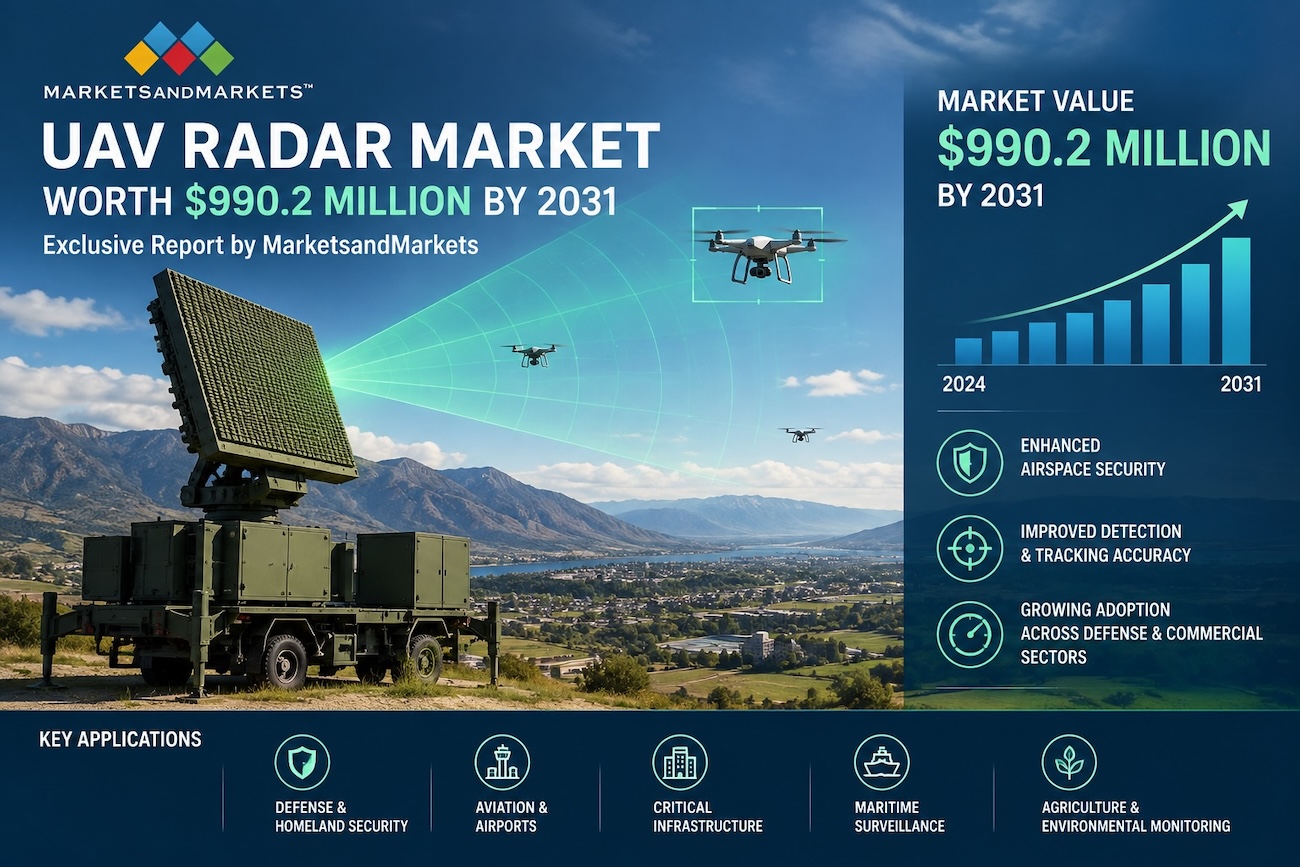
The UAV radar market is heading for a steep climb over the next five years, according to a new forecast from research firm MarketsandMarkets. The study values the sector at USD 360.7 million in 2026 and projects it will reach USD 990.2 million by 2031, a compound annual growth rate of 22.4 percent. The full report runs to 300 pages and covers market data from 2021 through 2031, with 200 data tables and 80 figures supporting the global outlook.
Several forces are pushing the numbers up at the same time. Purchases of counter-UAS systems are rising, more military drones are carrying radar of their own, and operators increasingly need persistent coverage of small, low flying, and low observable aircraft that are difficult to spot with other sensors. Demand is also climbing for compact radars with low size, weight, and power requirements, alongside electronically scanned arrays, software defined architectures, and multi sensor packages that strengthen ISR work, maritime surveillance, detect and avoid functions, border security, and air defense.
What Is Pushing the UAV Radar Market Higher
Militaries, border security organizations, airports, and critical infrastructure operators are all widening their use of radar for ongoing surveillance and counter-UAS missions, which the research points to as the start of a stronger procurement cycle. Drone manufacturers are moving in parallel, fitting smaller radar payloads for synthetic aperture and ground moving target indication, maritime surveillance, detect and avoid, navigation, and general mission safety. The shift toward smaller, software defined, electronically scanned designs is making radar practical across a far broader set of unmanned aircraft than before.
Development work is concentrating on low SWaP sensors, rapid beam steering, higher target update rates, automatic categorization of what the radar sees, and tighter integration with electro optical and infrared cameras, RF systems, and command and control networks. Those advances do two jobs at once. They widen the all weather intelligence and autonomous capability of onboard payloads, and they make radar more useful against low altitude and low observable drones. Detect and avoid is one area where the technology has already reached regulators, as the approval granted to the Sparrowhawk radar in Canada showed, and the report counts it among the growing use cases for airborne sensors.
Scanning Types, Frequency Bands, and Defense Demand
By scanning type, hybrid mechanical and electronic scanning radar is expected to post the fastest growth of any category at a 24.2 percent CAGR through 2031. Electronically scanned array radar is expected to stay at the top of the scanning category as airborne payload suppliers and counter-UAS radar makers both concentrate on small, fast steering designs. AESA, MIMO, metamaterial, and other controlled architectures can refresh tracks quickly, follow multiple targets, manage waveforms flexibly, and switch mission modes in software rather than depending on moving parts.
Other segment findings sharpen the picture further. ISR and surveillance radar payloads take the major share of the onboard category in 2026 according to the UAV radar market report, while search and detection radar holds the largest share on the offboard side across the forecast period. X-band is expected to account for a significant 26 percent slice of the market in 2026, and large UAVs weighing more than 600 kg are projected to hold the biggest share of onboard radar demand.
Defense remains the anchor of the sector. The report puts defense end users at 50.1 percent of the market in 2026 and expects them to stay dominant as armed forces widen counter-drone coverage and add radar to ISR, maritime, tactical, MALE, and combat focused unmanned aircraft. Military buyers are also asking for radars that can hold a track, identify targets, cue other systems, and feed layered air defense operations, opening opportunities in new installations and upgrades alike.
Asia Pacific Growth and the Companies Supplying UAV Radar
By region, Asia Pacific is projected to record the highest CAGR through 2031. Countries across the region are increasing spending on unmanned surveillance, air defense modernization, border monitoring, maritime security, and counter-UAS capacity. Domestic drone programs and sensor integration work are expanding in China, India, Japan, South Korea, Australia, and other regional markets, and the combination of procurement, local production, and rising concern about small drone threats is expected to keep demand steady for both onboard and offboard systems.
The competitive field mixes large diversified defense electronics groups with specialist radar suppliers focused on UAV and counter-UAS product lines. MarketsandMarkets names RTX in the United States, Leonardo S.p.A in Italy, Saab AB in Sweden, HENSOLDT AG in Germany, and Israel Aerospace Industries in Israel among the leading participants in the UAV radar market. With the sector on track to nearly triple in five years, those suppliers are competing for a customer base that now stretches from air forces and navies to airport operators and infrastructure security teams.
