

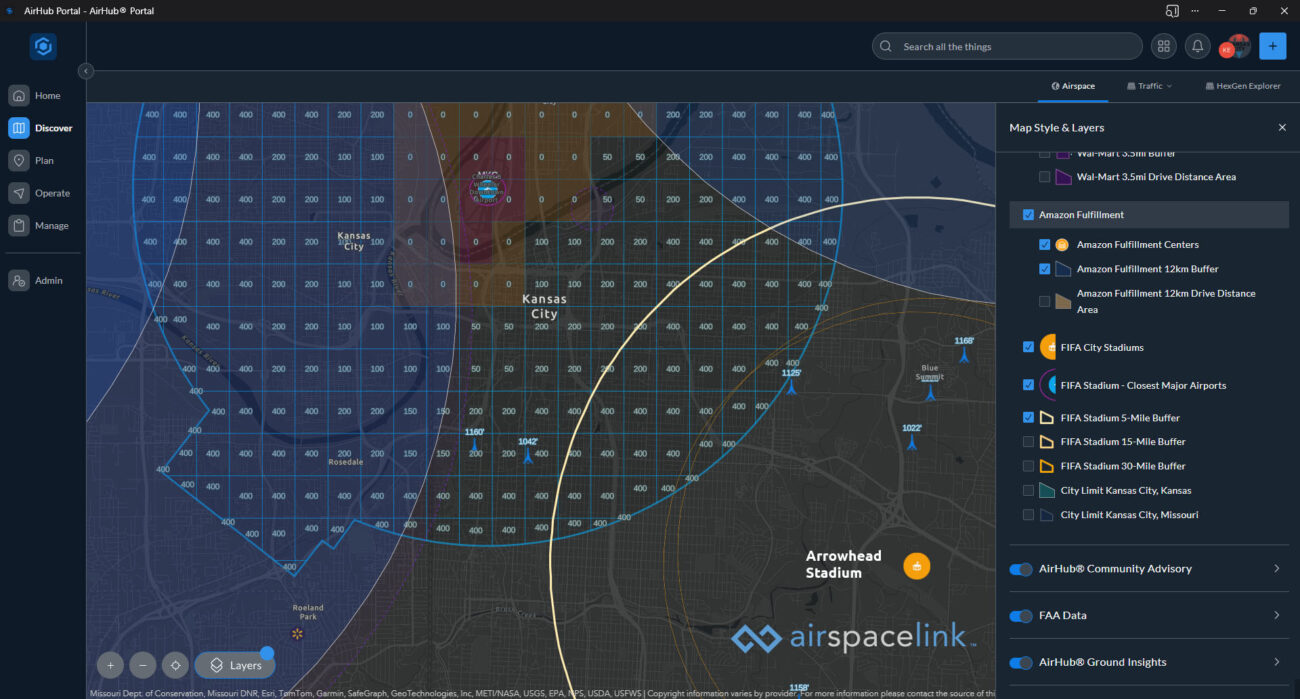
The Kansas City Police Department has launched an integrated Kansas City drone operations and counter-UAS platform designed to safeguard venues, fan zones, and public spaces during FIFA World Cup 2026. The deployment was announced on May 14, 2026, in partnership with Detroit-based Airspace Link and a coalition of regional public safety stakeholders. Funding comes from the federal Counter-Unmanned Aircraft Systems Grant Program administered by the U.S. Department of Homeland Security and FEMA, making Kansas City one of the first U.S. host cities to put coordinated airspace infrastructure in place ahead of the tournament.
The platform combines two complementary technologies into a unified framework. Airspace Link’s AirHub Portal serves as the shared operational airspace coordination layer, while DroneShield contributes counter-UAS detection and threat response capabilities. Together, the systems are intended to support drone awareness, identification, coordination, and security across the entire metro region during one of the largest sporting events the city has ever hosted.
How the Kansas City Drone Platform Protects World Cup Venues
AirHub Portal acts as the operational command environment for authorized drone activity throughout the metro area. The system integrates live FAA airspace data, Remote ID telemetry, UTM coordination workflows, approved flight operations, and emergency response activities. It also incorporates Identification Friend or Foe style operational awareness, giving participating agencies a single common operating picture during fast-moving situations. Airspace Link describes its flagship product on its AirHub Portal page, and the Kansas City deployment uses it as the central layer for regional coordination. The architecture supports coordinated activity between law enforcement, fire response, critical infrastructure operators, commercial drone services, media organizations, and authorized event operators throughout the tournament.
Counter-UAS protection runs alongside the coordination layer. DroneShield’s detection and threat response platform serves as the primary capability for identifying and responding to unauthorized drone activity. Cyber-over-RF mitigation technology and additional counter-UAS capabilities are also positioned within select supporting communities and operational zones inside the broader regional security perimeter. The combination addresses both authorized drone traffic that needs to be deconflicted and unauthorized aircraft that need to be stopped.
Multi-Agency Coordination Across the Region
The new system supports cooperation between a long list of agencies that share responsibility for tournament safety. KCPD is joined by the Kansas City Missouri Police and Fire Departments, Shawnee PD, Overland Park PD, Prairie Village PD, Kansas City Kansas PD, Lawrence PD, the Kansas Highway Patrol, the Johnson County Sheriff’s Office, and Sporting Kansas City, along with additional regional stakeholders supporting FIFA operations. The cross-jurisdictional setup echoes how counter-drone tech has been deployed at other large-scale events. Pulling so many partners under one platform marks a significant operational shift compared with the patchwork approach many cities still use today.
The deployment also opens integration pathways with public safety drone manufacturers and Drone as a First Responder workflows. That coordination lets airborne assets and responding officers on the ground share real-time information during active incidents. Major Greg Williams of the Kansas City Police Department spoke to what the city is building.
“Protecting a World Cup requires a level of airspace coordination that most cities have never had to think about before. We’ve thought about it — deeply — and what we’ve built here is a system that works for FIFA and keeps working long after the final match. Kansas City is committed to being a city where drones operate safely, and where public safety has the tools to respond.” Major Greg Williams, Kansas City Police Department
Building Long-Term Airspace Infrastructure Beyond the Tournament
The Kansas City drone platform is not built solely for temporary event security. It is meant to manage the increasingly complex low-altitude airspace operations already taking shape across the region. Amazon Prime Air recently launched commercial drone delivery in the area, making Kansas City one of only seven U.S. markets where the service is operational. Combined with anticipated FAA Beyond Visual Line of Sight regulatory expansion, demand for coordinated urban UTM infrastructure is rising quickly. Officials say the system must safely handle simultaneous public safety, commercial delivery, logistics, infrastructure, and media drone operations at scale.
Airspace Link Co-Founder, President and CEO Michael Healander framed the deployment as something larger than a single tournament. He described AirHub as foundational infrastructure designed to connect every stakeholder operating in low-altitude airspace into a shared operational environment that improves safety, coordination, and situational awareness across jurisdictions. DroneShield Director of Public Safety Tom Adams added that the level of airspace awareness required to secure major events did not exist a decade ago. Both companies position Kansas City as a practical reference point for other U.S. cities planning layered drone detection and operational coordination programs.
The deployment positions Kansas City among the earliest U.S. host cities to bring coordinated airspace infrastructure online ahead of FIFA World Cup 2026. Beyond the tournament, the same systems are expected to support public safety response, commercial drone delivery, media operations, and broader regional airspace coordination.
