

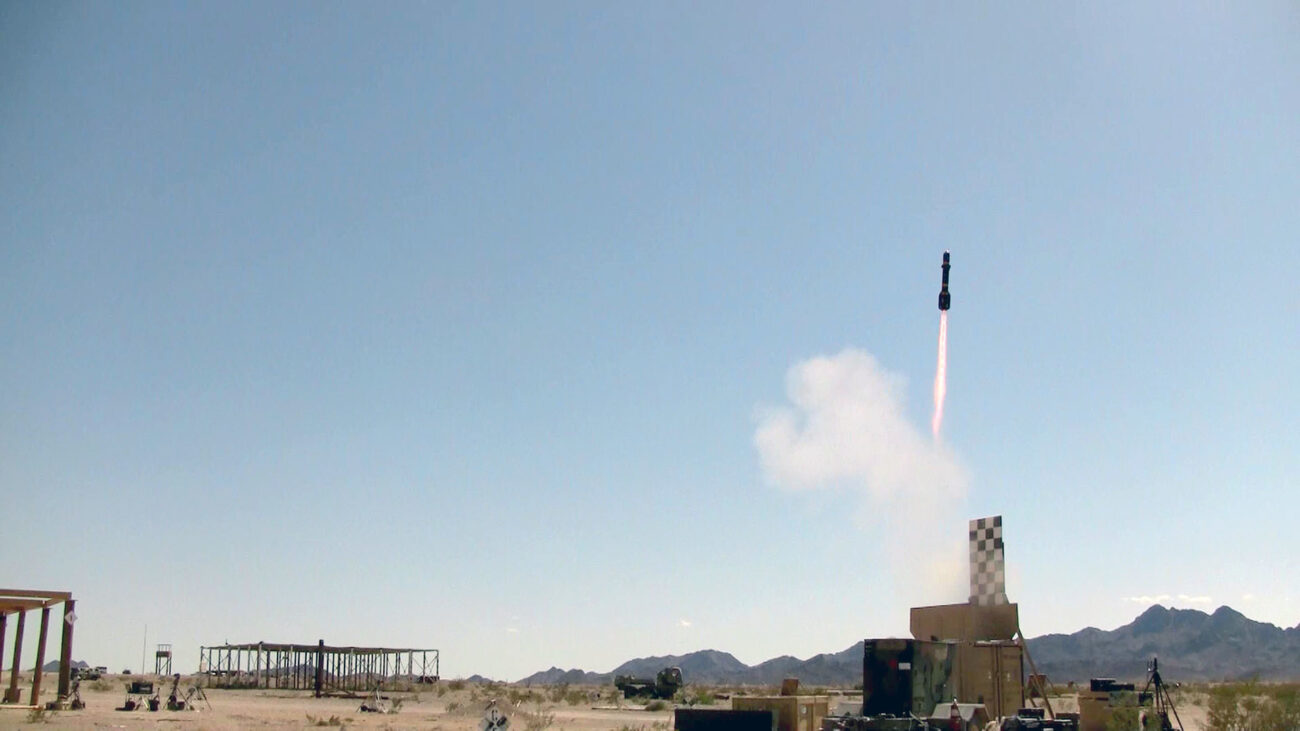
A Lockheed Martin drone defense test has delivered a first for the company, with a Group 3 one-way attack test drone knocked out of the sky over the Arizona desert. The defense firm, traded on the New York Stock Exchange as LMT, said it intercepted the target using a Joint-Air-to-Ground Missile, known as a JAGM, fired from a GRIZZLY containerized launcher. According to the company, it was the first time it had launched the missile from that launcher to defeat this kind of threat.
The engagement took place at Yuma Proving Grounds in Arizona, where several pieces of hardware and software worked together as one system. Sanctum, the company’s Counter-Unmanned Aerial System battle manager, ran the mission alongside Fortem R-40 radars. The radars detected and tracked the hostile drone, the Sanctum software processed the engagement, and the GRIZZLY launcher fired the JAGM that neutralized the target. The company described it as a single detect, track and defeat cycle carried out by the integrated system.
How the Lockheed Martin Drone Intercept Came Together
One of the headline points from the demonstration was speed. Lockheed Martin said it finished the integration work, including hardware-in-the-loop and live-fire testing, in under 45 days. The system was built on an existing prototype architecture, which the company says lets users field the ready-to-fire Sanctum setup without heavy infrastructure or a large logistics footprint. By tying together sensors, battle management and missile technology, the firm framed the outcome as a single, end-to-end answer to a fast-moving drone threat. Speed has become a major theme for defense suppliers facing cheap attack drones that can be produced and fielded in large numbers.
The result reflects a company that has been busy across a range of unmanned-systems efforts, including its EmberPoint wildfire venture, with this Lockheed Martin drone work extending that activity into containerized point defense. For this test, the appeal was a chain that runs from spotting a target to firing on it, all packaged in a container that can sit on the ground or aboard a ship. That design is meant to cut both the time and the equipment needed to stand up a working defense.
“The ability to integrate GRIZZLY’s proven launch architecture with Sanctum’s battle manager on an accelerated timeline demonstrates how Lockheed Martin is applying battlefield innovation and cross-program collaboration to rapidly deliver layered defense capabilities to the warfighter. This test demonstrated a modular, affordable point-defense solution that can be quickly scaled and deployed across multiple domains to counter evolving threats.” Randy Crites, vice president and general manager of Lockheed Martin Advanced Programs
Why the GRIZZLY and Sanctum Result Matters
Lockheed Martin set out several reasons it believes the approach stands apart. The radar sites are small and rely on distributed sensors, which the company says allows flexible coverage that can be shaped to a given mission. The containerized launcher can be mounted on ground sites or maritime platforms, while a wireless link connects the radars, battle management and launcher so the kit can be relocated and set up at speed. The firm said the launcher also supports distributed operations with a minimal logistical footprint, and it stressed cost by pointing to low-cost commercial sensors, a toolless reload and an eight-round capacity that it says keeps firepower high while holding down sustainment expenses.
The wider aim is a full kill web against Group 1 through Group 4 drone threats, linking radar, battle management, a proven weapon container and existing effectors through the Sanctum software to protect forward operating bases, critical assets and maritime platforms. Readers following the field can weigh the test against the company’s counter-drone capability overview, which describes how Sanctum is built to improve with each engagement. The JAGM adds a further layer through a dual-mode seeker that the company says makes it a cost-effective effector that can be launched across several domains.
“This test demonstrates a rapid, low-cost and modular point-defense solution that can be deployed on land or maritime platforms within days. The demonstrated kill chain can operate standalone or integrated with higher echelon command and control systems through the Sanctum mesh network, showing our commitment to meet our customers’ toughest missions.” Paul Lemmo, vice president and general manager of Lockheed Martin Sensors, Effectors and Mission Systems
The Lockheed Martin drone defense effort enters a market that has grown fast as cheap, mass-produced drones have become a common danger to bases, infrastructure and ships. The company presented the GRIZZLY and Sanctum pairing as a flexible, lower-cost way to meet that danger, and the Yuma test served as evidence that the separate parts can work as one from the moment a drone is detected through to a live intercept.
