

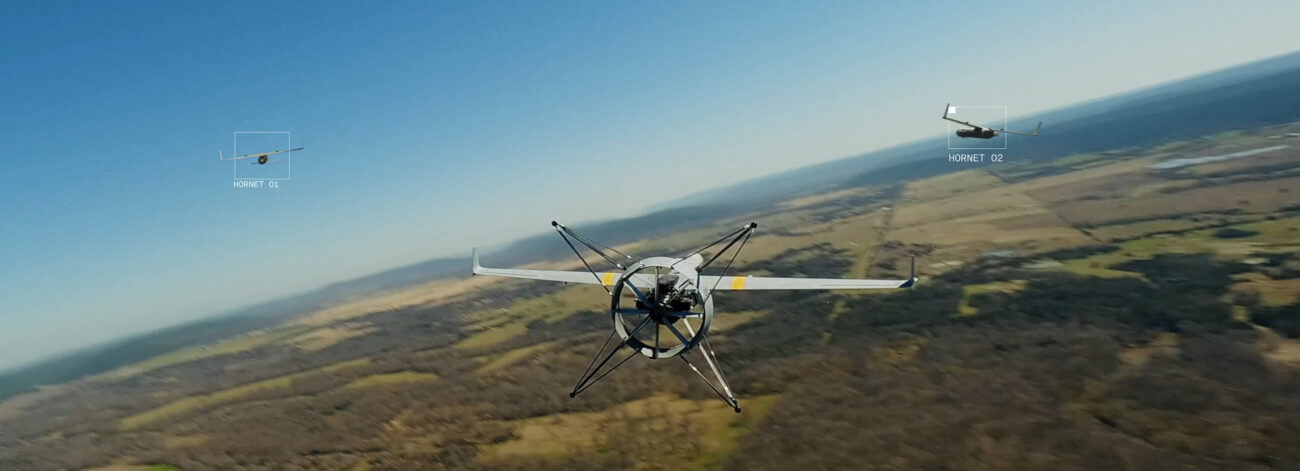
Shield AI and Destinus have completed a full-mission flight exercise that put Shield AI counter-drone autonomy through a complete strike sequence on the Destinus Hornet. The Hornet is an interceptor built for counter-UAS missions, designed to defend against loitering munitions, drone swarms, and other hostile uncrewed aircraft at scale. Carried out in Segovia, Spain, the tests checked whether Shield AI’s Hivemind AI pilot could coordinate and adapt while in flight inside contested airspace, and they showed how that ability could let operators react faster to large groups of unmanned threats.
The exercise marks the third phase of a steadily expanding partnership between the two companies. Earlier work first placed Hivemind in control of the Hornet, and a later round proved that the Hornet and Shield AI’s V-BAT aircraft could fly together as a team. For this latest stage, the companies ran a full operational concept written for the Destinus Ruta, a low-cost turbojet strike platform meant to fly close to the ground in GNSS-denied and contested settings. The Hornet served as the starting point for integration because it shares a flight control architecture with other aircraft in the Destinus family.
How Shield AI Counter-Drone Autonomy Performed in Segovia
Phase three ran the entire mission from start to finish, following the plan built around the Ruta concept. That sequence included autonomy-assisted mission planning through a ground control station, radio testing, autonomous terrain following, target updates sent mid-flight, and a final maneuver carried out on the operator’s command. The progress builds directly on the first phase of integration, which established Hivemind control on the Hornet in under two months, and a second phase that demonstrated multi-platform teaming in flight. Because the Hornet and Ruta share the same flight control foundation, the teams expect the work to move faster and with less technical risk as it shifts toward the Ruta.
“Autonomous systems must be able to sense threats, adapt, and act at the edge — especially in contested environments where direct command and control is degraded or denied,” said Christian Gutierrez, senior vice president of Hivemind at Shield AI. “What we demonstrated in Segovia is a repeatable, fieldable autonomous capability that closes the reconnaissance-to-strike loop at the speed the threat demands.”
Hivemind is the piece that sets this system apart from a standard autopilot. Where a traditional autopilot follows a fixed, preplanned route, Hivemind lets a platform sense its surroundings, make decisions, and act on its own within limits the operator sets and under clear command authority. It can reroute a mission as conditions change, respond to surprises, avoid obstacles, and run complex tasks safely. The Destinus Hornet itself is a multi-role autonomous platform that handles Shield AI counter-drone work alongside strike, reconnaissance, data relay, and security operations, and it forms part of a wider layered air-defense setup meant to guard high-value sites and critical infrastructure.
What Comes Next for the Destinus Partnership
The next phase will move these capabilities onto the Destinus Ruta platform in Ukraine, where the goal is to coordinate strike behavior between V-BAT and several Ruta systems at once. That follow-on evaluation will focus on repeatability, reliability, and how well the autonomy fits with the command-and-control systems operators already use. The Segovia campaign adds to a busy run for Shield AI, the venture-backed defense-tech firm behind the Hivemind software and the V-BAT and X-BAT aircraft. Founded in 2015, the company now operates offices and facilities across the United States, Europe, the Middle East, and Asia-Pacific.
Both companies plan to show their technology at Eurosatory, with Shield AI in Hall 5A and Destinus in Hall 4. Destinus, a European defence and aerospace company, builds autonomous strike and air defence systems in Europe for European and allied armed forces, drawing on a unified autonomy stack, deep vertical integration, and large-scale production that turns fast iteration into fielded capability.
