

Neura Defense Systems, Inc. has changed its corporate name to Volantyx Aerospace, Inc., the Florida company announced on August 26, 2026. The new name reflects a shift away from being a single product defense developer and toward a broader aerospace platform built around one shared edge intelligence architecture. Neura Defense Systems stays on as the company’s defense division and current operating business, so the counter-UAS work continues under the name it started with.
The change is administrative rather than structural. Volantyx Aerospace calls it a renaming of the same Delaware corporation, one that does not alter ownership, obligations or agreements. The company frames the new identity as room for a platform supporting several airspace security applications at once, while keeping the Neura Defense Systems label on counter-UAS and national security work.
“The new name describes what we actually built. We started by solving one hard problem — detecting swarm-drones that do not broadcast a usable radio signal. What came out of that work was an intelligence layer that fuses evidence from multiple sensors, makes decisions at the edge without depending on the cloud, and preserves a record of what the system saw. That architecture can serve more than one threat class and more than one market.” Sam Talari, Founder and Chief Executive Officer
The Detection Gap Volantyx Aerospace Is Chasing
Most fielded counter-drone equipment leans on radio frequency sensing and electronic warfare, and that runs into trouble against one class of aircraft. Autonomous, pre-programmed and fiber guided drones can fly without keeping a live radio command link open. Against them, RF detection, jamming and GPS spoofing become weak or useless, and hybrid designs that fall back to a radio link only if the cable snaps complicate the picture further.
Policy and money have moved in the same direction. Executive Order 14305, Restoring American Airspace Sovereignty, directed expanded federal action on counter-UAS in June 2025. The SAFER SKIES Act, passed within the FY2026 National Defense Authorization Act, extended federal counter-UAS authority and created new authority for state, local and tribal agencies through an interim final rule at 6 CFR Part 124 in July 2026. The Department of Homeland Security has set up a counter-drone contract vehicle worth up to $1.5 billion. Volantyx Aerospace argues that shifting threat behavior, wider authority and larger budgets together point to near term demand for layered systems that do not rest on one sensing method.
Inside the Neurex Platform and Product Line
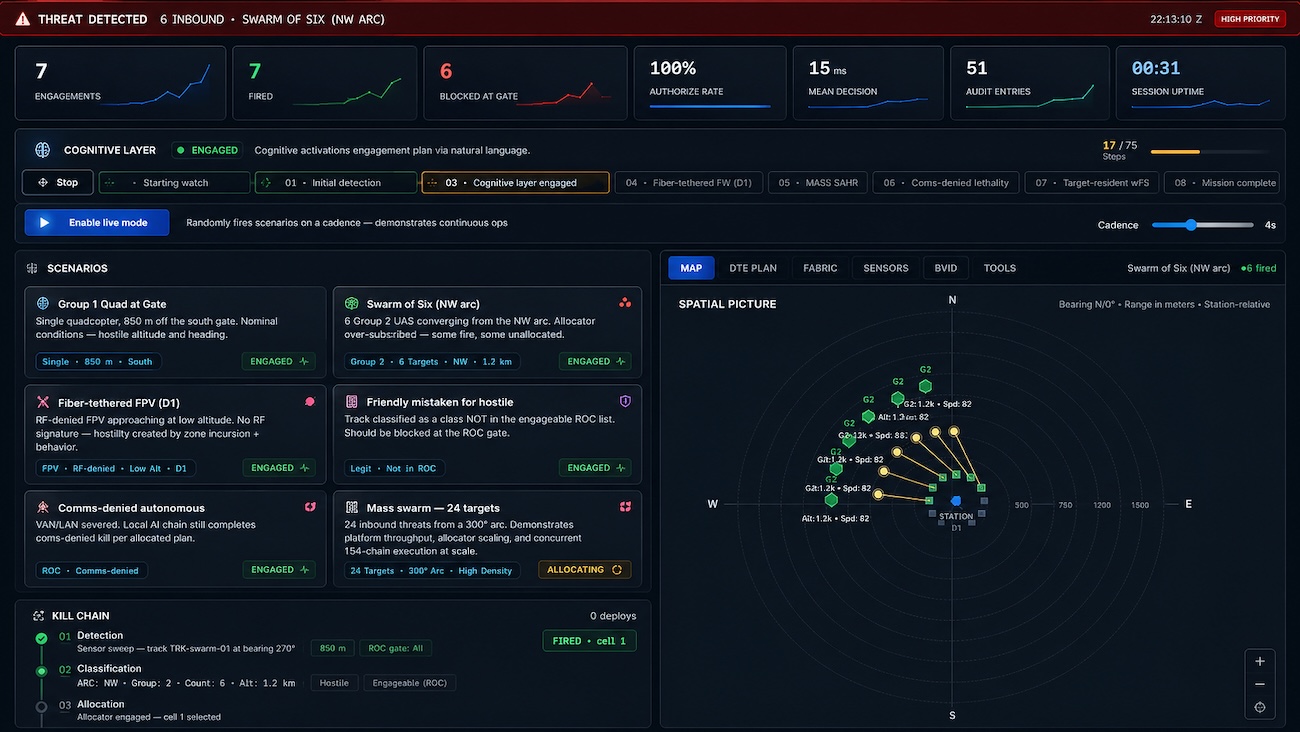
The defense division is building a distributed edge AI platform that pulls together acoustic, radar, radiofrequency, electro-optical and infrared evidence, holds tracks, classifies aircraft, and hands operators cueing and decision support with a human on the loop. Its own counter-UAS detection page stresses that the software is sensor agnostic. The architecture runs on NVIDIA Jetson Orin class edge compute with no cloud connection, and in the company’s own bench environment the path from detection to classification was measured at under 500 milliseconds.
Every track is written to a hash chained, cryptographically signed record that preserves what the system saw, when it saw it and the evidence behind the assessment, so the file stays verifiable after an incident. The product line starts with Neurex, the distributed autonomous intelligence platform, and adds Neura Station as the sensing and compute unit for fixed or vehicle mounted use, Neura Canopy to link several stations into one air picture, and the portable Neura Sentry, Scout and Patrol units. Neurex can also be licensed onto third party hardware so a customer keeps the sensors already installed.
Development Status, Patents and New Applications
The platform handles detection, classification, tracking, decision support and cueing rather than destroying anything. Where a customer needs a defeat capability, the system cues a countermeasure supplied by the customer or a partner. Other recent counter-drone programs have taken a similar route, leaning on edge autonomy rather than cloud links. The company says it does not currently make effectors but will do so in early 2027, and core capabilities so far have been evaluated in a company controlled test environment. Hardware integration and field evaluation are under way, and Volantyx Aerospace remains development stage with no fielded deployment or contract award claimed.
On the patent side, 13 United States provisional applications have been filed covering multi-modal sensor fusion, distributed networking, detection of non-emitting aircraft and cognitive command, with more disclosures being prepared. The Volantyx Aerospace identity also leaves space for two other efforts. Neura Orbital is an early stage project on orbital conjunction assessment, meant to help satellite operators separate real collision risk from false alerts and cut unnecessary avoidance maneuvers. It is not commercially available. Neura Compute is a federated learning and distributed trust layer that improves model performance across an installed base without raw customer data leaving a site. It is used internally while a separate enterprise offering is built.
