

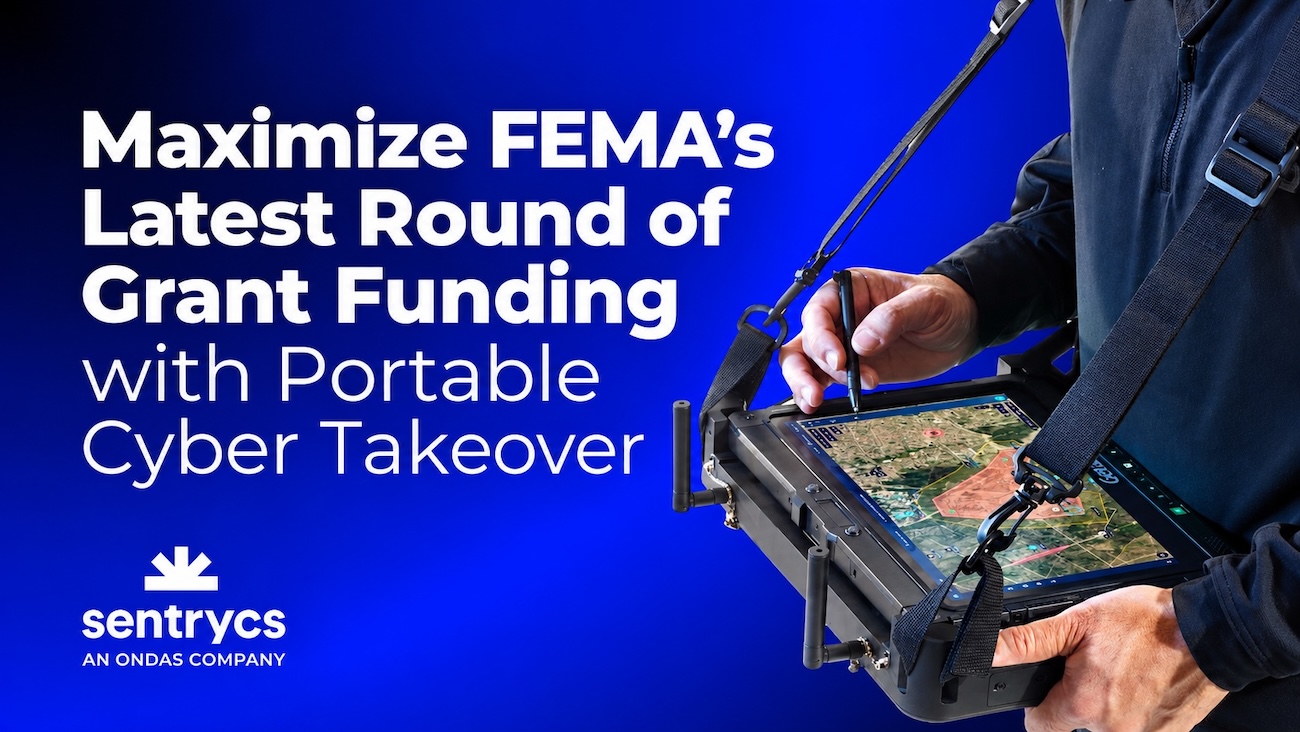
Sentrycs has put a fixed price on its portable counter-drone system, offering Sentrycs Ranger to state and local agencies for $99,000 with three years of maintenance included. The company, which operates as part of Ondas Inc. (Nasdaq: ONDS) and specializes in Cyber-over-RF counter-drone technology, announced the firm-fixed-price package on October 29, 2026, from Huntsville, Alabama. Ranger was previously sold under the name Scout, and the version in this deal is configured for detection, tracking, identification and mitigation, a combination the company refers to as DTIM.
The timing is tied to federal money. FEMA is opening its next round of Counter-Unmanned Aircraft Systems (C-UAS) grant funding, and Sentrycs says the offering is meant to help agencies get the most out of it. The company lists three goals for the package: widening airspace awareness against unlawful drones, spreading counter-drone capability across more operational teams, and giving departments a clearer picture of what long-term support will cost. Because the price is fixed and the maintenance is included, the package is built so departments can budget for support up front rather than treating it as a separate cost later.
How Sentrycs Ranger Detects and Mitigates Drone Threats
Sentrycs describes Ranger as a highly portable handheld unit that moves the company’s Cyber-over-RF approach onto a platform suited to mobile and tactical work. It relies on passive radio frequency sensing combined with advanced protocol manipulation to detect, track and identify drones. Operators receive real-time airspace intelligence they can act on, and the configuration included in this offer adds mitigation on top of those detection functions. The system already appears on the Safer Skies Authorized Systems List, where it is listed under the name Sentrycs Horizon.
The $99,000 figure covers a complete DTIM system along with years of maintenance, packaged as one predictable investment. According to the company, the structure is meant to help departments map out deployments across several teams and locations while still leaving room in their budgets for software, support, training and upkeep. Details on the Sentrycs Ranger system show a product aimed at operators who need counter-drone coverage while on the move, and the fixed price is intended to make operational adoption easier for agencies working within grant budgets.
“Expanding national counter-drone readiness means putting actionable capabilities into the hands of more operational teams. This Ranger offering advances our strategy of scaling field-proven defense and security technologies across public safety missions. It gives agencies a practical entry point into a broader counter-UAS capability, with predictable maintenance costs and room to evolve as operational requirements grow.” Tal Cohen, Sentrycs CEO
Sentrycs Ranger is one part of a wider set of counter-UAS tools offered by Ondas. That lineup includes Cyber over RF, passive RF detection, radar, electro-optical sensors and acoustic sensors, which together are intended to support detection of any type of drone threat. Sentrycs says the new offering builds on its role inside the Ondas counter-UAS portfolio by carrying its protocol-based technology into mobile public safety operations. The company adds that it also supports adaptive protection for sensitive sites and large public gatherings.
FEMA Grant Round Expands Counter-Drone Funding Nationwide
FEMA’s October 16 announcement made an additional $250 million in federal funding available for counter-drone efforts. The money is set to reach all 50 states, five territories and the District of Columbia, for a total of 56 recipients. The round marks a nationwide expansion of C-UAS capabilities, adding support for the 11 states that received funds in Phase One while giving 45 more regions money to begin counter-drone operations of their own.
Sentrycs Ranger is available through authorized Sentrycs distributors and partners. Agencies weighing counter-drone tech purchases under FEMA’s C-UAS Grant Program are advised to coordinate with their State Administrative Agency on funding eligibility and procurement requirements. The Ranger package lets those agencies see the price of the system and three years of maintenance as a single figure while they work through that process.
Sentrycs builds its products around a technology it calls Cyber over RF, or CoRF. Its systems are designed to passively spot, follow and classify unauthorized drones, then mitigate them when the situation calls for it, with setups tailored to airports, borders, prisons, critical infrastructure and mass events. The company maintains offices in Israel and the United States and works with customers around the world.
