

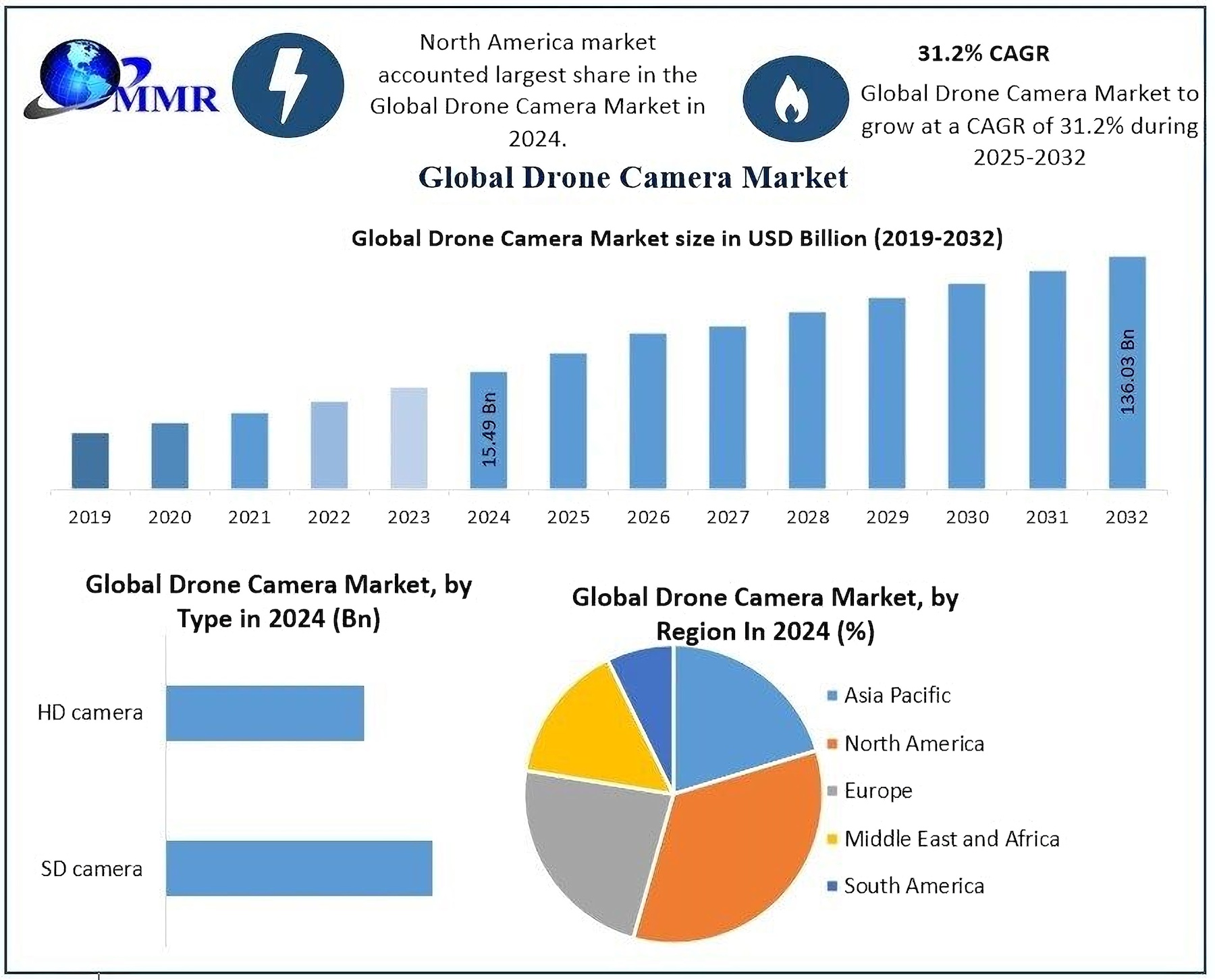
The drone camera market is expected to grow rapidly over the next several years, according to a new industry outlook. The analysis said the market was valued at USD 15.49 billion in 2024 and is projected to reach nearly USD 136.03 billion by 2032, with a stated CAGR of 31.2%. That forecast points to drone cameras becoming a much bigger part of both consumer and professional technology spending, especially as drones shift from being “nice to have” tools into “must have” equipment for inspection, safety, and documentation workflows.
One major reason for the growth is that drone cameras are no longer used only for capturing scenic footage. The report said adoption of AI powered drone cameras, high resolution imaging drones, and multi spectral or hyperspectral aerial systems is expanding how drones are used in aerial photography, surveillance, infrastructure inspection, and industrial applications. In other words, the camera is becoming the central payload that makes the drone useful, whether the goal is marketing a property, checking a bridge, monitoring farmland, or supporting a security team that needs live visual coverage.
Drone Camera Market Growth Is Linked to Smarter Imaging and Advanced Sensors
The analysis highlighted a mix of camera improvements and sensor upgrades. It said growth is being pushed by AI powered drone cameras, thermal imaging drones, LiDAR drones, and hyperspectral imaging drones, along with features such as automated flight modes, real time object detection, and edge computing for on device processing. These capabilities matter because they reduce the time it takes to turn a flight into useful information. Instead of collecting footage and sorting it later, more decisions can be made during or immediately after the mission.
Connectivity was also described as part of the acceleration. The report said 5G and high resolution streaming can support ultra low latency, high definition live video, which is useful for remote inspections, emergency response, and monitoring scenarios where teams want to see what the drone sees without delays. It also pointed to specialized solutions such as drones configured for pipeline monitoring, wildfire detection, and precision agriculture, which reflects how the market is splitting into more job specific use cases rather than one size fits all products.
Market Segmentation Shows Where Demand Is Concentrating
The segmentation in the analysis breaks the market into simple buckets that show where spending is expected to concentrate. By type, it lists SD camera and HD camera, with HD described as dominating. By application, it lists photography and videography, thermal imaging, and surveillance. By resolution, it lists 12 MP, 12 to 20 MP, 20 to 32 MP, and 32 MP and above. By end user, it lists commercial, military, and homeland security. The report also said the strongest momentum is in the 20 to 32 MP range, with photography and videography leading revenue while AI powered analytics and commercial applications continue to reshape what buyers want.
This kind of breakdown matters because different buyers care about different results. A real estate team might prioritize clean color, stable footage, and consistent framing. An industrial inspection team might prioritize sensors that reveal problems, like thermal signatures or precise 3D mapping. A security team might care most about surveillance workflows, where live streaming, detection, and tracking can be more important than cinematic image style.
Competition and Regional Trends Highlight Who Is Moving Fast
The analysis described a highly competitive landscape and named several companies shaping innovation, including DJI, Parrot SA, Autel Robotics, Yuneec International, and FLIR Systems, along with companies such as Freefly Systems and Auterion, plus other brands including GoPro, Sony, and Walkera Technology. It also described North America as the leading region, tied to enterprise adoption, defense investment, and 5G enabled drone ecosystems, while Asia Pacific was described as a fast growing region driven by manufacturing scale and expanding commercial demand.
The report also pointed to several 2025 developments as examples of how quickly the space is evolving. It said DJI unveiled its Matrice 4 enterprise series on January 8, 2025, focused on AI enabled thermal and multi sensor imaging for emergency response and industrial inspection. It also said FLIR launched a Boson+ IQ Dev Kit on September 2, 2025, intended to speed development of AI enhanced thermal payloads. The analysis further noted Autel’s stated enterprise and industrial focus on July 18, 2025, and said Parrot secured a multi year contract on November 24, 2025 to supply ANAFI UKR tactical micro UAVs to a European defense force, expanding its position in ISR and homeland security markets.
Overall, the forecast suggests that drone cameras are moving toward a future where image capture and analysis sit at the center of many workflows. As AI features improve, sensors get more specialized, and live streaming becomes more reliable, drones become less about flying and more about delivering actionable visual data. If the market grows the way the analysis projects, drone camera systems are likely to become more common across construction, agriculture, public safety, media, and defense, with buyers increasingly choosing platforms based on the camera and sensor capabilities that match their real world jobs.
